



EDINBURGH, Scotland — Not only did Edinburgh live up to its reputation as "the world's greatest festival city" during this year's mammoth, sprawling Edinburgh International Festival — it exceeded expectations.
The festival itself did very well this year, but the accompanying Fringe Festival — with 1,541 shows of its own (presented by 668 different companies in 207 venues) — sold well over a million tickets.
Now in its 57th year, the festival lasts more than three weeks each August, and even when you are not attending one of the more than 22,000 performances, the streets are filled with musicians from China, Africa and dozens of other countries, as well as actors, singers, jugglers, magicians, fire-eaters, clowns, acrobats and "living statues" of various types.
Though a significant film festival (as well as an impressive book festival) is going on during this same time, the International Festival that put Edinburgh squarely on the map consists big events taking place in all the large theaters and concert halls, as well as the sprawling Fringe Festival, where a much greater variety and more offbeat events occur at more than 200 different venues.
Counting all of the various arts forms making up the total Festival, nearly 40 percent are theater productions, with another 25 percent consisting of stand-up comedy. The rest is divided up among dance concerts of all almost every type from all around the globe, plus opera, musicals, orchestral concerts, art exhibitions — and the relatively new but ever-growing art form that has become my own personal preference, "physical theater."
Physical theater is most closely aligned with modern dance and pantomime, but performers must almost always be skilled as actors, acrobats and, often, as singers and musicians. And though it can be found these days popping up in such diverse spots as Brazil, Iran, Finland, South Africa and Costa Rica, physical theater is unquestionably very much at home among the avant-garde in Eastern Europe, with troupes from Russia, Poland, Hungary, and eastern Germany often dominating the scene.
If one venue in particular stands out in Edinburgh as a showcase for this lively and exciting art, it would have to be the former Church of St. Stephens, now transformed into an adaptable and potentially atmospheric theater space. Going by the name of Aurora Nova, Wolfgang Hoffmann, performer and artistic director from Germany's fabrik Potsdam theater for contemporary dance and movement, and Tim Hawkins, producer of Brighton, England's, Komedia arts and entertainment center, have managed the venue for the past three years. After this year, there should be no doubts that some of the most stunning, provocative and prize-winning events of the entire Edinburgh Festival take place there.
Among Aurora Nova's highlights this year would definitely be "Fallen," a fascinating hourlong dance piece for three men, two women and a solo cello. Combining a haunting folk tale of birds in the Himalayas who never touch down with the various ways that humans both fall — and struggle to defy — gravity, it's a production that soars higher in your estimation with each intriguing performance.
Another memorable production was "Pandora 88," with fabrik Potsdam's Wolfgang Hoffmann and Swedish Sven Till doing a perfectly timed and highly inventive one-hour-long pas de deux of "accommodation" — all inside a box the size of a small elevator. With the help of creative lighting, it's a humorous, gripping and mind-boggling piece that's definitely one of a kind.
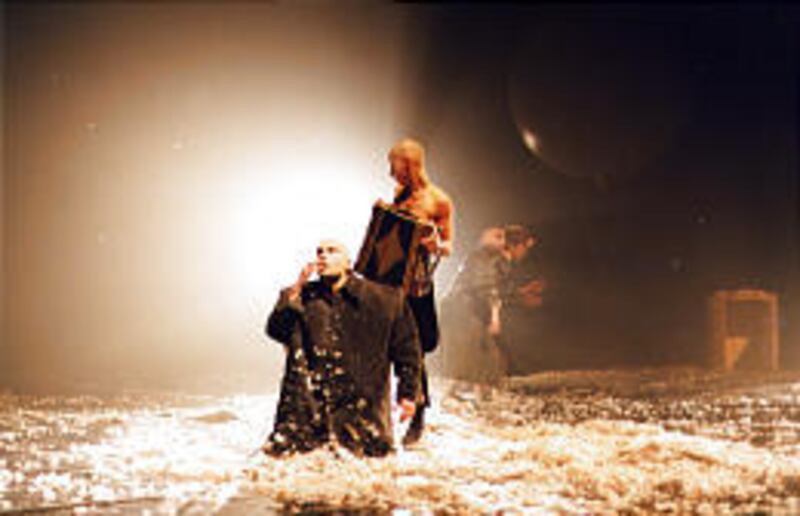
And there were many other dazzlers at St. Stephens this year, including the prize-winning "Islands in the Stream." Always a hit at the Festival, the famed physical-theater group known as Derevo (from St. Petersburg, Russia), convinces you that there must be more than just four performers in this immensely talented and versatile troupe. All with shaved heads and all dressed in a variety of costumes — but almost always in white — this year's 70-minute show featured one striking image after another. But all were connected with the sea and with sailing, ranging from seagulls in flight to slow-motion drowning to creatures at the bottom of the sea.
Two other Russian troupes enchanted viewers and made jaws drop at Aurora Nova/St. Stephens. Do Theatre's combination of dance and acrobatic theater in "Bird's Eye View" explored flight in all its variety of forms, and the memory of one sequence lingers — it was lighted only by eight continually moving flashlights or the image of the dancers surrounded by thousands of soft white feathers. And the continually astonishing "White Cabin," presented by Russia's Akhe Group, combines live-action, film, painting, dolls and puppets in such creative ways that, the moment it ends, you long to sit through it all again.
There were many more worthwhile shows at St. Stephens, including Toni Mira's one-man and highly personal "Loft" from Barcelona, and the increasingly fascinating "There Where We Were," by three talented dancers known as Deja Donne, who operate out of the Czech Republic but come from Japan, Italy, and Bulgaria.
Another such venue, continually rising in stature and popularity, is the Gateway Theatre, as five of its best shows this year prove.
"Elizavieta Bam," based on a provocative but outrageous play by Russian madman/genius Danill Harms and impeccably performed by the Quebecquois company Les Creations Diving Horse, may leave you wondering what on earth it's all about. Yet, at the same time, you would be eagerly willing to grab at a chance to see it again, not only because of its brilliant set — easily the most effective and innovatively flexible of the whole Festival — but also because of its wonderful lighting and atmosphere, precisely timed movement and outrageously unique characters.
Also notable at Gateway was Finland's extremely clever "The Father, the Son and the Holy Moses." This comic play — about an offbeat father and son living their very different lives in a cramped apartment — bewilders you at curtain time when only one actor comes to take a bow. The thoroughly engaging Martti Suosalo played both parts but led you to believe you saw both characters together on the stage for at least part of the time! Theatre Talipot from the Reunion Island also enthralled with a dance-drama, "Kalla," as did Kaos Theatre's highly original modern take on Shakespeare's "Titus Andronicus," and Italy's elegant dance-piece, "Stairway of Fire."
The always reliable Assembly Halls had much to amuse and excite audiences this year — the very best, in my estimation, being "The Argument," Theatre O's always surprising and hilariously stylized look at a dysfunctional family's 30-year clash. Also, "Pickle," another piece of total theater by New Zealand's prize-winning acting company, India Ink, which somehow manages to effectively split sides and touch hearts at the same time.
My favorite play of the entire festival, however, was found at the intimate Netherbow Theatre on the Royal Mile. The expert production of Brian Friel's "Faith Healer" was astonishing. The play itself — three Irish narrators telling, in turn, the same story — is just about as engrossing and spell-binding as good theater gets. And this particular cast — Finlay McLean, Anna Hepburn and John Shedden — was also miraculously close to perfection.
Surely one of the most delightful productions at the 2003 Festival was the comedy "Withering Looks," which featured two wonderful comediennes as Charlotte and Emily Bronte. With at least one verbal or visual gag every few seconds, this was not only cleverly written but even more brilliantly brought to life by its inspired casting.
At the nothing-quite-like-it-in-the-world Edinburgh Festival, there is always great variety going on all around you — from Oedipus and Antigone myths in "The Thebans" to Susannah York doing "Shakespeare's Women" to no less than five different productions of John Godber's tough, high-energy contemporary play "Bouncers."
And this year there was music and dance ranging all the way from a spine-tingling Thomas Quasthoff recital of songs of Schubert, Brahms and Wolf to a re-creation of Ballet Russe's productions from the 1920s and 30s, with original costumes and sets by Picasso to the terrific Soweto Gospel Choir the Swingle Singers to the exciting harmonies and choreography of the Naked Voices from Bristol to flashy Las Vegas-type revues, such as "The Ladyboys of Bangkok" and Mika Haka's boundary-bursting Maori cabaret.
The International Festival seemed bent this year on giving us a whole different take on the "tried-and-true." Chekhov's "The Seagull" was done by opening up the cavernous King's Theatre stage to its bare brick walls and visible lighting equipment and curtain ropes, plunking down a sofa or an armoire here and there to suggest intimacy, then casting Fiona Shaw to play an over-the-top Madame Arkadina, as if to compensate for all the empty space.
Calixto Beito's controversial "Hamlet" was set in a contemporary nightclub called "The Palace" with Claudius, in tuxedo, as a lounge singer crooning "He Ain't Heavy, He's My Brother," the voice of Hamlet's father's ghost provided over a microphone by the cocktail-bar pianist, and Polonius being not stabbed but beaten to death with a whiskey bottle.
And at the Edinburgh Festival Hall, Wagner's Ring Cycle also arrived in modern dress, with the Rhine maidens in stiletto heels, sipping martinis at a bar, and the very butch and Hells-Angelesque Valkyries arriving boisterously, wearing leather jackets and headbands as if they'd just got off their motorcycles. Meant to be a "Ring Cycle for our time," it was nonetheless musically impressive, even though visually a little hard for some of us to take (especially having been one of the 50 die-hards who only got in to the four operas after waiting 12 hours throughout a cold and drizzly night to get the last handful of coveted tickets to this otherwise sold-out-long-in-advance "Cycle").
Interestingly enough, my favorite events at the International Festival this year were two other operas — Wagner's "Lohengrin" and Handel's "Poro," both done "concert-style" (no sets, no costumes, no "acting," but done elegantly with chorus, orchestra, and soloists in evening gowns and tuxedos). Both were exquisite, and well-deserving of their standing ovations.
Were there certain themes inadvertently running through this year's festival? There were indeed: War and terrorism was unmistakable on many stages, as witnessed by "Finding bin Laden," "The Pugilist Specialist," "The Birds of Sarajevo," "Flanders Field," "Adolf," "Face the Wall," "Wanted, Dead or Alive," "Gjakova, Another War," "Refuge," "Sniperculture," "No Man's Land," "Oh, What a Lovely War" and many other productions — without even counting all the war plays of Shakespeare and Euripides.
And there also seemed to be an obsession with handicaps and behavioral disorders this year — OCD, ADT, autism, epilepsy, cerebral palsy, Asperger's syndrome, as well as other disabilities — sometimes with actors portraying these problems, but often with actual victims of these afflictions cast in the leading roles. Often there were even people from various health organizations on hand to pass out brochures on a particular disorder.
There seemed to even be an usual concern with water this year, with the aforementioned "Islands in the Stream" steeped in sea imagery, but also a highly inventive production called "The Whale" which turned out to be Carlo Adinolfi's creative handling of Melville's "Moby Dick," with carpenter/dancer/actor Adinolfi playing all the parts as well as designing and building an ingenious and impressive array of artistic props.
Still another theater-piece, "The Watery Part of the World," recounted the very 1920 sailing expedition that had been the inspiration for "Moby Dick," daringly opting to do essentially the entire production in total darkness, with just the voices of the sailors accompanied by a constant variety of first-rate sound-effects. And there was also a production called "Stars Beneath the Sea" with sea-diving as its focus. And David Mamet's "The Water Engine."
Most water-focused of all, however, had to be the highly unusual "Waterwall," from Italy, which was held out-of-doors at night in Edinburgh's spacious and atmospheric Old College Quad. Consisting of a specially constructed set with an effectively lighted 16,000-liter waterfall constantly pouring down, a cast of 12 agile acrobat/dancers, with the help of harnesses, elastic ropes, swings and sometimes nothing at all, dived, somersaulted, splashed and cavorted for a full 70 minutes.
But there was still another theme whose presence surpassed all of these this year: The memorializing of real-life human beings, whether villains or saints, great celebrities or just little people — those we've now almost forgotten or who may have gone through life almost never noticed at all. There were productions about Hitler and bin Laden, and plays based on the lives and talents of Judy Garland, Edith Piaf, Peggy Lee, Gertrude Lawrence, Noel Coward, Frank Sinatra, Bing Crosby, Elvis Presley, George Orwell, Saul Bellow, Mark Chagall, Gustave Mahler, Emily Dickinson, Sylvia Plath — even Monty Python's Graham Chapman — and many more.
A stand-out play from Vancouver called "Brilliant!" — and brilliant it certainly was — focused on Nikola Tesla, a name unknown to many today. A genius of electrophysics, he was also an immigrant from the Balkans who arrived in New York around the turn of the century and, although the equal of Edison or probably even far superior, he got pushed aside and ended up neglected and forgotten. If only this dazzling and inventive Canadian production — "Brilliant! The Blinding Enlightenment of Nikola Tesla" — could be seen by everyone in the world! It's a revelation in every way.
Even Johnny Higgins is not a familiar household name to most of us — but the British remember him, for he was a master pool shark, and twice world champion. In the powerful one-man show, "Hurricane," Richard Dormer gave an exhausting tour-de-force performance of the once lucky but ultimately luckless "Hurricane Higgins," as he slipped from the height of his glory to being an alcoholic bum on the streets.
And 13-year-old Darius McCollum might only be known to a certain generation of New Yorkers, but in 1981 he became known as "the boy who stole the subway." Still in a maximum-security prison at age 38, he was incarcerated because of his lifelong obsession with trains, which resulted in his impersonating a New York transit worker and, while still a child, illegally operating subway trains. New York's 78th Street Theatre Lab's stylish — and stylized — production of "Boy Steals Train" was one of the hits of the this year's Festival.
And if Tesla, Higgins and McCollum are not household names, the Edinburgh International Festival/Edinburgh Fringe Festival itself, running simultaneously at the end of every summer, ought to be known in every household in the world — because the Edinburgh event is not just a world-class performing-arts festival, it's clearly unsurpassed anywhere in the world.