

Rep. Chris Cannon has had no problems winning re-election in his 3rd Congressional District in recent elections. But a new Deseret Morning News/KSL-TV poll shows a number of his constituents, including his own Republicans, still are undecided about whether they'll vote for him again.
And adding to Cannon's political woes are two wannabes in his own party challenging him and seeking those undecided GOP voters.
Meanwhile, up in the 1st Congressional District, which now includes part of Salt Lake City, GOP Rep. Rob Bishop has few concerns. Bishop is well ahead of his challengers as the U.S. House races begin to heat up this spring, pollster Dan Jones & Associates found in a new survey for the newspaper and TV station.
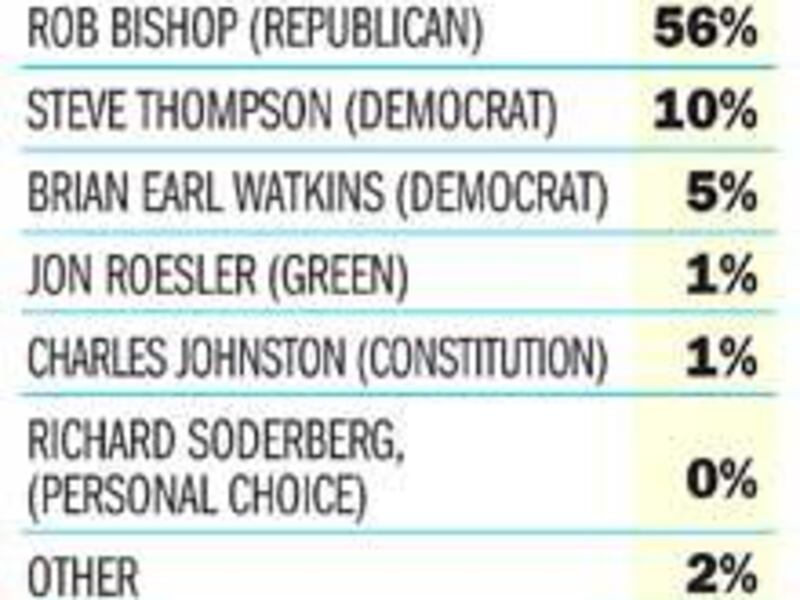
Bishop, who faces his first re-election, has 56 percent support among all the candidates, Jones found. Democrat Steve Thompson has only 10 percent support, while Democrat Brian Earl Watkins has 5 percent. Minor party candidates pick up a percent here or there. Twenty-four percent of those polled still are undecided.
Bishop is not challenged within his own Republican Party.
Cannon defeated Democratic Rep. Bill Orton in 1996 but was forced into a primary just two years later by a conservative-driven state Republican convention. Cannon easily prevailed, ultimately winning re-election.
In 2002 he had several legitimate challengers within his own party. He defeated them in the state convention.
This year, again, Cannon is challenged by viable contestants from his party's right wing.
Deseret Morning News graphic
3rd Congressional District poll
Requires Adobe Acrobat.
Jones found Cannon has 40 percent support among all of his constituents, GOP challenger Greg Hawkins has 9 percent support and another 9 percent goes to former Republican state legislator Matt Throckmorton.
But what may concern Cannon is that 37 percent of the voters are "undecided." Even though he has been in office for eight years, more than a third of his constituents aren't ready to say yet that they want him again.
Among those who told Jones they are Republicans, Cannon's support increases to 50 percent. Still, 35 percent of the Republicans said they were undecided about whom they support. Considering only Republicans, Hawkins' and Throckmorton's support drops to 7 percent each.
By comparison, 80 percent of Republicans support Bishop in the 1st District, Jones found.
"Chris Cannon has not done the amount of campaigning and advertising to obtain name identification that other incumbents have done," said Jones, who has polled in Utah for 30 years.
"Some people are still not aware of what he's doing in Congress," said Jones, interim co-director of the University of Utah's Hinckley Institute of Politics and a political science professor.
"And enough who are in the far right of his party are upset with Cannon that they're willing to oppose him."
Throckmorton ran against Cannon two years ago. Throckmorton was eliminated in the state GOP convention when Cannon received more than 60 percent of the delegate vote, winning the Republican nomination outright.
"The real question this year is whether Cannon can get 60 percent in the convention again and avoid a primary," Jones said.
"If there is a primary, this could become a difficult race for Cannon," said the pollster. "If the Republicans beat up on Cannon in a primary, it will be easier for the Democrats. But the district is still heavily Republican."
Jones, a contract pollster for the newspaper, has done work for some GOP candidates this year but not for any in the 1st or 3rd congressional districts.
In 2000, Hawkins, a local attorney, challenged U.S. Sen. Orrin Hatch, R-Utah, and came within several dozen convention delegate votes of forcing Hatch into a primary. Hawkins says he considered running for several offices this year but settled on the 3rd District after coming to believe Cannon was out of step with district voters.
After redistricting in 2001, the 3rd District is not as conservative as it was during the 1980s and 1990s. In fact, more district residents live along the west side of Salt Lake County than live in Utah County, which still remains the philosophical heart of the district. But ever since Orton's defeat in 1996, the Democrats have not presented a serious challenge to Cannon.
Even though current state Democratic Party chairman Donald Dunn ran a well-funded race against Cannon in the 2000 race, Cannon still defeated Dunn 58-37 percent.
Jones found that Cannon, even with a relatively large number of "undecideds," still is the strongest candidate in a head-to-head match-up with Democrat Beau Babka, a South Salt Lake police captain.
Cannon leads Babka 57-22 percent; Hawkins leads Babka, 46-23 percent in the new poll; and Throckmorton leads Babka, 41-22 percent; Jones found.
Still, said Jones: "This will be Cannon's most difficult race since he won the seat" in 1996, "both in the convention, the primary — if there is one — and in the general election."
E-mail: bbjr@desnews.com