

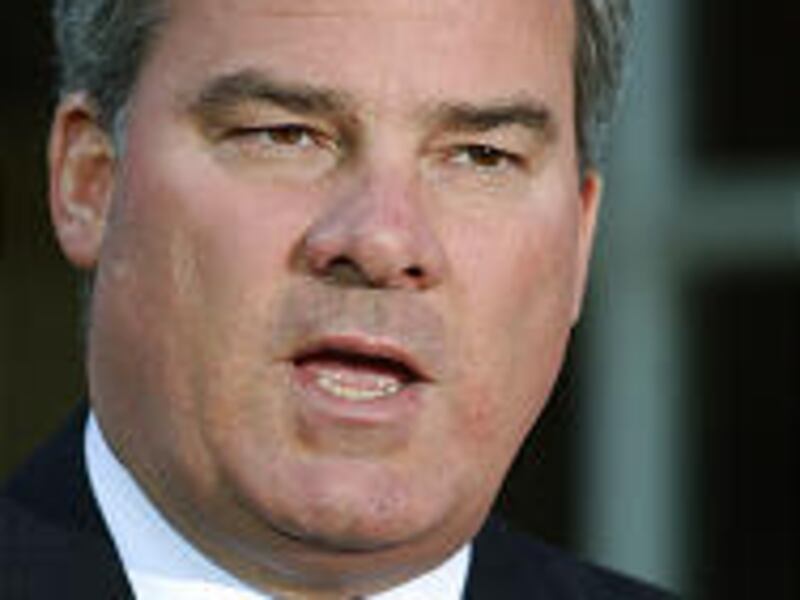
HARTFORD, Conn. — Gov. John G. Rowland announced his resignation Monday amid a months-long cascade of graft allegations, a federal investigation and a rapidly gathering drive to impeach him for accepting gifts from friends and businessmen.
Rowland, a third-term Republican who was once one of the GOP's rising young stars, became engulfed in scandal in December when he admitted accepting renovations at his lakeside cottage — including a hot tub and new heating system — and lying about it. Other gifts and favors soon came to light.
"I acknowledge that my poor judgment has brought us here," Rowland said, standing on the back lawn of the governor's mansion, his wife Patty by his side.
Rowland, 47, becomes the first U.S. governor in seven years to resign under pressure. His resignation is effective July 1.
Republican Lt. Gov. M. Jodi Rell will serve the rest of Rowland's term. The next gubernatorial election is in 2006.
Rowland did not directly address the allegations against him but said he remained proud of his accomplishments.
"I hope there have been times when I made you all proud, or made you all smile or at least piqued your interest in this wonderful institution we call government," he said.
One longtime friend, a state contractor, bought the governor's Washington condominium at an inflated price through a straw buyer.
Rowland received cigars, champagne, a vintage Ford Mustang convertible, a canoe and free or discounted vacations from employees and friends — including some with state contracts. The FBI was even looking into whether Rowland skimmed money from low-stakes poker games he hosted.
For months, Rowland has insisted he never did anything in exchange for the gifts. But the drumbeat of allegations sent his approval ratings plummeting and led to demands for his resignation from Republicans and Democrats alike.
"The governor has chosen late in this journey to take the honorable road. John Rowland made many bad choices that led us to today's resignation," said House Speaker Moira Lyons, a Democrat. "I am sad that such a gifted and talented leader chose a path of deception and ethical malaise for so long."
The decision effectively brings an end to what was once considered a remarkable political career. Rowland was elected to the state House at 23 and quickly became the boy wonder of Connecticut politics, using his charm to get elected to Congress at 27 and become governor at 37.
"It's a sad ending to what had been a brilliant political career. It certainly takes an enormous weight off the shoulders of the committee and of the House of Representatives and for that matter the whole legislature," said Rep. Arthur O'Neill, the Republican co-chairman of the state House Select Committee of Inquiry.
On Friday, the governor suffered a major setback when Connecticut's Supreme Court ruled that he must testify before the committee, which was just days away from deciding whether to recommend his impeachment.
He is a former chairman of the Republican Governors Association and was once rumored to be under consideration for positions in the Bush administration.
"Certainly, it's a historic moment for him and one I think he has spent a lot of time anguishing over," said Rell, 58.
During the committee hearings, the governor's lawyers criticized the investigation, arguing that the 10-member panel never set any standards for impeachment. Rowland fought the subpoena on the grounds it violated the separation of powers between the legislative and executive branches.
Senate Minority Leader Louis DeLuca, a Republican, said he spoke with the governor shortly after news leaked about the resignation. He quoted Rowland as saying: "I think it's reached the point that it's the right thing to do."
The governor remained in seclusion most of the day at the governor's residence in Hartford, fine-tuning his speech and receiving calls from supporters.
Dean Pagani, Rowland's former chief of staff and longtime spokesman, said Rowland understood that few lawmakers would have been willing to vote against impeachment.
"I don't think there was any way he could have survived, especially in a legislative election year," Pagani said.
The House committee postponed further testimony to await Rowland's expected resignation. Committee leaders said they probably would still issue a report on its investigation but not an impeachment recommendation.
In recent years, Connecticut has been rocked by scandals — two of them involving former mayors of Waterbury, the governor's hometown.
"This has been a long and painful process and with today's announcement we can begin to move forward and heal the wounds this scandal has inflicted upon our state," said GOP Sen. John Kissel.
The last U.S. governor to resign under pressure was Arizona's Fife Symington, who stepped down in 1997 after he was found guilty of defrauding lenders during his previous career as a real estate developer. The conviction was overturned on appeal.
Only seven governors in U.S. history have been impeached and removed from office. The last was Arizona's Republican Evan Mecham, a former car dealer who was impeached in 1988 on charges of trying to thwart an investigation into an alleged death threat made by a state official.
Contributing: John Christoffersen, Laura Walsh.