

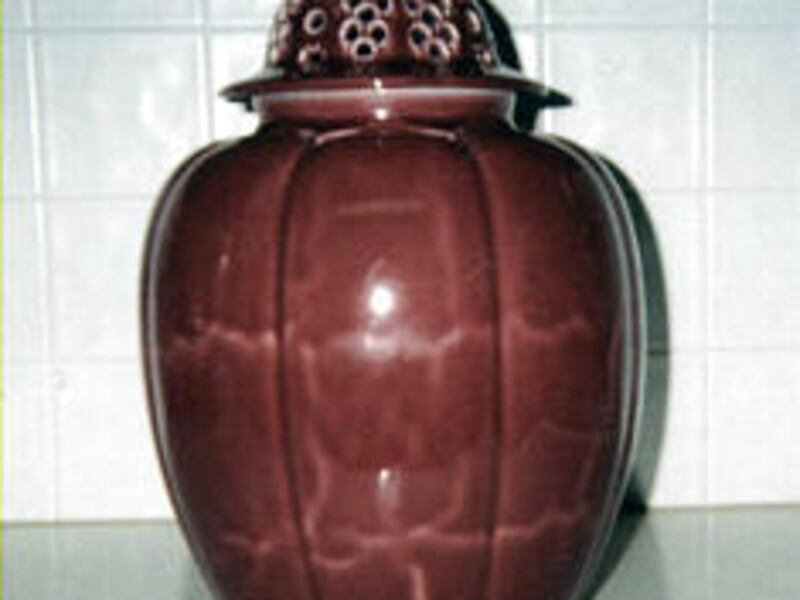
Dear Helaine and Joe:Enclosed are pictures of a Rookwood Pottery vase. Can you tell me when it was made and how much it's worth? — W.R.W., Edgewood, Ky.
Dear W.R.W: The Rookwood Pottery of Cincinnati, Ohio, was founded in 1880 and quickly became the premier maker of American Art Pottery. Today, collectors are very eager to find choice pieces of their artist-decorated wares, and there is a growing demand for their lesser non-artist executed or "production-line" pieces.
Like many wealthy women of her day, Maria Longworth Nichols took up china painting as a hobby. In the early 1870s, some of her neighbors joined her in this artistic enterprise, and they took classes to enhance their skills. Around 1875, Nichols discovered some books on Japanese design, and in 1876, she saw the Japanese ceramics exhibited at the Philadelphia Centennial Exposition and was impressed.
She decided to start her own pottery, and began experimenting at the Dallas Pottery until she set up shop on her own in an old school that her father had purchased at a sheriff's sale. Nichols named her enterprise "Rookwood" as a tribute to the famous Wedgwood Pottery in England and in reference to the crows or "rooks" that filled the woods near her father's country home.
Rookwood adopted an impressed "RP" mark (with the letters being printed back to back) in 1886, and every year thereafter a flame was added above or to the side of this monogram until 1900 when there was a halo of 14 flames around the letters. At this point the flames stopped being added and a Roman numeral was added below — a I for 1901, a II for 1902, and so on.
On the piece belonging to W.R.W., the number XXIII appears below the mark and this signifies that it was made in the year 1923. There is another incised mark on the bottom of this piece that is also significant.
It is the "X" that appears below the mark and off to one side, and this means that this example was not considered to be first quality when it was made (probably because of the air bubbles in the glaze mentioned in the letter) and was marked with the "X" as a second.
This piece has a variety of names — some might call it a "potpourri jar," others a "rose jar," and still others a "scent jar." The idea was to store flowers in this vessel, and when the inner lid was in place, the fragrance would be locked inside, but when it was removed and only the pierced outer lid left on top, the flowers would emit their fragrance and perfume a room. Yes, this was an early 20th century air freshener.
It is hard to tell the glaze color on this jar, but it is probably a dusty rose that looks a little brown in the photographs. This is a "production-line" piece, meaning that it was molded and not decorated by an artist. W.R.W. should insure it for between $750 and $900.
Helaine Fendelman and Joe Rosson are the authors of the "Price It Yourself" (HarperResource, $19.95). Questions can by mailed to them at P.O. Box 12208, Knoxville, TN 37912-0208.