

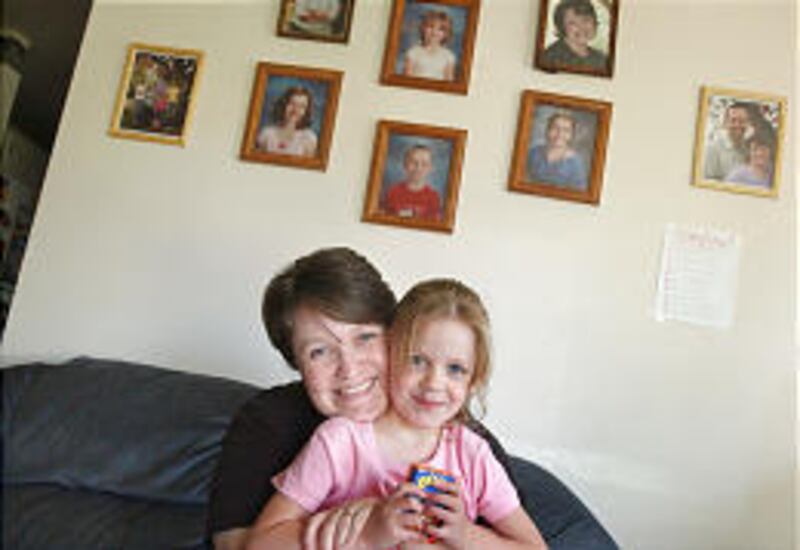


Are you ever totally ready for the curves life throws at you?
Even though 3-year-old Jessica had been, at times, a difficult child, Amy Maida Wadsworth felt her world had been turned upside down when Jessica was diagnosed with autism spectrum disorder. "I felt like an anvil had been dropped on my chest. How could this be possible?"
The previous year, Jessica's pediatrician had told the Wadsworths that Jessica had a developmental disorder, but that there was little or no chance that she would be autistic. Jessica was learning to speak and sing songs with her family. She could be sweet, affectionate and cuddly. "Then almost overnight, and without any apparent illness, she seemed to forget everything she had learned," says Wadsworth.
New tests, new evaluations showed that Jessica was autistic.
Since then, it has felt like she turned onto a totally unknown road, says Wadsworth. "I knew little or nothing about the disorder. And other people didn't know how to treat us, either. It's like some people thought Jessica's disorder was contagious."
Because autism is not a disability that can be detected by physical appearance, such as Down syndrome might be, it is difficult for other people to discern the difference between a normal child with difficult behavior and an autistic child. "So much of it is displayed in behavior, but people have those behaviors who are not autistic, so when people see those behaviors, they tend to think that it's bad behavior, or that parents just aren't disciplining their kids."
To help people understand more about autism and the challenges of dealing with it, Wadsworth wrote a book called "Faraway Child" (Covenant, $14.95).
It is Wadsworth's third novel, and one she had not planned to write. "My editor suggested it. I had written an article on the experience we had with the diagnosis, and asked her to read it. She thought it would make a good novel. We thought that a how-to book might be helpful for other parents, but that a novel might reach a wider audience and help other people understand autism," says Wadsworth.
Much of the book is based on personal experiences, but it was still hard to write, she says. "It was hard to come to a resolution, because the autism does not change or go away." In the book, the mother does come to accept her daughter and her life as it is, and she finds peace and happiness in the midst of trial. "And the same is true of me," says Wadsworth. "Although, it is a continuous process. I have to keep renewing my outlook. I have to say that my faith has had a lot to do with it. I have to believe there is a purpose, that she's in there, locked inside, and that someday I'll get to know her."
Since she has had to take a crash-course in autism, Wadsworth has learned she is not alone. Thousands of other parents in the United States have to deal with the same issues. She cites figures from the U.S. Department of Special Education that indicate a person is diagnosed with autism every 23 seconds. The National Institute of Mental Health has estimated that as many as one in 250 people in the United States are autistic.
"In 1995, when Jessica was diagnosed, there were only 173 known cases of autism in Utah," she says. By 2003, that number had risen to 1,179.
Writing the book, she says, has helped her see "how far Jessica and my family have come in coping with autism." But she also hopes it will help other people know the importance of patience, love and understanding in dealing with each other.
She and her husband, Jason, have three other children: Maida, who is older; and Russell and Kira, who are younger. Jessica is now 12, and that is a difficult age for any child, says Wadsworth. When she was younger, she was in the Children's Behavioral Therapy Unit associated with the Carmen B. Pingree School for Children with Autism, and is now with the school district. When the Pingree School was started, Jessica was too old to attend classes there.
"She's doing pretty well," says Wadsworth. Still, she says, "every day brings new challenges. We're still learning about her. There's so much still locked inside. I can honestly say life is never boring. I have not been bored for a very long time."
Every child with autism is different, just as every other child is different. "Communication is the hardest," says Wadsworth. "You so take for granted the ability a child has to let someone know he's not feeling good or is tired. Jessica feels those things but is not able to tell us. We have to learn body language. If one thing doesn't work, you try something else."
Just brushing Jessica's hair is "a daily torture session. She hates it." When Jessica is upset or doesn't like something, she screams. "She's also very ritual-oriented. If you deviate from the routine in any way, she gets upset. Sleep is a big issue. She often can't sleep."
Jessica also has food issues, and will only eat certain foods. "Sometimes we can predict it, and sometimes we can't." She is obsessed with the calendar and marking off the days. "We took her to the beach, and she hated the sand and started stripping. Things like that are harder as she gets older."
On the other hand, they've learned things that can help. "She's also obsessed with scrapbooks. That's one thing that will settle her down. We took her to Disneyland, and she rode everything; she was a little daredevil. She loves to swim."
Jessica also has what is called a "stimming" behavior, a way that she twists her fingers that stimulates her and helps her focus.
In school, she works with a peer tutor. "And that has really helped," says Wadsworth. "She still needs interaction with peers. The kids in church have started working with her, too. They've been great."
One of the things that was the hardest for Wadsworth to learn, she says, "was to be willing to accept help when it was offered. Like many people, I think I was scared to ask for help, or felt I should be able to handle it on my own. This was my child. I was the mother. It was very hard to accept that I couldn't fix it."
Autism indicators
Early detection of autism is important, says Amy Wadsworth: "Getting Jessica in an early intervention program enhanced her development." According to the National Institute of Mental Health, possible indicators of Autism Spectrum Disorders include:
Does not babble, point or make meaningful gestures by 1 year of age.
Does not speak one word by 16 months.
Does not combine two words by 2 years.
Does not respond to name.
Loses language or social skills.
Other possible indicators:
Poor eye contact.
Doesn't seem to know how to play with toys.
Excessively lines up toys or other objects.
Is attached to one particular toy or object.
At times seems to be hearing impaired.
For more information from NIMH about autism, go to www.nimh.nih.gov.
E-mail: carma@desnews.com