

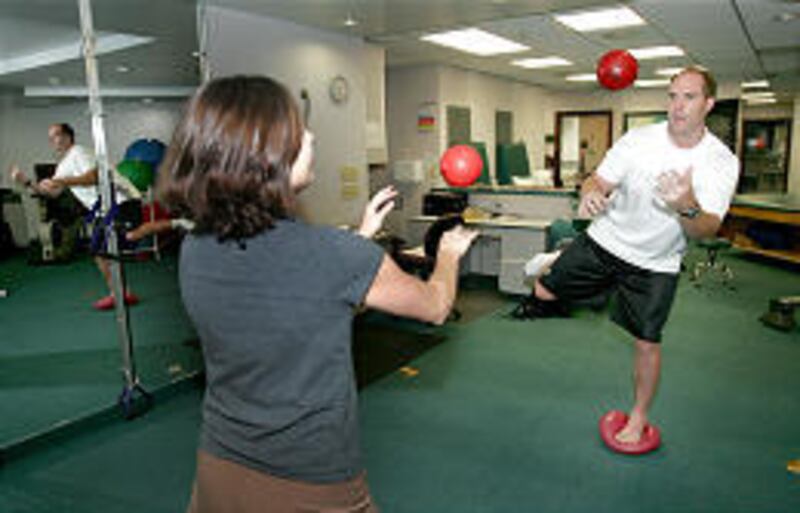
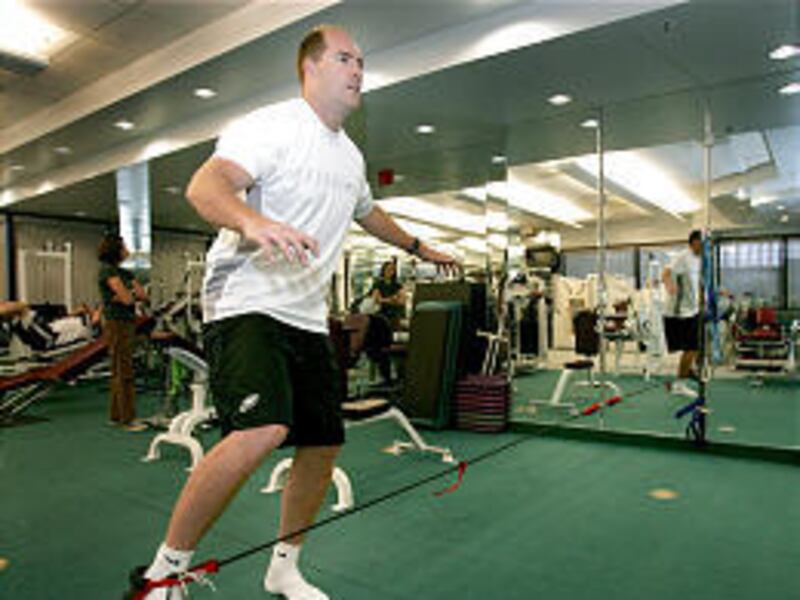
This is how serious Chad Lewis' injury is: The Philadelphia Eagles' All-Pro tight end is in his ninth month of rehab, and he's still not ready to return to the playing field.
It's called a Lisfranc injury, named after Jacques Lisfranc, a French surgeon in Napoleon's army. During the Napoleonic wars, soldiers falling out of their saddles sometimes caught a foot in the stirrup and were dragged around the battlefield. This resulted in a tear to a major ligament in the middle of the foot that was so severe that it often meant amputation.
The injury no longer results in amputation, but it can and often does spell the end of an athletic career.
Lewis injured the foot while catching the game-clinching touchdown pass in the Eagles' 27-10 win over the Atlanta Falcons in the NFC Championship game. In the ensuing celebration, Lewis merely sat in the end zone. He knew immediately that he had severely injured his foot and that he would not be able to play in the Super Bowl with his teammates.
Lewis, now a free agent, is living in his offseason home in Utah (he grew up in Orem), training at BYU and hoping to make a comeback. Ten NFL teams — the Eagles among them — have called to inquire about his services, including Norm Chow, the new Tennessee Titans offensive coordinator who coached Lewis at BYU. They're all waiting on the healing of his foot, and there's no guarantee that will happen.
"My No. 1 goal has been to get healthy again," says the 33-year-old Lewis. "That's what I'm doing. I'm working four hours a day on my foot."
Doctors told Lewis from the start that it could take a year or more to recover, and that he might never again be the same athlete. The Lisfranc ligament — located halfway up the foot, directly above the arch and aligned with the gap between the big and second toes — is the literal keystone of the foot, hinging the bones, ligaments and the arch.
After injuring the foot, Lewis limped to the bench, removed his shoe and watched as the foot dislocated completely — the big toe sagged away from the other toes right before his eyes.
"As soon as it did that, they (team doctors) looked at me with those eyes," says Lewis. "I told them, 'Don't worry, I already know.' It's a little-known injury. It's worse than an ACL (tear). If you tell a surgeon you have an ACL tear, they'll tell you that you'll come back. But if you tell them you have a Lisfranc injury, they give you this look, like you'll probably never come back.
"The injury happens in car wrecks, when the driver is pushing on the brake and slams into a car. It happens when falling off a horse. And the other way it happens is to catch a touchdown pass in subfreezing weather on hard clay."
Lewis believes the conditions at the championship game — 17 degrees at kickoff, zero-degree wind chill — contributed to his injury. On the fateful play, he had to turn his body and plant his foot hard into the turf to catch the ball. As luck would have it, one of the country's top orthopedic surgeons, Mark Myerson, was at the game. He looked at the foot after the game and pronounced, "Yeah, you're done; I know exactly what you need." He performed the surgery.
As Lewis explains it, the foot is a compressed spring of potential energy; when the Lisfranc ligament is ruptured "the spring is sprung."
It's difficult to rewind the spring, so to speak, which affects the explosiveness needed to sprint, jump and cut. To repair the injury, a surgeon must realign all of the bones and ligaments — a tricky business — and immobilize the foot for three months.
"Part of it (foot performance) will never come back," says Lewis. "You can't bring the arch all the way back up. It's like having brain surgery. If you poke around in there, it's not going to be the same. It's a delicate, complex ligament."
Lewis, who has been doing pregame radio work for KSL broadcasts of BYU football games, spent the first few months cycling and running on a treadmill in a pool at BYU and submitting to hours of rehab at a Provo hospital. Last week, he rode to the top of Big Cottonwood Canyon with Lee Johnson, the former BYU and NFL kicker. He is now able to run.
As for the future, Lewis says, "My role as a tight end requires me to be fast and run good routes and get open and block well and have power. If I can't get that pop in my foot, if I can't cut and run fast, there's no way I can play football. I can tell there's a difference. I can't get to full speed yet, try as I might. As much as I'd like to be out there, in reality there is no way."
The foot is still painful. Doctors have told Lewis it might hurt for the rest of his life. But the famously upbeat, optimistic Lewis says, "it takes a lot more than a Lisfranc injury to get me discouraged. It's fun for me to have something to go after. I like the challenge. To be back in Utah in the fall and ride a bike in the canyon when the leaves are changing and to be with my kids, I wouldn't trade anything. I haven't had a down moment."
E-mail: drob@desnews.com