

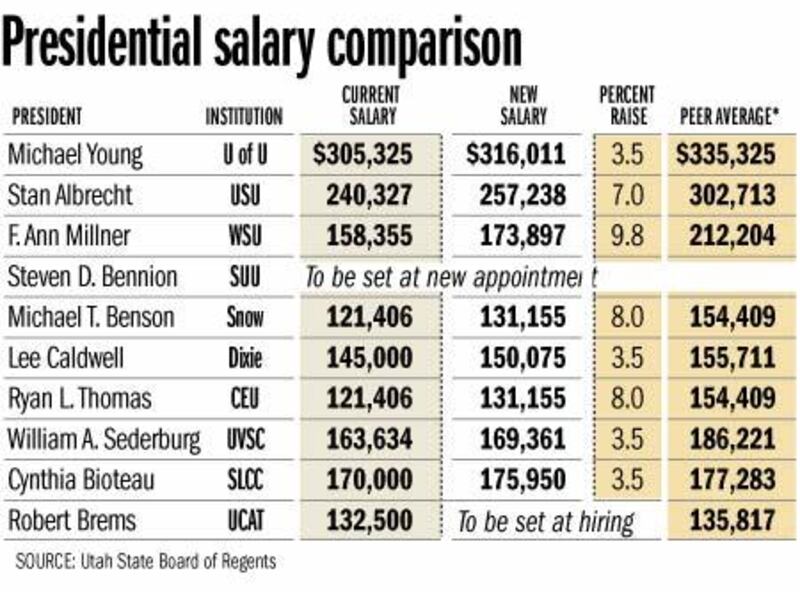
Paychecks for the leaders of Utah's public universities and colleges are getting a boost next year with some hikes nearing 10 percent.
Those increases still aren't enough to put Utah's school presidents on par with national peers, a shortfall that has higher education leaders worried about recruitment and competition.
"We want to be somewhat current. We want to retain the presidents we have and recruit when we lose one," said Rich Kendell, commissioner of the Utah System of Higher Education.
Kendell added that the hikes approved Friday by the Board of Regents are not at the request of the institution presidents nor based on merit but are rather an attempt to bring the state more in line with salaries nationwide.
A recent review of presidential salaries found that seven of the 10 Utah institutions were only in the 20th percentile of their peer groups, two were in the 30th percentile and only one — the University of Utah — was close to the median.
"In the national picture this is not an impressive set of numbers," consultant Kenneth Mortimer wrote in a report to higher education officials. "The board needs to make the judgment whether these types of salaries permit the recruitment and retention of good presidents."
The pay increases still only bring Utah university presidents up to 85 percent of their national peer averages, but Kendell said it's at least a step toward one day meeting that national level.
Ideally, Kendell said he wanted to bump the salaries up to 90 percent of national averages, but couldn't crunch the numbers into the budget.
Weber State's Ann Millner, who received the system's highest increase, 9.8 percent, said her salary has never been a consideration in whether to stay in Utah. Millner previously made $158,355, far short of the $212,204 average of WSU's peer institutions. Millner will now be making $173,897.
"I've been there 24 years. I love my job and the university. Salary is not why I'm there," she said.
Snow president Mike Benson and College of Eastern Utah President Ryan Thomas also received some of the highest increases with 8 percent hikes. Both presidents will now be earning $131,155 compared to their peer average of $154,409.
Five of Utah's school presidents only received the 3.5 percent increase approved by the Legislature this year, including University of Utah President Michael Young, who will now make $316,011.
Salaries for the yet-to-be-named president of Southern Utah University and newly named president of the Utah College of Applied Technology, Robert Brems, are still to be set.
In other business Friday, the Board of Regents:
Appointed Jed H. Pitcher as board chairman to replace Nolan Karras, who is leaving his post after serving two two-year terms. Karras will remain on the board.
Pitcher joined the Board of Regents in 2001 and previously chaired the regents' Finance and Facilities Committee and the Utah Higher Education Assistance Authority board of directors. He is also a member of the Utah College of Applied Technology board of trustees.
Pitcher recently retired as the chairman of the board of Regence Blue Cross Blue Shield of Utah. He was also formerly on the Utah Opera Company board of directors and the Salt Lake Area Chamber of Commerce.
A Utah native, Pitcher earned a bachelor's degree in business administration from Utah State University.
"I have extremely large shoes to fill replacing Nolan Karras," Pitcher said via conference call Friday.
Approved a regional planning initiative to coordinate career and technical education throughout the state.
Although the Legislature created the Utah College of Applied Technology several years ago to grant certificates in technical fields, Kendell said the education system is still trying to reduce duplication and better streamline career and technical education.
"It had some problems. We've been trying to pick those off and deal with them one or two at a time," he said.
Friday's proposal creates nine districts with universities and career schools pairing up to ensure degrees are offered by only one institution in the area and that the degrees are in response to workforce needs.
In Summit, Utah and Wasatch counties, for example, Utah Valley State College and the Mountainland Applied Technology College will oversee career and technical education.
"The lack of that coordination has been the thing that's held us up," outgoing UCAT President Darrell White said. "Every time UCAT made a proposal it panicked everybody because we have a presence in every nook and cranny of this state."
E-mail: estewart@desnews.com