

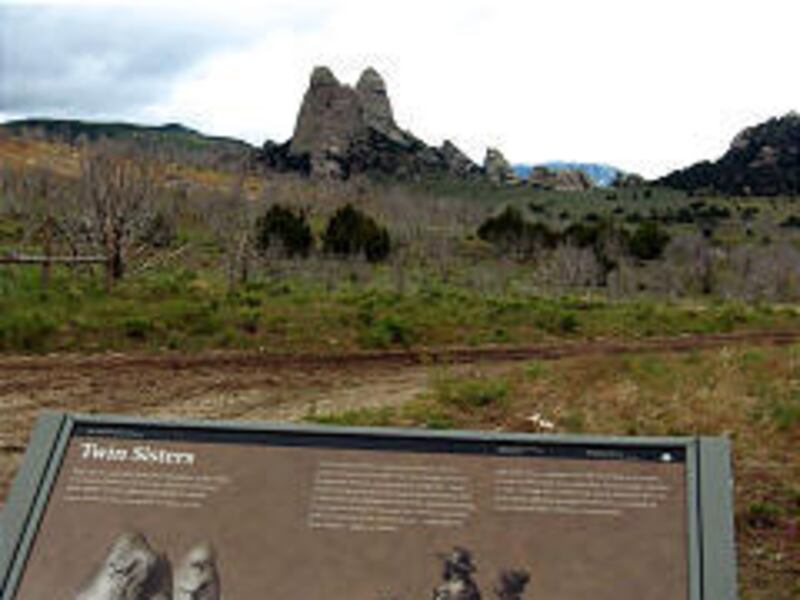
CITY OF ROCKS NATIONAL RESERVE, Idaho — As one of the few climbers to scale the 600-foot-tall pair of granite spires known as the Twin Sisters, park ranger Brad Shilling describes the three-state panorama from the top as "by far the best view of the California Trail landscape you could ask for."
From the ground, however, some visitors to the City of Rocks National Reserve in southern Idaho see things differently.
One visitor wrote in a letter to the National Park Service that climbers roping their way up the sides of the two stone towers that served as beacons to 19th century wagon trains look like "Lycra-clad filth."
Six years after a federal judge ruled the Park Service could legally ban sport climbing on the Twin Sisters because of their historical significance, the debate has been renewed. With the support of Idaho's congressional delegation, a national climbing organization is asking the federal agency to reconsider its 1998 ban on scaling the Sisters.
"This is not dead by a long shot," said Jason Keith, policy director for the Access Fund, a Colorado-based group that claims to represent 500,000 rock and mountain climbers in the United States. "We're not saying you shouldn't preserve the significance there, but there are ways you could allow limited climbing opportunities without impairing the historic values."
The fund sued the Park Service in an attempt to overturn the climbing ban, but in 2000, U.S. Magistrate Judge Mikel Williams dismissed the case after deciding the agency properly gave greater weight to preserving the cultural value of the Twin Sisters.
"Admittedly, the closure was based on the somewhat intangible values of feelings and association, but there is almost no other way to judge or weigh the merit of historical or cultural resources," Williams wrote.
In 2004, the four members of Idaho's all-Republican congressional delegation asked Park Service director Fran Mainella to ease the ban as part of a review of the 1998 climbing management plan. In a written response, the Pacific Northwest regional director, Jonathan Jarvis, defended the climbing ban but told the Idaho lawmakers "the need to address other pressing planning issues at the City of Rocks has caused us to reconsider this position."
Idaho's state historic preservation officer wrote to Sen. Larry Craig, R-Idaho, and Mainella in December last year, arguing the City of Rocks Reserve was created by Congress to protect nationally recognized overland trail landmarks, not to promote climbing them.
"Historians and the public travel to City of Rocks to experience the historical setting and features that remain from the early travelers," said Steve Guerber. "Climbing on the Twin Sisters, and the staging activities that support the climbing, distract from this experience."
In January, a Park Service review team recommended a dozen revisions to the 1998 climbing management plan but chose to keep the Twin Sisters climbing ban in place.
"We felt there was no new compelling information to consider an alternative or any change in NPS policy," said City of Rocks National Reserve Superintendent Wallace Keck, whose staff is now preparing a draft of the updated climbing management plan for public review. "It doesn't make any sense to flip-flop."
Since the recommendation to keep the climbing ban in place was released, the Park Service has received dozens of critical comments from people who argue the decision is unfair to climbers. Climbing does not damage the granite, they say, arguing that the view of the dual stone pinnacles is already cluttered with modern intrusions.
"When I look over at the Twin Sisters, my view is obscured by fence lines, roads, grazing cattle, a private residence with a satellite dish, numerous parked cars, occasional camper trailers as well as an outhouse and campsites maintained by the same government which restricts climbing," said Doug Colwell of Boise.
Climbing is allowed under various restrictions at culturally or religiously significant rock formations in other Park Service sites such as Devil's Tower National Monument in Wyoming, Half Dome in California's Yosemite National Park and Denali National Park in Alaska. Last month, the Park Service rewrote rules at Arches National Park in Utah to outlaw climbing on any named arch or natural bridge after a climber announced with photographs and video he had made an unassisted ascent of Delicate Arch, a signature span that adorns Utah license plates.
The first recorded technical climb — using ropes and anchors fixed into the rock — of Twin Sisters was made in 1962 by a small climbing club from northern Utah and members of the Lowe family. Climbing the Sisters grew in popularity for the next 25 years, with the Park Service documenting at least 22 established routes up the Twin Sisters, coined with names such as "Safer Than Sex," "Crack-A-Jawea," and "Static Cling."
Since the closure, sport climbers are restricted to the more than 600 established routes on other granite formations inside the City of Rocks Reserve.
It's not the same, though, said Keith, who will be holding meetings in Pocatello, Ketchum and Boise to encourage Idaho climbers to urge members of Congress to overturn the Twin Sisters ban.
"The Park Service tries to say all these other rocks are out there, go climb them instead. But the Twin Sisters is a unique resource," said Keith. "It's like saying, 'Why do you want to golf these 18 holes when we have all these nine-hole courses available?' "