


ANETH, San Juan County — It is unclear how the area along the San Juan River came to be known as Aneth.
One historian surmised it came from the Spanish word anexo, meaning annex. But aneth is not a Spanish word. Nor is it a Navajo word.
Regardless, Navajos call it t'aabiich'iidii, a reference to the business practices of the first Anglo trader on the land. It means "just like the devil."
According to College of Eastern Utah professor Robert McPherson, a Methodist minister in 1895 named the area aneth, which is Hebrew for "the answer."
Answers are what some 2,300 people scattered across the vast desert in prefabricated houses have been seeking for years. More than a third lack plumbing and a quarter are without kitchen facilities. Almost half heat their homes with wood. Nearly eight in 10 don't have telephones, according to the U.S. Census.
Unemployment is 33 percent. Fifty-four percent didn't graduate from high school. The median family income is $15,604. More than half live below the federal poverty line.
People still live in houses without running water, electricity and telephones. Education hasn't improved. Roads remain unpaved. Existing jobs are few. Prospects for new ones are bleak.
"Economic development is really on the back burner," McPherson said.
Just like they have for the past 50 years, Utah Navajos rely on oil and gas money for basic needs like housing and water.
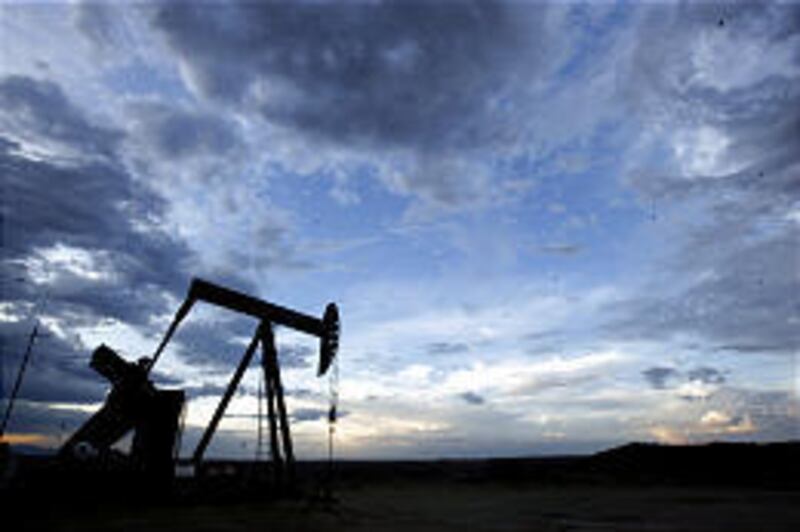
Oil rigs atop mesas in this corner of the Navajo Nation rise like a shrines above the sagebrush-covered valley floor.
The steady clank of their counterbalanced lever, like a giant hammer pounding an anvil, break the silence in the sparsely populated desert. The up-and-down motion drives a pump to create suction to pull crude up through the well.
Wells in this faraway slice of southeastern Utah have extracted nearly 500 million barrels of oil the past half century, making the renowned Aneth oil fields Utah's largest producer. Geologists, fittingly, call the area Paradox Basin.
Utah Navajos should seemingly be much better off. The tribe has collected millions of dollars in oil and gas royalties over the years. But its members remain impoverished. Most don't have much to show for what their land has earned.
Oil wells are the boon and bane of life on the reservation. Crude propels what little economy exists. But it also is the source of decades-long litigation and infighting. Environmental degradation, too, has left scars on the tribal land and psyche.
Remoteness, lack of infrastructure and no capital investment dollars works against starting new businesses on the reservation. Even so, the economic potential remains untapped, according to the Navajo Utah Commission, made up of leaders from the tribe's seven chapters in the state.
The commission wants the state to work with the tribe to set up a Small Business Administration business development office on the reservation. It also would like Utah to hire a full-time economic development assistance provider to help all tribes.
A Department of Interior ruling last month that eliminates bureaucratic red tape could kick-start business development. The Navajo Nation no longer needs federal approval through the Bureau of Indian Affairs to develop land, a process that previously took at least three years. The decision empowers local chapters to identify property and plan projects on their own.
The Bureau of Indian Affairs and Indian Health Services provide the Navajo Nation with most of its money, with some dollars getting to the Utah portion of the reservation.
Navajos have not broken into the high-tech industry as have other tribes. They are banking on other projects to revive the economy.
Officials have plans for a $2.5 billion coal-fired power plant in New Mexico that would provide thousands of construction and hundreds of permanent jobs. Tribal members also recently approved a gaming initiative that will bring casinos to the reservation — none in Utah — for the first time
The Utah Navajo Trust Fund, which administers oil and gas royalties, remains the only source of local revenue. Navajos in San Juan County reap 37.5 percent of the profits, while the other 62.5 percent goes to tribal headquarters in Window Rock, Ariz.
Created by Congress in 1933 to allow the state to administer oil and gas royalties on behalf of Utah Navajos, it is the only fund of its kind in the nation.
The oil and subsequent royalties in the tens of millions of dollars began flowing in the 1950s. In 1971, the nonprofit Utah Navajo Development Council was created to provide health care, education and general welfare for Navajos in San Juan County. It was followed by the for-profit Utah Navajo Industries, which was charged with starting businesses, employing Navajos and developing their managerial skills.
Bad investments, poor decisions (including a failed puppet-making company), misappropriation and fraud doomed both entities and squandered millions of dollars. Several officers in those organizations were convicted of embezzlement.
A University of Utah finance professor determined in 1992 that had the money been managed properly, the fund should have had $100 million. Instead, it had about $9 million.
A group of Navajos sued the state in 1992, claiming it mismanaged the money and gave funds to entities that embezzled it.
"It was shoebox accounting," said Brian Barnard, a Salt Lake civil rights attorney who represents tribal members.
A federal judge ruled earlier this year that the state must account for millions of dollars spent out of the fund from 1955 to 1990. The state appealed the decision, adding at least another year to the litigation.
Other than the fund being administered by three state-appointed Anglos — including state treasurer Ed Alter — Navajos have no complaints about how the money is managed.
The Navajo Utah Commission has proposed turning the trust fund over to Navajos, said Clarence Rockwell, executive director. Short of that, it has requested that a Navajo immediately be placed on the three-member board.
The trust fund took in $2.7 million last year, bringing the total account to about $21 million, but none of it goes to economic development. The fund doesn't do anything in the way of job creation anymore.
"That's one of the programs we stay away from because of our history," said Tony Dayish, trust fund executive director.
Due to the prior mismanagement and, as Alter says, "cockamamie proposals that didn't make a lot of sense," state law now severely restricts dollars for economic development.
A large chunk of money each year is used to build medical and dental clinics in an area where tooth decay is rampant, as are disease like diabetes. "It's one of the things that benefit everyone," Alter said.
About $500,000 a year today goes to college scholarships for Navajo students, Dayish said. Another $500,000 annually is used for new and rehab housing, water and electricity on a house-by-house basis.
The scholarships are a two-edge sword: Educated students rarely return to the reservation to work or start businesses.
"There's not many job opportunities here in San Juan County. There's not anything for them to come back to. We don't get too many coming back," Dayish said.
A share of the annual royalties is socked away for the day when the oil no longer flows.
Denver-based Resolute Natural Resources partnered with Navajo Oil and Gas Co. to buy out the ChevronTexaco and ExxonMobil operations in Aneth, knowing it is in its "11th hour," said Resolute operations manager Dale Cantwell.
"We're trying to wring a little more oil out of the field," he said, estimating production of 10,000 barrels a day.
And when the well atop the highest mesa grinds to a halt in perhaps 10 or 20 years, Navajos in southeastern Utah will have to find other ways to sustain themselves.
E-mail: romboy@desnews.com