


A 12-year-old performer getting ready to sing the national anthem at a state Democratic convention was visiting with former Utah governor Cal Rampton when he asked about her family's political affiliation.
"I think my parents are Republicans," she said.
"I guess I shouldn't be surprised that we're so short on Democrats the party would have to hire a Republican to sing the national anthem," Rampton replied with a laugh.
That convention in 2000 reflected the political norms of what has become Republican-dominated Utah. But back in 1964, when Rampton was first elected governor, both political parties had representation in the state's top elected offices. Utahns also had elected four Democratic governors before Rampton, although it had been 16 years since a Democrat last had been governor when he took office.
Close friends in the Democratic Party convinced Rampton to run, but he credits a Republican for that win.
"The person that elected me governor in '64 was Barry Goldwater," the GOP candidate running against Lyndon B. Johnson, Rampton says. Johnson, who won in a landslide, carried Utah by about 55 percent.
"I carried by about the same percentage," Rampton says. "I think it was the ticket that carried me through."
He went on to become Utah's only three-term governor, serving a full 12 years, and each time he was elected by overwhelming majorities. A centrist, moderate Democrat, he was one of the state's most popular governors.
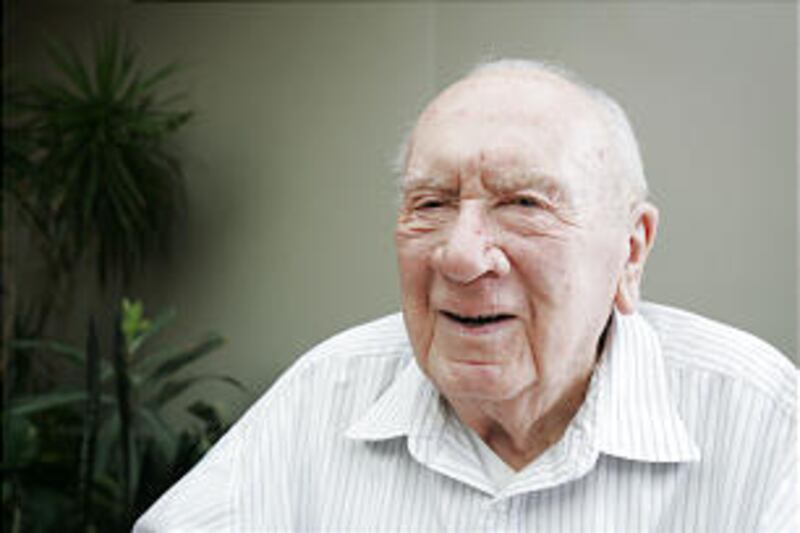
At 93, he's still known as "the governor" — and that's how the staff members of a Salt Lake City care facility refer to him since he arrived there recently, following a kidney problem that marked a sudden downturn in his health.
The path to his political career wasn't so evident when he was a young man growing up in Bountiful. He dropped out of school in 1931 to take over his father's car business in Davis County when his father died.
The business was sold in 1933, and Rampton headed for the University of Utah, and then to George Washington University in Washington, D.C., for law school. He came back to Utah to finish law school at the U. in 1940, and he married a Utah girl he had met in Washington two years earlier.
"I was smitten almost immediately," he says of Lucybeth Cardon. He says the happiest day of his life was when she said she would marry him.
Rampton was Davis County attorney from 1939 to 1941, and he went on to become assistant Utah attorney general in 1941 and 1942. He left to serve in the Army in Europe during World War II.
After the war, he came back to Utah and was active in party politics. He also mounted unsuccessful campaigns for the state and U.S. senates. As a lawyer, he practiced in Utah, specializing in transportation and tax law, and also argued cases before the U.S. Supreme Court.
But Rampton was skeptical about his chances in a governor's race when he first launched a gubernatorial campaign against Mitchell Melich, after incumbent Republican Gov. George Dewey Clyde announced he would not seek re-election. Even so, Rampton says, "Somebody whispering in your ear sounds like a mighty chorus, and I said, 'Yeah.'"
Rampton had worked with LBJ in Washington and fully expected a congratulatory call from him after they both won their elections.
"He never did call me and congratulate me, and I felt quite hurt," Rampton says.
He asked his secretary, "What's the matter with Lyndon? He must not know I was elected. I would think he'd be calling me." But Johnson didn't call, even after Rampton first took office.
"A week went by and (my secretary) came in all breathless one day and said, 'The president is on the phone,'" Rampton recalls. "I picked up the phone and said, 'Yes, Mr. President?' and he said, 'Cal?' and I said, 'Yes, sir?' 'I understand Bob McNamara is at some place called Alta.'"
McNamara, the Vietnam War-era secretary of defense under both Johnson and John F. Kennedy, was on a ski trip to Utah and was snowed in. No one was getting in or out of Little Cottonwood Canyon, Rampton says.
Following an attention-getting expletive, all Johnson said was, "Get him out of there." Then "bang" the phone slammed, and Johnson was gone.
"First I tried with a National Guard helicopter, and they couldn't get the altitude safely to carry two people," Rampton says. McNamara was still stuck.
Rampton then went to a private helicopter operator. "I had no money to do it, but I rented one of his helicopters and paid for it with Democratic Party funds, rather than public funds, and brought him down that way."
A week or so previously, outgoing governor Clyde had met with Rampton the day after the election to facilitate a transition. "He said, 'There are 157 different departments in the state government that report directly to me. A lot of them I've never seen.' He said you need to reorganize government, so I decided that would be one of the things I would present to the Legislature initially," Rampton says.
The Legislature established the Committee on the Reorganization of the Executive Branch that became known as the Little Hoover Commission, taken from a federal-government restructuring initiative created by Franklin D. Roosevelt.
State government underwent a significant restructuring as a result, with departments consolidated under executives that currently comprise the governor's Cabinet.
Rampton and friends in the business community got together with the idea of forming a group of people, businessmen, each of whom would pay their own expenses to go out on business to other states and other chambers of commerce to present the advantages Utah had to those who were planning to expand their businesses into other states.
The group became known as Rampton's Raiders. "I think it was quite successful. In fact I've been informed that we're still getting people that started their planning back at that day. Not very many now but a few," Rampton says.
He also undertook significant changes in the state's public school system and launched the state's first Olympic bid — something he says was good publicity for the state, although he personally didn't think the state was ready to host the Games then and was glad to see the proposal advance no further than U.S. Olympic Committee approval in 1973.
"I was exhilarated by the job" of governor, he says. "I didn't wear out. I enjoyed every minute of it. Well, that's sort of an overstatement I guess — I had times I got angry and times that I got hurt, but normally I liked it."
The Ramptons' two daughters and two sons left the nest during Rampton's tenure as governor. Lucybeth "enjoyed the role" as first lady but was diagnosed with clinical depression that was treated with medication.
That strain was one reason Rampton did not seek a fourth term. He says his wife, who died in 2004, was his most trusted adviser. But after three terms, "my wife had had enough of politics," he says. "Besides that, I was broke. The governorship provided adequate expenses but very little in the way of salary. I spent all I had in savings, and I had to get out and get a job and earn some money."
He joined the law firm Jones Waldo Holbrook & McDonough after leaving office and had an active practice for the next 15 years. He kept an office at the practice after that, "mostly keeping correspondence," but his visits there tapered off over time.
Becoming a "former governor" has had two notable perks, he says.
"I did get some very substantial cases because people knew of me as governor, so I think it helped my (law) practice," he says.
And the other? "People call you 'governor.'"
Rampton says he hasn't been overly active in politics since leaving office. He is a founding member of the "Damned Old Democrats" club that has lunch at the Alta Club on Fridays. Rampton says a lot has been made about the DOD club. Its real foundation? "Darned if I know," he says. It was mostly an excuse to meet with friends for lunch, and the group was mostly nonpartisan, he adds.
Rampton's view of politics in general is tainted by the times.
"Personal bitterness. I just don't like it at all. It's pervasive through the country. It's true in Washington. It's true in Salt Lake. (Candidates) have personal animosity towards each other," he said.
"I had a good candidate against me," Rampton says of Melich, his 1964 opponent. The two "divided over some issues but there was no personal bitterness," Rampton says. "He was a good friend. I played golf with him all through the campaign."
E-mail: sfidel@desnews.com