

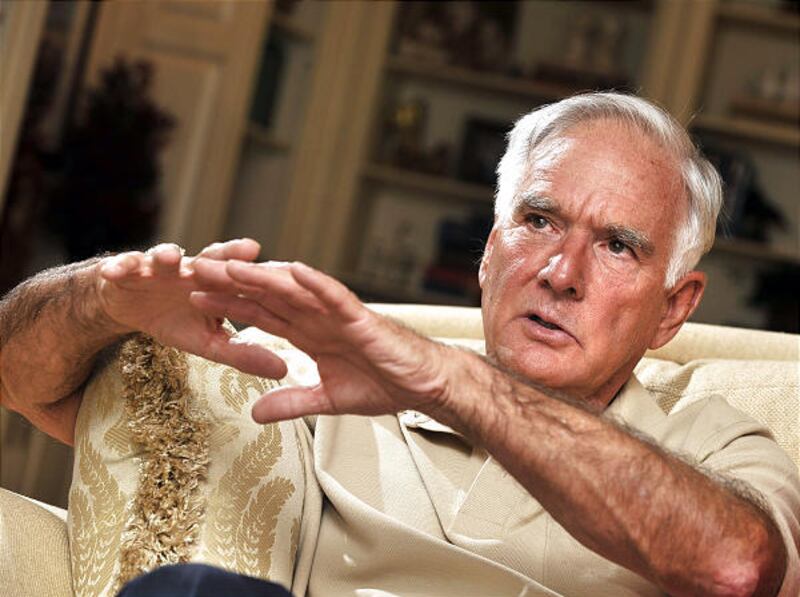
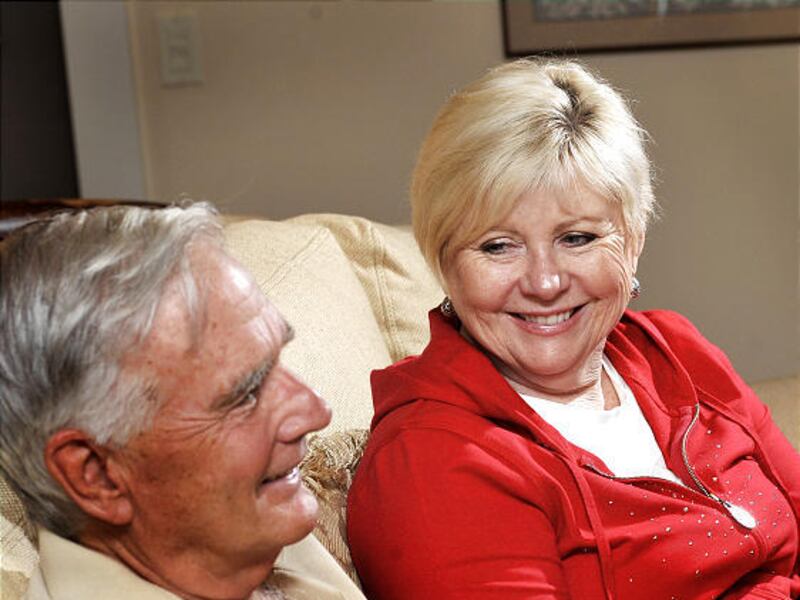
COSTA MESA, Calif. — On any other day, the trip to Nordstrom with his wife and daughter would've been almost mindlessly routine, his pre-shopping breakfast a simple plate of bacon and eggs.
But on that morning recently, Bill Burke was just one day removed from an adventure so epic that it left him finding new meaning in the mundane. So Burke's eggs tasted better than usual; his time with family was sweeter, more meaningful.
Less than 24 hours before picking out new shirts, Burke had been on the other side of the world, in Nepal, wrapping up a trip in which he'd gone to the top of the world's tallest mountain.
And, as he shopped, Burke was adjusting to something new — attention. Reporters soon would ask him for details of his adventure. Mountain climbers would call, seeking his advice. School kids, some of whom had followed his itinerary on line, wanted to hear his story.
At 67, Burke had become the oldest American ever to climb Mount Everest.
But he was — and is — uninterested in records. Climbing, for Burke, is about listening to his heart.
Burke has always had an adventurous spirit, but comparatively few opportunities for adventure.
He married his wife, Sharon, 47 years ago, shortly after they both graduated from Burbank High School. They had their first child, Lisa, while Burke was in college, and their second, Lori, was born when he was at Stanford Law School.
Life zoomed. The Burke family moved back to Burbank, Calif., had two more children, (Danny and Amy), and Burke's career as a corporate attorney blossomed. In 1972, they moved again, settling in Costa Mesa, Calif.
In the mid '90s, Burke worked at a law firm in Asia. There, after climbing in country parks near Hong Kong and twice getting to the top of Japan's Mt. Fuji, he discovered a new passion — mountain climbing.
"I've always been up for adventure," Burke says, "and for challenging, and pushing myself, to see how I can perform under stress."
But Burke didn't pursue serious mountaineering until he was nearly retired. His kids were no longer little; his career no longer needed building; his income was no longer a huge issue.
"I wondered what the big mountains would be like."
His first successful high-altitude climb was Mount McKinley, in 2002. McKinley is one of the more difficult mountains on earth, and Burke climbed it at age 60, older than most serious climbers.
He was hooked.
"It was really a great feeling because I realized after I finished the mountain, this was something I was capable of doing."
In 2003, Burke climbed the Aconcagua in Argentina's Andes Mountain Range. In 2004, he reached the apex of Mount Kilimanjaro in Africa. A year later came Mount Elbrus in Russia. After that it was Vinson Massif in Antarctica, Mount Kosciuszko in Australia and Indonesia's Carstensz Pyramid.
Burke's wife, Sharon, and their children and grandchildren, were supportive of, if not particularly thrilled about, his climbing hobby.
Then, as he approached 65, Burke embarked on something truly big.
In 2007, he made it to the southeast ridge of Mount Everest, about 300 vertical feet from the summit. But, abandoned by his Sherpa, a mentally and physically exhausted Burke had to make a choice: Should he continue up, alone, to complete the ascent? Or should he be prudent and start down the mountain, failing to reach his goal? It was, literally, a life or death decision.
He chose to head home. Life was too precious; his family was waiting.
"I was disappointed," Burke says. "I had been on the mountain for eight weeks."
Still, there was no doubt he'd try again.
"Once I came down, I felt good. I knew that the mountain would be there the next year, and the year after that."
In 2008, Burke tried again to summit Everest, but a pulmonary edema — a lung malady often caused by breathing at high altitude — prevented him from even reaching base camp. A helicopter flew Burke out of the mountains, momentarily ending his dream.
Then, in late March of this year, Burke again left home for Everest.
Along with his new Sherpa, Mingma, Burke trekked up and down the mountain for eight weeks. They dealt with storms, witnessed an avalanche that killed another Sherpa, and sometimes camped for days, alone in a tent, until it was safe to move on.
Unlike his previous stints on the mountain, Burke didn't feel altitude sickness or out of breath. Training he had done at home — gym workouts three or four times a week, plus climbing local mountains and biking with his grandson Oliver, who has Angelman Syndrome — prepped him for the journey.
When it was time for a final drive to the summit, Burke and Mingma knew there was a cyclone in the Bay of Bengal, something that would soon turn the weather on Everest into something lethal. Still, he felt confident.
On May 23 about 8:30 a.m., Burke reached the summit, dropped to his knees and thanked God. The wind was so intense that he couldn't take off his oxygen mask or goggles.
But he could unfurl a small American flag, and a second flag he'd made in honor of a foundation representing Oliver's disability, a genetic disorder that can involve a sunny disposition but also problems with coordination and communication. Burke took photos and, after 30 minutes, began the dangerous trek back.
Life on flat ground isn't boring for Burke.
Recently, he visited an elementary school in Newport Beach, Calif., and told the kids there about Everest.
He also still works part-time as a consultant, between workouts and hanging out with his 14 grandkids.
But Burke is planning other adventures. He's talking about a "Grand Slam," where he'd summit the highest mountain on each continent and trek to the North and South poles on skis while pulling a sled. He's also considering a traverse climb of Everest, in which he'd ascend from the south side in Nepal and descend the north side, into Tibet. Or maybe he'll hike the Pacific Crest Trail from Mexico to Canada. Or climb the highest mountain in each state in the United States.
"I just find it exhilarating and refreshing and cathartic to be in the mountains," Burke says.
"I think the lesson that comes out of my experience is whatever your dream may be, go for it."