

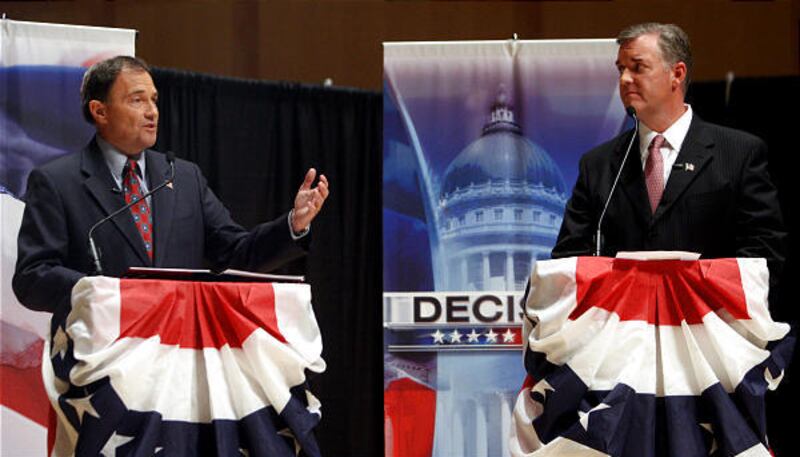
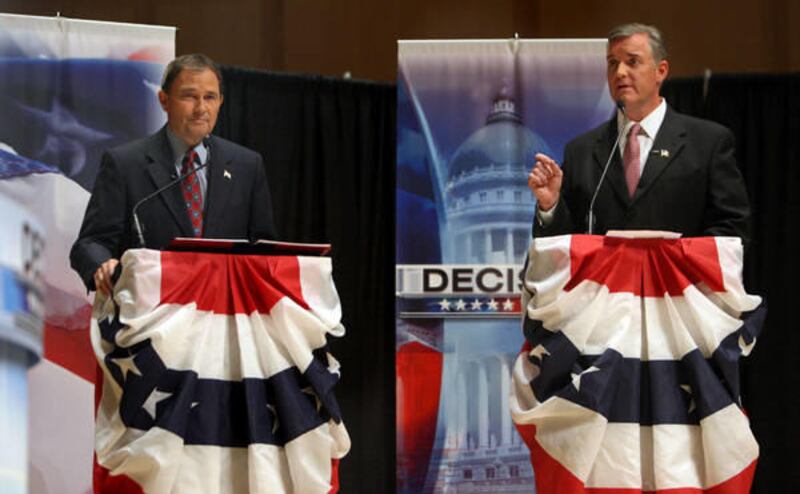

SALT LAKE CITY — The final debate Tuesday between GOP Gov. Gary Herbert and his Democratic challenger, Salt Lake County Mayor Peter Corroon, covered all the major issues of the campaign.
And, just as in previous debates, the candidates bickered briefly over questions raised by Corroon about the influence of campaign contributions to the governor on the award of state contracts.
The hour-long debate was broadcast live on KSL-TV from the University of Utah's Libby Gardner Hall and featured pre-selected questions from community leaders as well as moderator Bruce Lindsey on education, immigration, ethics and the economy.
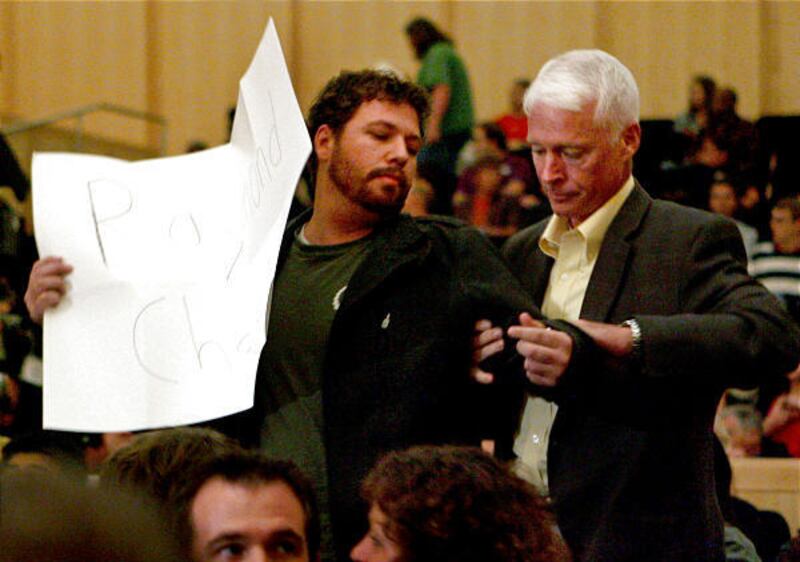
There was a brief interruption when several audience members stood up and attempted to draw attention to the suicides of gay and lesbian youths by holding signs bearing their names and shouting.
The audience members, who said they wanted the governor to address why he wouldn't support a statewide anti-discrimination law to protect gay and lesbian Utahns, were escorted out of the auditorium.
Herbert called the interruption "a little unfortunate for the debate" and said both he and Corroon want to wait to take state action until more cities and counties pass their own ordinances. He said he has gay and lesbian supporters.
Most of the questions posed to the candidates focused on education, a priority for voters surveyed for the Utah Priorities Project, an effort to identify key issues in the race involving the Deseret News, KSL-TV, the Utah Foundation and the U.'s Hinckley Institute of Politics.
Corroon said the state needs a long-term plan to improve schools.
"We need to fund our education system in good times and in bad," he said. "We can't wait for a strong economy in order to have a good education system."
But Herbert said the state can't spend money it doesn't have. "That's why my focus is on economic growth and development even though my priority is education. They work together."
Both candidates supported expanding the availability of all-day kindergarten classes, and Herbert said he is including funding for the program in his budget proposal to the 2011 Legislature.
Immigration was also discussed at length. Herbert said he expects a "methodical approach" to the issue by lawmakers next session will produce news laws "we will feel good about."
Corroon said passing new laws against illegal immigration won't work without funding for enforcement. "If they're looking to pass more bills to put people in jail and they're not funding it, that's not really going to do us any good," he said.
Once again, ethics was the hot-button issue of the debate. Both candidates said they supported ethics reform, but Corroon said new laws passed last session backed by the governor didn't go far enough.
Herbert said Corroon's own campaign "isn't very ethical" and asked whether there shouldn't be "some level of decency, some modicum of civility that ought to be involved in a campaign."
Corroon responded by again raising questions about the $87,500 in campaign contributions Herbert received from a member of the winning bid team in the $1.7 billion I-15 project through Utah County that resulted in a $13 million settlement with some of the losing bidders.
"I'm not questioning his ethics, I'm questioning his leadership on this issue. It think he's dead wrong," Corroon said, suggesting the governor is uncomfortable with his actions.
Both candidates said afterward they were pleased the debates were finished.
"I think we've had plenty. We're sort of just repeating ourselves over and over again. I think we're not plowing any new ground," Herbert said.
U. political science professor Matthew Burbank agreed.
"I think what you saw was largely a repeat of statements that have been well made by both sides," Burbank told the audience after the debate. "I don't think you saw a whole lot new and different here."
e-mail: lisa@desnews.com