

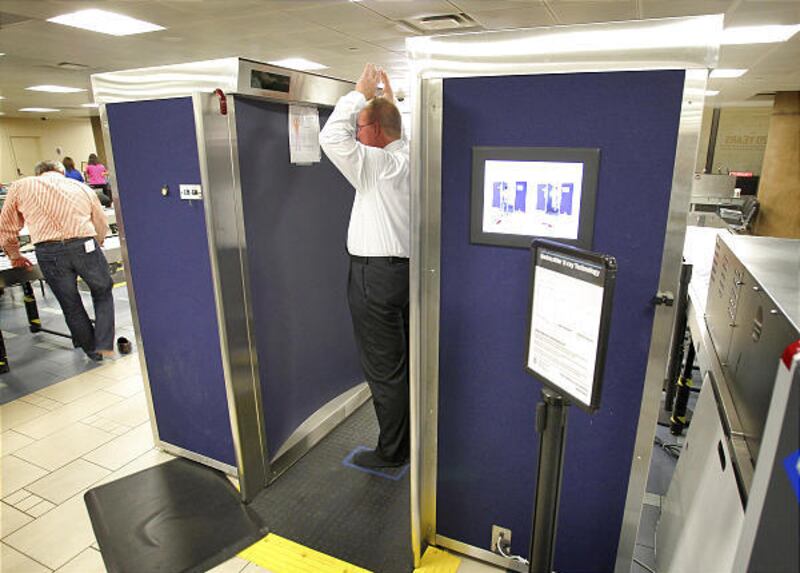
Before members of the Senate pass through the whole body scanners at Ronald Reagan Washington National Airport on their way home after this lame-duck session of Congress, they may wish to pass the currently stalled Aircraft Passenger Whole-Body Imaging Limitations Act, which overwhelmingly passed the House of Representatives in June 2009.
Rep. Jason Chaffetz, R-Utah, presciently introduced that legislation when he recognized the potential for overreach in this extraordinary technology. The bill thoughtfully addresses many of the legitimate concerns that have surfaced as this powerfully invasive, but questionably effective, technology has been introduced around the country thanks to government stimulus funds.
It is more than a little disconcerting that the full anatomy of passengers can be displayed in high-resolution to perfect strangers employed by the Transportation Security Administration (TSA). And despite the TSA's protestation that images are not saved, the fact that the Internet is now awash in images that were supposed to have been erased provides us little comfort as this high-resolution technology becomes even more pervasive. Passengers also might justifiably harbor the same kind of doubts that respected radiologists at the University of California and Columbia still have about the safety of this radioactive procedure.
The Whole Body Imaging Limitations Act prohibits the use of whole body imaging as the sole or primary method for screening passengers. Only if another method of screening indicates cause for full-body scanning would the procedure be allowed. Even then, passengers thus identified would have the option of a pat-down instead. Furthermore, the act would prohibit the storage, transfer, sharing, or copying of the strikingly graphic images generated by such screening once a passenger has been cleared for boarding — with a penalty attached for violation of these provisions.
This procrastinating Congress has left a slough of critically important legislation undone. The long-forgotten Whole Body Imaging Limitations Act might seem a lower priority than providing a budget for the federal government, clarifying tax rates and ratifying treaties. Nevertheless, it seems to us that even a fractured lame-duck Senate could agree on striking this sensible balance between safety and decency before families travel this holiday season.