

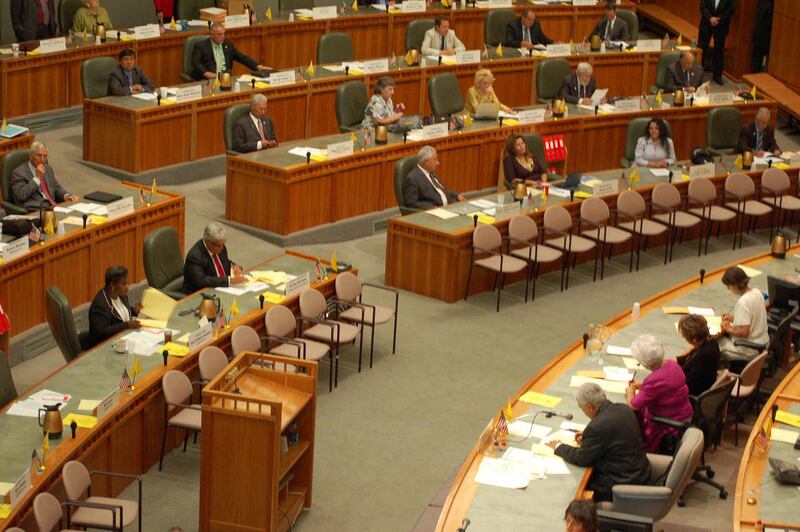
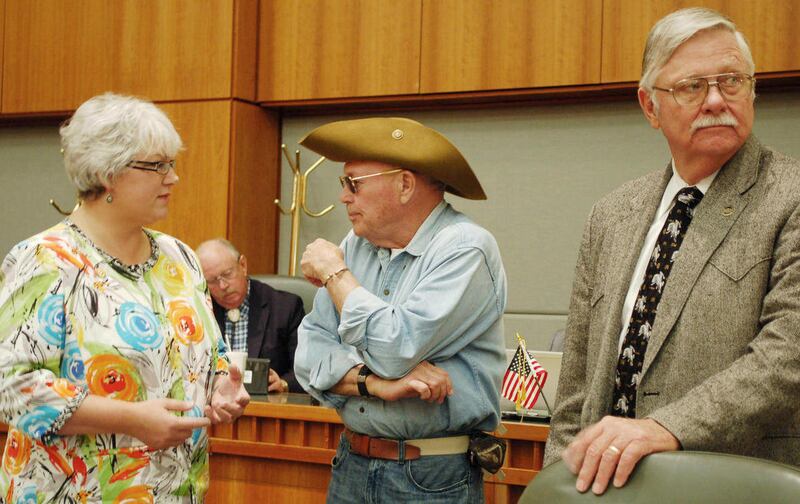
SANTA FE, N.M. — The Legislature convened Tuesday for a special session and immediately focused on the politically charged task of redistricting, which will influence elections and public policy in New Mexico for the next decade.
As lawmakers returned to work, House and Senate Democratic leaders said redistricting was their top priority. But Republican Gov. Susana Martinez also wants the Legislature to consider 10 proposals besides drawing new boundaries of congressional, legislative and other elective office districts.
Included on the governor's agenda were several potentially thorny issues, including overturning a 2003 law allowing driver's licenses for illegal immigrants and giving the state, as well as local governments, the power to ban all fireworks during extreme drought conditions.
Martinez also asked lawmakers to require school districts to hold back third-graders who can't read at an adequate level — ending a practice of "social promotion" in which students are promoted to the next grade regardless of whether they have basic academic skills.
There is no requirement that the Legislature vote on any of the governor's proposals, which were outlined in a formal proclamation issued by Martinez shortly before the session convened.
"Our No. 1 priority is to get redistricting done ... as quickly as we can and then we'll look to see what we can get of the remainder of that proclamation," said Senate Majority Leader Michael Sanchez, D-Belen.
The Senate derailed the governor's license proposal earlier this year when the Legislature held a 60-day session. Democratic leaders contend that Martinez has added it to the special session agenda to get more ammunition for next year's legislative elections.
Senate President Tim Jennings, D-Roswell, complained there was a partisan tone to the governor's proclamation outlining the session agenda.
"If we keep with this political rhetoric ... that is so antagonist, we'll never get the job done," he said.
Even before the session convened, the immigrant license proposal sparked competing demonstrations. Immigrant rights supporters against Martinez's proposal gathered on one side of the Capitol, chanting, "Jesus was an immigrant." Tea party activists rallied on the opposite side of the building with placards reading: "Licenses for legals only," and "Terrorists can fly with NM licenses."
Republican Lt. Gov. John Sanchez, the governor's running mate last year, told the tea party rally that the immigrant license repeal measure was not motivated by race or partisan politics.
"Make no mistake about it, as a proud Hispanic and working shoulder to shoulder with other proud Hispanics, it has nothing to do with race. It has to do with following the law," Sanchez said of federal requirements.
In redistricting, lawmakers must equalize district boundaries as much as possible to comply with the legal doctrine of one person, one vote. The Legislature must adjust the boundaries of New Mexico's three congressional districts as well as the 70 seats in the state House of Representatives, 42 Senate districts and districts for the state's utility regulator, the Public Regulation Commission, and the Public Education Commission, which can approve charter schools.
Shortly after the session began, the House and Senate met jointly for a briefing on redistricting and the legal requirements that lawmakers must following in adjusting district boundaries for population changes during the past decade.
Redistricting, by its nature, is a highly partisan task. Democrats and Republicans will jockey for a political advantage for their parties in future elections and individual legislators will fight to ensure their home districts are favorable to their re-election. The outcome of redistricting could influence future policy decisions by helping to determine whether Democrats can retain their majorities in the House and Senate.
The total number of seats in the Legislature will remain unchanged, but redistricting could reshuffle regional political representation.
Eastern New Mexico, for example, faces the prospect of losing seats in the House and Senate because counties in the region grew at slower pace during the past decade than the statewide average.
Districts must expand their boundaries — gain precincts — if their populations lagged behind the rest of the state and two districts may have to be combined to even out populations and make way for a new district, such as in the fast-growing west side of Albuquerque.
Follow Barry Massey on Twitter at http://twitter.com/bmasseyAP