


This article was first published in the State of Faith newsletter. Sign up to receive the newsletter in your inbox each Monday night.
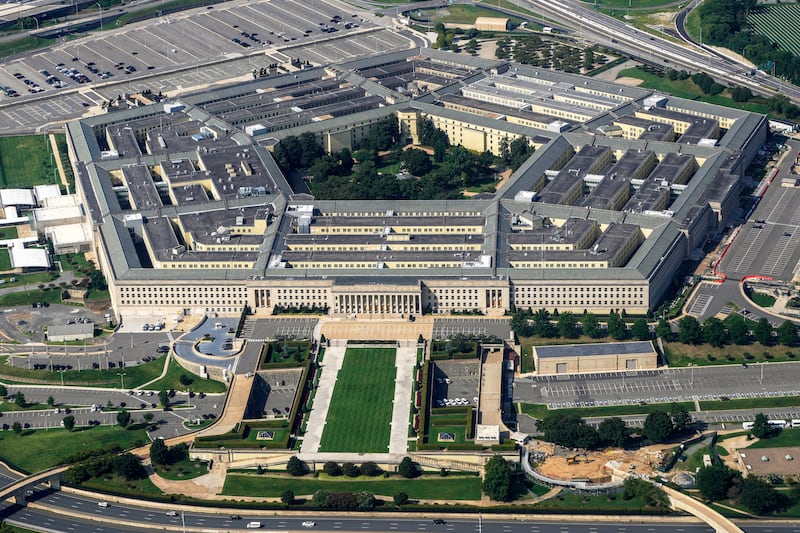
The latest controversy over the omission of Latter-day Saints from the Christian category on the Pentagon’s religious affiliation list — which has since been corrected — brought into focus an important point: While Americans continue to disagree about Latter-day Saint theology, the broad agreement is that deciding who does and does not qualify as Christian is not a call that the government should make.
“Listen, it’s fine if you, as an individual, don’t think Mormons are Christian. Or if you don’t think Catholics are Christians. Or Protestants. But the GOVERNMENT should not be deciding who is and isn’t Christian and THAT is the problem with what the Pentagon did,” April Ajoy, author of “Star-Spangled Jesus,” wrote on X.
David French wrote that the argument is not about theology, but has “everything to do with the Establishment Clause.”
Even Glenn Beck chimed in: “I don’t want the GOVERNMENT classifying religions.”
Following fierce pushback from Republican Latter-day Saint politicians to correct the mis-categorization, government officials complied and reiterated their respect for religious groups.
“The Pentagon’s job is not to adjudicate theological debates, but instead to ensure sincerely-held faith is respected and encouraged in our ranks,” the Pentagon said in a statement on Monday, which came with a revised list that removed the “Christian” category from all faiths.
On Friday, the Department of Defense released a list of religious affiliations that reduced the number of faiths that it recognizes from over 200 down to 31. On the list of 21 faiths coded as Christian were Lutheran, Quaker and Jehovah’s Witnesses, but not The Church of Jesus Christ of Latter-day Saints, which appeared listed in a separate category. The list also removed “humanist,” “Wicca,” “Native American” and other religions from the list.
“Labels matter,” said Joseph DuWors, a retired Army chaplain, Latter-day Saint and current Ph.D. candidate at Claremont Graduate University in Mormon Studies. “When you other somebody like that, somebody who you’re not even asking how they prefer to be represented, there is reason for concern.”
According to the Pentagon, the decision was mostly practical, meant to simplify the religious codes “to allow chaplains to quickly look at the religious composition of their units and determine how they structure resources to best provide for warfighters of all faith groups.” The Department of War’s statement, dated May 20, said this consolidation would “streamline” religious affiliation for service members. This omission stirred pushback from Republican Latter-day Saints — Sens. Mike Lee and John Curtis of Utah, and Sen. Mike Crapo of Idaho, who asked for the classification to be reversed.
The kerfuffle resurfaced an old question about categorization of Latter-day Saints in the broader religious landscape, according to Jenna Carson, who became the first female military chaplain endorsed by The Church of Jesus Christ of Latter-day Saints and was an active duty chaplain in the Air Force from 2022 to 2025.
“I think there’s a long-standing question of what to do with us,” she said.
DuWors interpreted the quick adjustment to the fact that the initial omission was more about “theological carelessness than adjudicating a denomination’s status as ‘Christian,’” he told me. Still, he has questions about what motivated the prompt willingness to reverse the change.
“First impression as it strikes me as an effort to appease the Latter-day Saint concerns without offending evangelical concerns,” he said.
DuWors believes that the removal of the “Christian” code for other faiths, including the Latter-day Saints, still shows bias.
“Their decision to de-label the rest of the Christian groups in preference to not labeling Latter-day Saints as ‘Christian’ is still suggestive of a bias about Latter-day Saints in the Department of Defense/War,” DuWors said.
There is a long history of prejudice against the Latter-day Saints within both government and Protestant cultural circles, he said, which risks being amplified against the background of Christian rhetoric that’s fused with political power.
“Changing this label should enable the previous status quo to continue — Latter-day Saint chaplains will likely function as they did before and Latter-day Saint service members will not feel othered,” DuWors believes.
Carson, who served in the Air Force, expressed concern that earth-based religions like Paganism and Wicca were excluded from both old and new versions of the list, along with Unitarian Universalists and Humanists. She also pointed out the spelling imprecisions in “Latter-day Saints,” “Seventh-day Adventists” and “Baháʼí” that remained in the adjusted version of the list.
“As chaplains, our prerogative is to care for the need of the individual in the military and to respect people’s right to practice their religion.”
She wants to see Latter-day Saint chaplains as bridge-builders within Christian denominations.
“I think that if we are concerned about not being listed as Christian, I feel like I ought to also be concerned about the other faiths that are not represented,” Carson said. “It does point to greater questions of religious freedom and religious representation.”
Fresh off the press
- Pentagon rethinks policy that omitted Latter-day Saints as Christian. Here’s how Utah lawmakers got involved.
- A new report confirmed that being affiliated with a religious community is actually good for your physical health — heart health, life longevity, stress, dementia and Alzheimer’s, and the list goes on.
- This piece by Meagen Kohler hit a little too close to home. Opinion: How a Latter-day Saint women’s conference helped me with my midlife crisis.
Spirituality in Salt Lake City

I’d visited, and written about, the Sri Sri Radha Krishna Temple in Spanish Fork, but I’d never been to the smaller Hare Krishna temple in Salt Lake City. I was in town this weekend, so when I heard the temple was hosting its Festival of Colors on Saturday, I decided to stop by.
I arrived intending to avoid being covered in colored powder. But when I saw a child of about 5 marching toward me with a fistful of bright pink powder, I realized I had no choice.
The Festival of Colors celebrates Holi, a Hindu celebration of renewal and the arrival of spring. In India, people toss colored powders and water at one another — a ritual of unity, masking distinctions like status and age. Due to cold weather this spring, the Salt Lake City temple held its celebration in the summer.
Part religious festival, part dance party, Utah’s Festival of Colors was founded by Christopher Caru Warden, the priest and founder of the Sri Sri Radha Krishna Temple in Spanish Fork, who died in a car accident in April.
Over the years, Utah’s festival inspired similar events in Texas, Las Vegas, California and even Australia. Utah has also become the hub for making the colored cornstarch powder and transporting it from Utah to other parts of the country for various festivities.
Among the attendees were two women who told me they had both grown up religious but now found much of their community through sword-fighting. Still, they appreciated seeing Utah families bring their children to experience Hindu traditions.
One woman said she views the universe itself as a higher power and is exploring the Bahá’í faith. The other was drawn to Daoism and Zoroastrianism.
The stewards of the temple are increasingly welcoming people who are searching for meaning and community outside traditional religious institutions. Every Saturday, the temple hosts a “seeker-friendly” program with devotional music and a talk. “If you have questions like ‘Who am I?’ you can come,” temple manager Pakhi Misra told me.
She says they continue to carry forward the legacy of their late leader, Caru.
“He meant to bring people together and realize we are all children of God, that we all have the same love of God in our heart,” Misra said. “Our soul is craving for that love. And these kinds of festivals give your soul satisfaction.”
Faith in the news
- Catholic sisters push Palantir on human rights as faith leaders rally in New York. — RNS
- Priest Who Said Aliens Were Demons Removed as Exorcist for Washington. — The Washington Post
- Pope Leo XIV draws 1.2 million to Mass and challenges Europe to acknowledge its Christian roots. — AP
- Latter-day Saints continue to demonstrate uniquely high religiosity, according to a new BYU report. — Deseret News
- ‘It’s Bible time’: How religion became part of the USMNT’s World Cup identity. — The Guardian
End note
I may be a little late to the party, but I’ve recently discovered the Dominican Sisters Open Mic podcast, and it’s pure delight. Sister Miriam interviews her fellow sisters about what it’s like being a nun — they talk about their hobbies, the games they like to play, why they like religious life and the challenges of being a nun.
One thing that struck me watching their videos is how much these sisters laugh and cheer on each other. Sister Miriam even noted on a recent episode that she felt that that’s what God wanted her to be doing during the times of recreating — laughing with her sisters.