
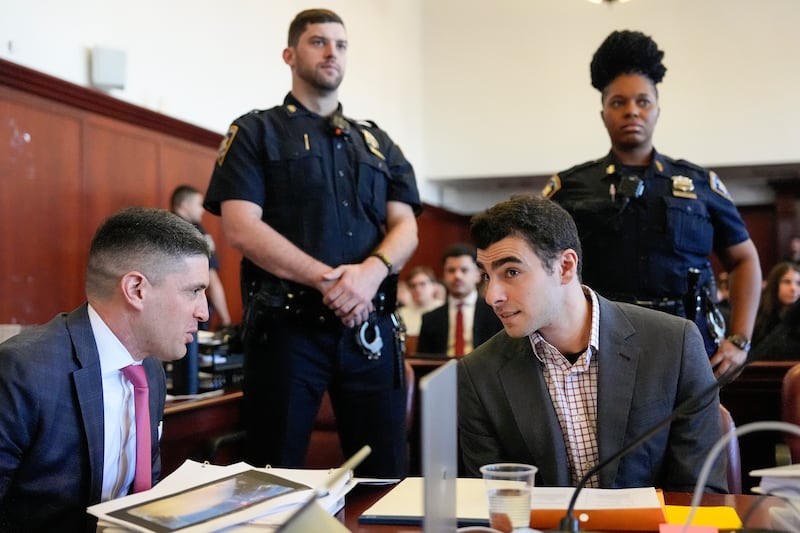

Nearly a year after UnitedHealthcare CEO Brian Thompson was gunned down on a Manhattan sidewalk, the man accused in the killing returned to a New York courtroom Monday as his lawyers tried to keep some of the most explosive evidence out of a future jury trial.
Luigi Mangione, 27, appeared in Manhattan Supreme Court for the first in a series of pretrial suppression hearings that will determine whether prosecutors can use a handgun, a red notebook and several of his statements to police in the state murder case, per CBS News.
Mangione has pleaded not guilty to nine state counts, reported AP News, including second-degree murder and multiple weapons charges, and faces a separate federal case in which prosecutors are seeking the death penalty. Trial dates in both courts have not yet been set.
Focus of the hearings: Gun, notebook and police questioning
The hearings — expected to last several days and possibly all week — center on whether New York and Pennsylvania officers violated Mangione’s constitutional rights during a five-day manhunt that ended with his arrest at a McDonald’s in Altoona, Pennsylvania, on Dec. 9, 2024.
CBS News reported that defense attorneys are asking Judge Gregory Carro to:
- Suppress a 9 mm handgun and other items police say they found in Mangione’s backpack, arguing the search was conducted without a warrant after he was already detained.
- Block prosecutors from using a red notebook and other writings seized in that search, which investigators say contain diary-style entries about targeting the health insurance industry.
- Exclude some of Mangione’s statements to officers, contending he was questioned before being properly advised of his Miranda rights.
Prosecutors with the Manhattan district attorney’s office have pushed back, saying officers acted lawfully and that the search of the backpack was justified by safety concerns — including the possibility of explosives, per AP News — during a high-risk arrest of a suspected gunman.
Eliminating the gun and notebook would be a major win for the defense. Prosecutors say the weapon is consistent with the firearm used in the Dec. 4, 2024, shooting and argue that the notebook includes passages in which Mangione talks about striking back at what he calls a “greed-fueled” insurance system and expresses an intent to “wack” a health-care executive.
Inside the courtroom
Mangione was allowed to appear in civilian clothes rather than a jail uniform after his attorneys requested the change, reported Fox News. He entered the courtroom in a gray suit and patterned button-down shirt and sat quietly at the defense table as officers removed his handcuffs so he could take notes.
Rows of reporters filled most of the gallery, with several dozen members of the public in the back, some wearing green apparel or shirts with Mangione’s name or image — a nod to an online “Free Luigi” movement that has cast him, controversially, as a symbol of frustration with rising health care costs, reported Newsweek.
Court officials say the evidentiary hearings could stretch beyond the first anniversary of Thompson’s killing later this week.
The prosecution’s early witnesses Monday included an NYPD sergeant who described how surveillance images of the suspected gunman were pushed out to news outlets and social media in the hours after the shooting, and a representative of the company that managed surveillance cameras at the Altoona McDonald’s where Mangione was arrested, per AP News.
What happened in the Thompson shooting
Prosecutors say Thompson, 50, was walking toward a Midtown hotel for an investors’ conference on Dec. 4, 2024, when a masked assailant approached from behind and shot him on the street. The killing of the chief executive of the nation’s largest private health insurer drew national attention and prompted a multistate search.
Police have said ammunition recovered in the case was marked with words echoing a phrase critics use to describe how some insurers handle claims, and court filings indicate investigators believe Mangione’s writings show an ideological motive tied to anger at the health insurance industry.
Five days after the shooting, officers in Altoona confronted Mangione at the McDonald’s following a tip. According to court records and defense filings, he produced an identification card that authorities say was fake, matching documents linked to the New York suspect.
Officers eventually handcuffed him and recovered a backpack containing a handgun, a magazine and cartridges, a silencer, electronic devices and handwritten notes, including the notebook at the center of this week’s hearings.
Competing narratives over constitutional rights
According to NBC News, defense lawyer Karen Friedman Agnifilo has said that “law enforcement has methodically and purposefully trampled his constitutional rights by interrogating him without Miranda warnings in violation of the Fifth Amendment and illegally searching his property without a warrant in violation of the Fourth Amendment.”
She has asked Carro to bar witnesses from describing his writings as a “manifesto” and to limit public discussion of the notebook’s contents, arguing that making them fully public now could taint potential jurors in state, federal and Pennsylvania cases still to come.
Legal experts note that suppression fights like this are routine in major criminal cases, per Newsweek, but the stakes are particularly high here: if the judge excludes the backpack evidence or portions of Mangione’s statements, it could reshape how both state and federal prosecutors present their cases to future juries.
Broader legal and political backdrop
Monday’s hearing comes after Carro tossed out two state terrorism-related murder counts in September, ruling that prosecutors had not shown sufficient evidence that Mangione intended to intimidate the public or influence government policy through the attack. The remaining state counts still carry a possible sentence of life in prison if he is convicted.
Mangione also faces four federal counts — including murder through use of a firearm and interstate stalking — in a separate case in the Southern District of New York. The U.S. Department of Justice has said it will seek the death penalty in that case, with the next federal hearing scheduled for early January.
For now, though, all sides are focused on the Manhattan courtroom where Carro will decide what jurors can ultimately see and hear — a set of decisions that could determine how the high-profile case moves forward into 2026.