

Third in a series
Pinning Gov. Mike Leavitt down on gun control is like trying to shoot skeet with an air rifle.
Most recently, the governor was asked about the topic as he sat in his chair at a monthly televised news conference. With his crisp white shirt and charcoal suit, he looked calm and relaxed — but he declined to say whether he supports or opposes the guns-out-of-schools initiative.
Off camera, he refused to say even if he'll vote for it, should it get on the ballot.
As the governor straddles the gun fence, moderate legislators and political observers wonder if four more years of a Leavitt administration will be one of taking on tough issues or yielding to the demands of Utah's increasingly vocal right wing, which opposes the gun-control initiative.
Will the state's most popular governor stands his ground on issues like education funding, tax cuts, Internet taxation or high-level nuclear waste storage? Or will he spend his time detecting which way the political wind blows as he clearly has on the issue of removing guns from schools and churches?
April 1999: Leavitt has a sense of urgency to deal with guns and very much wants to hold special session of the Legislature.
July 1999: "I've said before and say again: There should be no guns in schools. And I think sooner or later we'll get there."
January 2000: Barely mentions the "g" word in his state-of-the-state address posing only the question, "How about limiting possession of guns in our churches and schools?"
Leavitt said Thursday says he's made himself clear on the issue of banning guns from schools and churches. He doesn't want them there. Yet he won't take sides on an initiative to get the Safe to Learn, Safe to Worship Act on the November election ballot. He's said he's not involved himself because it's a citizens' initiative.
Now he's saying this is not just about guns. It's about people being fed up with government intruding in their lives, another common conservative battle cry .
David Magleby, a Brigham Young University political science professor, and Ted Wilson, head of the University of Utah's Hinckley Institute of Politics, say Leavitt would be making a mistake by moving to the right over his next four years if he wins re-election.
"He may well move to the right" to avoid more painful confrontations with his party's right wing, says Magleby. "But he'd be moving away from mainstream Utah, although he would be moving closer to the dominate wing of his party in the Legislature."
Leavitt has received fire from the right — a broadside from angry conservatives who forced a surprised two-term governor, much liked by Utahns at-large, into a June 27 primary.
The Wall Street Journal even took note of Leavitt's troubles on the homefront in an editorial two weeks ago headlined "Alienating the Base," as in the home base. The editorial notes "his national profile on Internet taxation merely added to his big government image."
Steve Forbes called Leavitt a "tax—loving politico" in the May 15 issue of Forbes magazine.
Leavitt has shown no signs of hitting the delete button on Internet tax issues, at least not on the national front. He's logged thousands of air miles the past few weeks to tout his unpopular proposal.
But he appears to have tugged on the reigns at home, saying nary a word on the subject since archconservatives shouted him down at the convention.
Two weeks ago, he scuttled a scheduled speech at the Utah Taxpayers Association convention on what has become his signature issue in recent months — the viability of sales tax in the 21st century, according to the conference program — in favor of a presentation on a new economic development plan.
The governor talked briefly on the advertised topic during his allotted time. "And used the rest for a campaign speech," said taxpayers association chairman Steve White, who paused before adding "for economic development."
Leavitt denies his political stands will change — people know him, he'll move ahead as planned.
Asked if he just got lazy or arrogant in his intraparty and interpersonal dealings, the governor says no. He's always worked very hard at this job, and arrogance "is not in my nature."
"I am sure that there are groups in the party that feel that they have disagreement with me and haven't supported me and there always will be," Leavitt said. "I feel that they may mix not listening with not agreeing."
But as he scrambled to travel throughout the state last week, meeting privately with local GOP leaders and officeholders, one wonders about the political fallout.
Garfield County residents have lost trust in the governor partly because of his chummy relationship with Interior Secretary Bruce Babbitt, said Bill Cox, Garfield County Republican Party chairman.
"People I've talked to are very hesitant about voting for Leavitt," he said. "The thing is they think (Democratic nominee Bill) Orton would be worse."
But rural residents still smarting about being bypassed on Leavitt's wilderness proposals and public land trades haven't ruled out GOP challenger Glen Davis, even though they don't know him. "They're that upset," Cox said.
Leavitt absorbed a heavy dose of straight talk on his fence-mending tour of rural Utah, perhaps in the vein that his GOP challenger used to force an unexpected primary election with the popular governor.
Apparently he's listening now. And perhaps even agreeing.
Keith Goodspeed, Duchesne County GOP chairman, chatted the governor up on gun control. "Let's concentrate on the criminals," he told Leavitt.
"He was very attentive," Goodspeed said. "He gave me the impression that maybe he is rethinking his position on guns in schools and churches."
Wilson doesn't see Leavitt gravitating to the right. "First, he'd be admitting he's a lame duck governor," Wilson said, by giving in to the right wing in the Legislature in his last four years, if he wins a third term.
But at the same time, he can't afford to ignore the right. He's a relatively young man with a long political future ahead of him. He may want to run for the U.S. Senate or some other office. "He'll play it close with his party and the right wing," said Wilson.
GOP House Speaker Marty Stephens, who considered challenging Leavitt this year, said it's clear Leavitt is trying to mend fences with some conservatives. And Leavitt may make "some minor" changes in his political stands to appease some of the detractors that he'll have to work with for four more years.
"It's natural when you run for re-election to make some midcourse corrections," says Stephens, R-Farr West. "But I don't think you'll see major changes."
It's frustrating, Leavitt said, that the right wing doesn't see the big picture. Still, he said he understands that conventions are places where people with special interests come to make a statement. "And they did and I heard them and I learned some things."
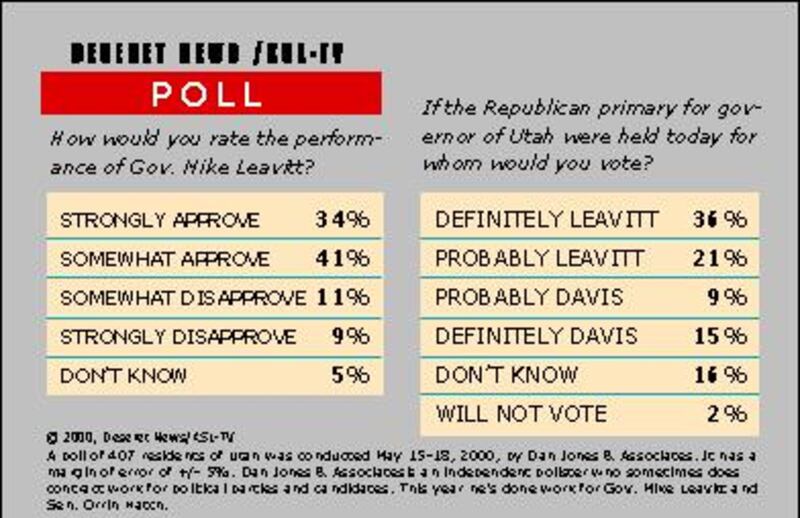
Deseret News staff writer Bob Bernick Jr. contributed to this report. E-mail: romboy@desnews.com , lucy@desnews.com and bbjr@desnews.comOn KSL-TV tonight: Further reaction to polling that shows Utah Gov. Mike Leavitt with a better than two-to-one lead over GOP challenger Glen Davis.