

PORT-AU-PRINCE, Haiti — Haiti's story is one of courage and resiliency. Those traits still keep the Haitians going.
When Christopher Columbus named the island Hispaniola in 1492, he was looking for Asia. In reality, what he found was an island that at its closest point is about 60 miles from the southeastern-most tip of what would become Cuba. It was occupied by gentle Arawak Indians who were soon annihilated by white man's diseases and overwork. In 1697, Spain gave the western third of the island — the part that would become Haiti — to France.
It was a gorgeous and coveted place, according to the history books, referred to as the "Pearl of the Caribbean." It was one of the richest colonies of the 18th century French empire, filled with sugar cane and coffee plantations. Labor was supplied by slaves brought from Africa.
In 1791, a group of those slaves decided they'd had enough, revolting and gaining control of the northern part of the land.
Napoleon Bonaparte was furious and sent his elite troops over, led by his own brother-in-law, to put down the rebellion. It wasn't supposed to take long.
It didn't. Local forces, helped considerably by diseases like malaria, wiped out the French army and in 1804 declared independence from France. They named it Haiti, Arawak for "mountain land." U.S. President Thomas Jefferson signed an executive order banning Haitian immigrants from entering the country because he didn't want them to inspire an American slave uprising.
It is widely believed that the financial devastation of the failed battle with Haiti led Napoleon to sell the Louisiana Territory to the United States that year. France badly needed money.
Political turmoil is not just a modern-day malady for Haiti. Between 1843, just after the Dominican Republic broke off, and 1915, there were 22 changes of government. That instability in 1915 prompted the U.S. government to send in troops. Though they withdrew in 1934, a few U.S. soldiers are again stationed in Haiti.
There are two views of recent politics. Near the presidential palace, then-President (and soon-to-be-again) Jean-Bertrand Aristide is memorialized in a statue. By one view, the people are holding him up as he releases a dove of peace. Others say he's standing on them.
With all its troubles, the pull of the homeland is strong for Haitians who have gone elsewhere seeking a better life. Expatriate Haitians help keep the economy afloat. The two primary income sources in Haiti are foreign aid and money sent home to family left behind.
Gina Duncan, director of the Healing Hands for Haiti Clinic on Rue Babiole, knows that pull. Her family left Haiti when she was 4. In her 20s, she returned, married, had a child and divorced, then married Lucien Duncan. Haiti has brought her great sorrow at times. And gifts of joy.
Perhaps the greatest gift is her daughter, 3-year-old Sarah. A man came to her one day carrying an infant, probably only hours old. He'd found twins in a garbage can, but he could only carry one baby.
Duncan took the tiny girl and sent him back to get the other one. It was too late.
Sarah, the survivor, now gleefully chases her older brother, Remi, through the rooms of the clinic, stopping to flirt with the American volunteers.
For the first Healing Hands clinics, the group splits up. Occupational therapist Beth Cardell is among those who go to Wings of Hope, an orphanage. The others go to St. Vincent's, a school, orphanage and medical clinic.
At the end of the week, Cardell will tell you she wants to come back. That she must, to see how things turn out.
A little girl with autism caused her to change her mind. Eva Rose, only 4 years old, chews on herself for stimulation. She's worn her thumb raw from gnawing on it and then started in on her wrist. Restraints just make her frantic and further tear into the ravaged skin on her arms.
Cardell makes splints, designed to hold the child's elbows straight so she can't reach her hands. Cardell figures the girl will go crazy when they're put on, but she sits quietly. It's not a cure for autism. But it will give her hands time to heal and perhaps will turn her focus to something else.
In the United States, children in homes with the conditions like those in most of the orphanages of Haiti would be removed to foster care. In Haiti, the children are lucky to have a shelter overhead, though they may sleep four or more to a closet-size room.
Emphasis is placed on education. Volunteers like artist Herode Guirand or Dieuferie "Jeff" Losier visit once and are hooked, returning again and again to teach French or English, to work on math.
"They are hungry and feeding them is important," Guirand said. "But I believe that in learning French lies their freedom. Haiti needs a lot of things, but it starts with education. You can take their liberty, their land, even their culture. But you cannot rob them of the education they have gotten."
When American visitors come, the children — sometimes as many as 100 in a small building — smile shyly and sing "We Welcome You" in English. Language barriers fall away in a sea of smiles as they happily pose for pictures.
Ronald and Jacqueline Kouri, humanitarian directors of The Church of Jesus Christ of Latter-day Saints for Haiti, return again and again. They bring food, supplies, sewing machines. Most of all, they bring the human touch. Jacqueline Kouri never hesitates to pick up even the dirtiest child. Though she has learned Creole, or Kreyol, the language with which she reaches them is one of the heart. A touch, a smile, a nuzzle.
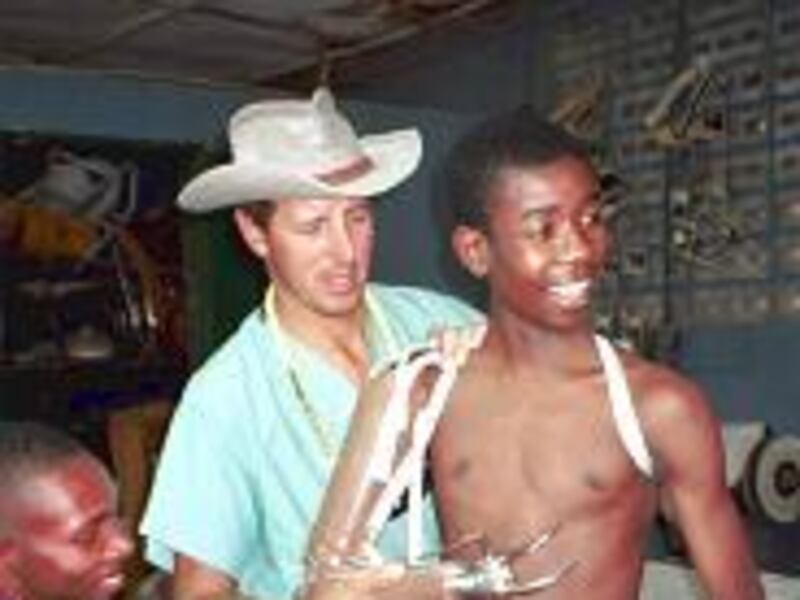
Matthew Bracken's the only member of the Healing Hands for Haiti medical team who stays in one place. He spends every day at St. Vincent's. It has a small prosthetics clinic and that's what he does. He makes braces and artificial limbs, helped by locals he's been training on every trip he's made to Haiti. Some of them have artificial limbs themselves.
Last year, he made an artificial arm for Carlos, who's 16 and had an accident when he was 11. The boy has grown and the arm now rubs on his shoulders, so he doesn't wear it. Soon, the problem's fixed, but Bracken has to retrain Carlos to use the dual-line limb, which ends in a hook.
He builds a brace for a 3-year-old whose leg is curved like the letter C. The child will wear it at night; that's when children do most of their growing. If the leg can't be trained to grow straight, he'll eventually either undergo a painful surgery or be permanently disabled.
Bracken has earned the nickname "Cowboy" because of the hat he wears, even in the shade of the clinic. He is, according to Joseph Jean-Paul, "a favorite" at the clinic.
John-Paul has shoulders but no arms. He was reared at St. Vincent's and remains as the receptionist. He wears two-part braces that are both crutches and hooked hands, a result of treatment he received in New Jersey. Perhaps because he was born with it, he has adapted well to his disability. He's a painter and a good one, using his prosthetic appendages to create Haitian scenes with brightly daubed acrylics.
Over the course of four clinics, the Utah volunteers see a bit of everything. Though their focus and expertise is in rehabilitation, people come with infections, tumors, arthritis. Sometimes the care is rudimentary. Sometimes it's more dramatic, like giving a lightweight wheelchair to a woman who had been pushing her daughter in a heavy, old wagon.
Sometimes, there's just nothing they can do.
On the day Healing Hands' own clinic opens, a boy, about 10, complains that he can't go to school because he's weak and sick, always tired, continually falling down. As nurse Beth Weekley and Dr. Jeff Randle watch, he fails a series of balance tests, teetering dangerously when he tries to walk heel to toe.
Randle thinks he might have a brain tumor, but it would take a CT scan to tell. That isn't available at the rehab clinic, or very readily elsewhere in Haiti, either. The family can't afford to go to a hospital. If Randle provided the money, they'd "just buy food," which isn't a bad thing when people are hungry. But it wouldn't help diagnose the boy.
Vitamin and mineral deficiencies, caused by poor and sporadic diet, can also create the symptoms. That's an easier one to handle. Randle gives the boy's mother a bottle of vitamins and instructions, in Creole. Then he provides a pediatric walker to steady the child, in hopes that he'll at least be able to get around safely.
A little girl, dressed in a frilly, white dress with bright red bows in her hair, extends her arm. There's a huge purple growth that obscures her elbow. It's grotesque, but not dangerous. A fatty tumor.
"It's such a waste," Weekley noted sadly. "It would take less than an hour in an American doctor's office to remove it."
In Haiti, that won't happen. The expense can't be met, the risk of infection is too great. And though it doesn't threaten her life, it will help shape it. The mass will likely determine how she views herself, whom she marries, how she fits in. In a way, the benign blob represents the heartbreak of health care in Haiti.
Doctors, both Haitian and volunteers from outside, provide some medical care to the island community, though not enough. Randle would like to add pediatricians, orthopedists, general practitioners to the list of people who come to Haiti with Healing Hands. It's hard to recruit them, though. As a trip gets closer, they tend to find other things they need to do. They cancel.
Though frustrated by the sheer number of people who don't ever get necessary medical attention, "for the spinal cord injury or the curved foot, we're what he needs. It's our contribution to Haiti. We can't cure everyone. But we can help," Randle said.
A woman with arthritis tells interpreter Chad Lowe that she can't work and her children are starving.
In another room, LDS Hospital nurse Kathleen Acree examines a boy she's pretty sure has leukemia, questioning his mother closely. The signs are all there, but the simple diagnostic blood test that would confirm or deny her hunch is elusive.
If they had a diagnosis, would it help? Chemotherapy doesn't exist in Haiti. While children in America usually survive childhood leukemia, Haitian children never do.
Lowe, a student at Brigham Young University who, like Jonathan Gifford, learned the language in a Haiti-Creole mission in Florida, tells the boy's mother to see that "he gets the best food in the family and he stays away from sick people." He suggests asking their pastor to say a special prayer for the child.
Tuesday: Life at the clinic.
E-MAIL: lois@desnews.com