

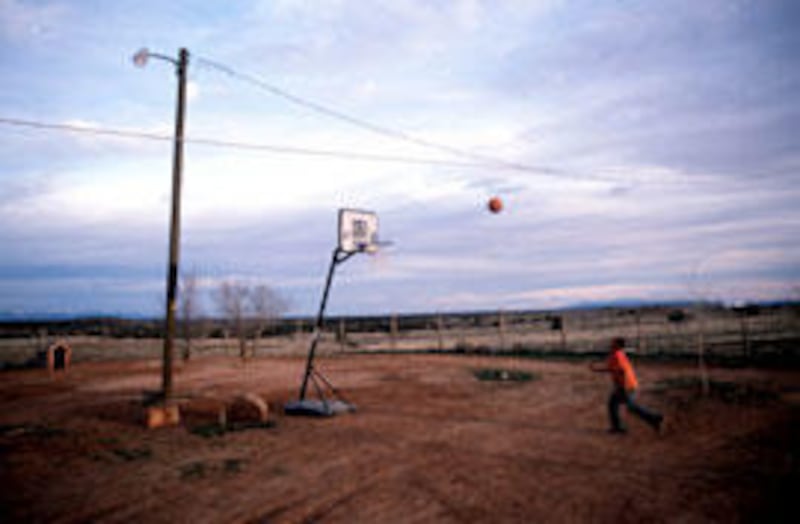


BLANDING — When Billy Mike died last spring, they said he was older than the state of Utah.
Some accounts had the Ute elder being born in 1895 (Utah was created in 1896) and living in three different centuries.
Mike himself couldn't be sure. What he was sure about was his place in the scheme of things. According to his beliefs, he lived at the center of the world — the White Mesa Ute Reservation in southeastern Utah.
During the day, Mike was a quiet man. At night, he dreamed of wild horses.
When asked, in his final interview, if he'd like to visit his beloved Allen Canyon one more time, he patted his wheelchair.
"I don't think my horse would make it," he said.
It never did.
For many, Mike was the face of the White Mesa Ute tribe itself — rugged, resilient, stoic, spiritual. He knew the vital legends — how Coyote, the trickster, emptied the Creator's satchel of people and scattered them over the Earth.
He knew the vital history — the stories of tribal alliances, broken treaties, rebellions and migrations.
Mike held his tribe together by looking back.
Mary Jane Yazzie, a Ute face of the future, holds her tribe together by looking ahead.
As the tribal chairwoman, Yazzie often drives 800 miles each week to monitor programs and to keep the members of the tribe "stitched together." So many things in life threaten to pull her people apart these days, she says. Life for the young Utes is much different than life was for the elders.
"Our culture is slowly being drained away," she said. "Just a few people still teach their children the Ute culture and language. We need that. We are a very unique community."
Years ago, the regional Paiutes — who spoke a clipped, choppy language — referred to the White Mesa Utes as "fancy talkers." And indeed, the tribe has always had a way with words. Landmarks were given descriptive names: "River-Flowing-From-the-Sunrise" (the San Juan), "Two Rocks Canyon" (Cow Canyon) and "Where-the-Sun-Sets-Last" (the La Sal Mountains).
Even months of the year were charged with poetry. March was "Warm Days Beginning," April "Green-Grass-Appearing," and the people always returned to the mountains "When Doves Sound Soft."
When Jesus was said to have visited four tribal elders, the elders referred to him as "He who leaves footprints of light."
But maintaining a poetic vision of the world while trying to keep the wolf from the door can be a challenge. That's especially true because the tribal headquarters are in Colorado, leaving the White Mesa Utes almost exiled in Utah.
"It took us 21 years to get on a good government-to-government relationship with the tribe," Yazzie said. "But for the past two years it's been going well. Our new school is finally coming along. We have five new housing units in the community. And I believe the tribe has purchased some of the modular units that will be used in the 2002 Winter Olympics."
One reason for the flurry of activity is the growing population at White Mesa. In the past couple of years the number of residents has risen from 194 to 340. And though the upsurge has heightened some social ills — more alcohol woes, some more drug use — Yazzie says growth in general has been positive.
And the presence of a full-time police officer at White Mesa over the past year has helped keep a lid on problems.
Still, education and unemployment remain a worry at White Mesa, as they are on most American Indian reservations. Many tribal members have taken to commuting hundreds of miles to work in the tribe's Colorado casino. Yazzie keeps looking for opportunities to build a stronger economic base and keep her people at home.
The key, for Yazzie and others, is to embrace the modern world without buying into all its values. Stan Bronson, a branch president for The Church of Jesus Christ of Latter-day Saints at White Mesa who has appeared in several LDS biblical films, views the situation through the eyes of a concerned outsider.
"Unemployment is a challenge," he said. "It's hard for the Utes to live their traditional lives in the world we've created. But in order to survive, they must be a part of our world now."
Must be "a part," Bronson says, but also keep themselves "apart."
In short, young Utes must be taught — taught about their past and heritage and also taught skills and given information that will help them succeed in the modern work-a-day world.
Like the famed "double eagle" that looks in two directions at the same time, the Utes must learn what was but also what is to be.
A look at statistics shows why Yazzie and other Ute leaders put education "right at the top" of tribal priorities.
According to Utah State Office of Education, there are 7,430 American Indian students in the system, about a quarter of them living in San Juan County, home of the White Mesa and Navajo reservations.
The discouraging news for Indian leaders is that, on the 2001 Utah Core Criterion Test, which measures basic skills of Utah schoolchildren, American Indians finished sixth among six ethnic groups in language arts, mathematics and science. Some encouragement can be taken from the fact Indian children were the top ethnic group in "partial mastery" of the material, so the gap can be closed.
Also, the number of American Indian school dropouts in the state was 211, compared to 1,208 Hispanics and 5,046 whites. Those statistics tend to back up observations by John Maestas, former director of the Indian Education Department at Brigham Young University; namely, that you can get Indian kids into the classroom, the problems come in how they are taught and a sense of why they need to master new information.
In his 20 years at BYU, Maestas struck on several successful techniques.
"Our Indian kids were much better at problem solving," Maestas said, "but they didn't do well when it came to memorizing abstract material and regurgitating it. Every day on the reservation kids have to solve problems, even if it's just finding a way to get into town and back. So, they do better if they see a practical application of their learning."
Also, to stimulate interest in education, Maestas would bring many American Indians onto the BYU campus during the summers to show them what their options might be if they stayed with their studies.
He also tried to recruit the very best high school teachers for them and foster a mix of ethnic groups in the classroom. At BYU, if a math class was scheduled for three days a week, for instance, Maestas would hold the class five days a week and invite anyone who wished to attend the extra sessions to show up on the extra days. Indian students would show up regularly for the extra classwork.
"Studies have shown that Native Americans, by and large, are right-brain dominant," said Maestas, pointing to the fact they are good at creative thinking, as opposed to "left brain" analytical types. The school system, however, doesn't always put a premium on such skills.
At White Mesa, chairwoman Yazzie knows there are many problems, but she is also excited about a chance to change things. The new school at White Mesa will be dedicated soon, and the entire community is filled with anticipation, she says.
"We've worked for 22 years to get something like this for the community," she said. "We have a library we're getting started and a computer lab. We'll also be tutoring students at every level."
The school doesn't have a name yet, but it will be dedicated in honor of Barbara Morris, the long-time local director of education who was tragically killed in an automobile accident recently.
"These are good people who know more about what's important than I do," Bronson said. "I think they have a clear view of the world because everything ties back to the way they used to live and still try to live. They are very connected with the Earth and with God and the family, the things that life is really about."
Holding on to that spiritual connection has been the life-mission of several residents of White Mesa, including Aldeen Ketchum, a flute maker and artist.
"The Ute philosophy was to live with nature and not destroy it," Ketchum said. "The Utes understand the importance of everything around them. I think the flute helps us feel that. It helps us to relate to people from long ago while still learning to survive. It's a thin line we have to walk.
"We were one of the last tribes to be put on a reservation. White Mesa was once our winter home. The spirits of those who died are still here. It's a good feeling. But to understand the area, you have to be one with it," Ketchum said.
That spiritual point of view is what many fear will be replaced by modern materialism. The death of Mike, in fact, was just the latest blow to the old traditions. Other venerable elders will soon follow him to the grave. But Yazzie and others are determined to create an education system on the reservation that will hold onto the things Mike loved most.
"That is our dream," Yazzie said.
And Mary Jane Yazzie does know how to dream.
She called Mike her "grandfather."
Coming Thursday: Northern Utes and discrimination
E-mail: jerjohn@desnews.com