

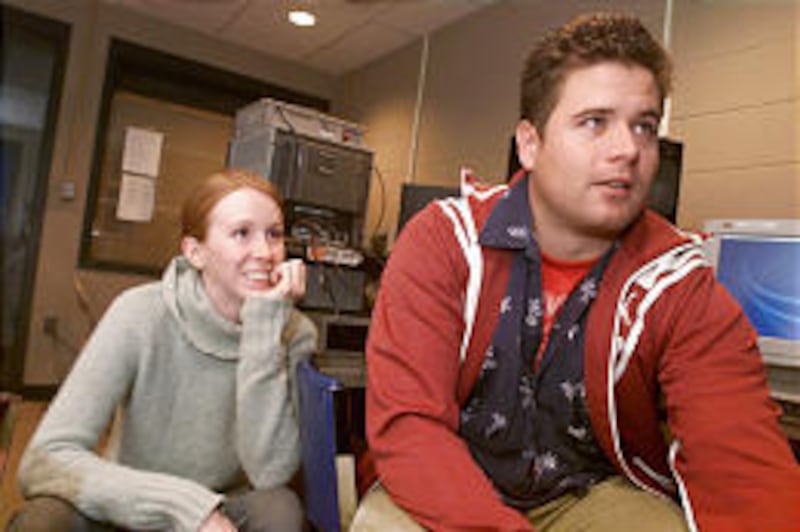
BOZEMAN, Mont. — John Shier has backpacked more than 100 pounds of camping and camera gear into the mountains to videotape grizzly bears in the wild.
Sara Slagle has hiked 23 miles into the most remote section of Yellowstone National Park to get one interview — and hiked out with plastic garbage bags on her feet after her boots froze.
Praveen Singh has spent a night up in a tree in the jungles of India — almost too afraid of getting eaten to turn on his camera — to film a leopard feeding.
It takes the curiosity and intellect of a scientist and sometimes the daring and determination of Indiana Jones to be a student in Montana State University's graduate program in science and natural history filmmaking.
The program's first students have reached their third and final year. They have traveled as far as Australia, Argentina and Afghanistan. Already they're racking up some remarkable footage and recognition.
Shier recently won the Michael Brinkman Emerging Filmmaker Award at the 2003 Jackson Hole Wildlife Film Festival. Student Tracy Graziano has received a $2,000 grant from the American Wildlife Research Foundation to pursue her dream of making a film about coyotes. And the program was recently featured in The Chronicle of Higher Education for offering a unique educational program.
The Brinkman award will provide Shier with four months' worth of equipment, worth about $100,000, to make a film about the Gobi bears of the Mongolian desert.
A longtime filmmaker himself, program director Ronald Tobias has made 15 hours of science and natural history films for the Discovery Channel. He has traveled to remote jungles and mountain wilderness to make films about mountain lions, wolverines, wolves and the Amazon's piranhas and anaconda snakes.
He has stood in a vampire bat cave where the floor was covered with a pool of blood. He has squatted bare-chested in a Brazilian jungle village and had natives decorate his body with hand prints, as the photos on his office wall attest. He has come home from expeditions with malaria, dysentery and mystery infections.
Still, Tobias misses it and would like to get back out in the field and do what his students are doing. He has one proposal out to the BBC to work with a scientist in New Guinea who's studying the world's largest varanid lizard, known as a tree crocodile.
"People call it 'death from above,' " he said. The adults have never been filmed, perhaps because this is in head-hunting territory.
The Brinkman award means that in addition to spending three months filming bears in Mongolia, Shier can spend a month filming brown bears in Alaska in Katmai National Park. That's the same park where bear lover, author and filmmaker Timothy Treadwell and a female companion were recently killed and eaten by bears. Treadwell was trying to show that bears are harmless.
Shier said he works differently. He won't camp on a path next to a salmon stream, or in a brushy area where the bears can't see him from a distance.
"Basically he violated every rule," Shier said. "I'm aware, alert. I realize dangers are there."
Shier, 26, studied engineering at Marquette University in Wisconsin and was heading to a job with a Seattle computer firm after graduation. Then one day he spotted the MSU natural history filmmaking program's eye-catching poster — a snarling cougar with a roll of film flying out of its mouth. He said he is happy with his choice.
"I remember being in Yellowstone. I thought, 'Holy cow, I could work 24 hours straight and it wouldn't feel like working.' "
He is passionate about filmmaking for other reasons, as well.
"Of all the arts, film can incite the most emotion in viewers," he said. "If you want to effect change in people's perceptions of the environment, you've got to affect their hearts."
It was over $6 beers in a bar in Sweden that the idea for an innovative filmmaking program first bubbled up. Tobias recalled a colleague saying that the people who make films about science and nature really ought to have a background in science and nature.
"It's no secret there's a gulf of incomprehension between scientists and filmmakers," Tobias said.
Filmmakers have resisted working closely with scientists, partly out of fear the scientists will meddle. So filmmakers tend to show up with a camera, grab a quick talking-head shot and leave to finish their film — often inserting conclusions that the scientist would never have made. The scientist feels misquoted and misrepresented and that his reputation is in danger.
"Too many filmmakers made enemies in the past," Tobias said.
To Discovery executives, he pitched the idea of a program that would train scientists to be filmmakers.
"I said the magic words — 'This would be the first in the world.' "
Students who apply have to have a degree in science, engineering or technology or at least a minor in the sciences. Now the program gets so many applications, it accepts only one student in five.
By the second year, students must make a professional-quality film that will be broadcast on TV, used in a museum or in some other significant way. And they have to raise the money to pay for it.
In the third year, students have complete creative control to make the films they want to make.
One goal of the program, Tobias said, is to get natural history filmmakers out of their rut. For about 100 years, they've stuck to a straightforward format: make an argument and prove it with pictures. He urges students to try new methods, such as showing images with no voice-over, or first-person story telling, or using actors and recreations.
Sara Slagle, 25, has up on the editing screen one of her interviews with the self-proclaimed king of slime, scientist Bill Costerton, head of MSU's Center for Biofilm Engineering.
She is finishing a 25-minute film on biofilms and the role they play in cystic fibrosis, a disease that produces excess mucous in the lungs. It often kills victims in their 20s or 30s.
Slagle has followed a 15-year-old girl from Billings in her daily battle to breathe, to show how bacterial infections make the disease even more miserable, and how scientists are fighting back.
Costerton is enthusiastic about the filmmaking program.
"Reporting on science is really difficult," Costerton said.
Scientists tend to feel that everything they say gets twisted or misconstrued in sound bites. The MSU student filmmakers, he said, are instead explaining science by using a strong human-interest hook — a girl fighting a terrible disease — and then educating viewers with accurate information.
"This is the very best way for science to get interpreted," Costerton said. "We get to explain what we're doing and why."