

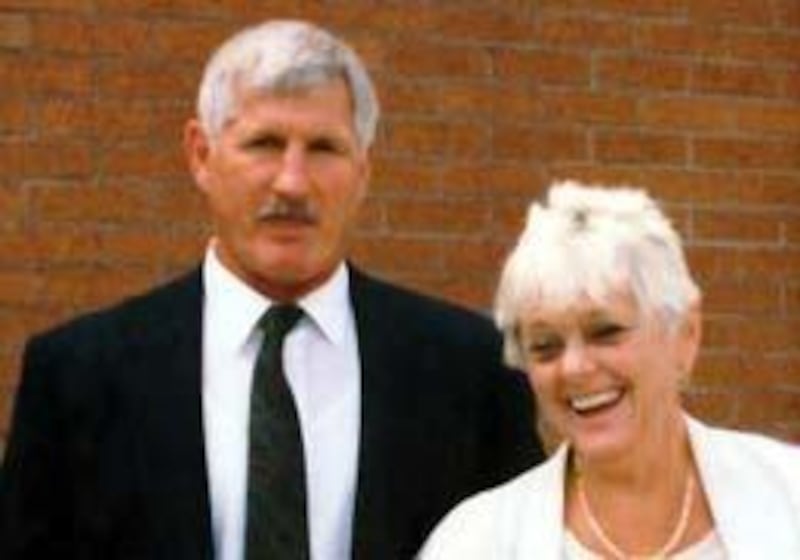
It's been two weeks since Fred Whittingham died, and I still can't believe he's really gone. Put death and Whittingham in the same room, one-on-one, and I would have given death only even odds.
Whittingham was that tough. He was a man's man and a coach's coach. He was exactly the kind of guy you picture when you think of an old-school NFL middle linebacker, which is what he was. This is all you need to know: Teammates nicknamed him Mad Dog.
He was the quintessential coach. He played the game. He coached the game. He was intense and obsessive about the game. Whittingham was never a head coach at the college or pro level and never should have been. Head coaches are more CEOs and public-relations frontmen than coaches, and PR was never Whittingham's strong suit. When a reporter wrote something he didn't like, he told the reporter, and usually not in a nice way.
He was a made-in-the-USA original, bigger than life. He looked like he walked straight out of central casting, with a handsome chiseled face, a mop of iron hair, a graying mustache, and thick, sloping shoulders.
He had a low, raspy voice and a full set of teeth, but only because there were replacements for the ones he left on football fields. His knees were shot, and he walked as if he had shards of glass in his shoes.
His body was a wreck.
I wrote this about him in 1992: "The knees that once chased Gale Sayers are chronically stiff and sore. . . . He has arthritis, pain in his neck and a herniated disk in his back from smashing into the likes of Jim Brown. The fingers he used to grab Bart Starr, Johnny Unitas and Fran Tarkenton are permanently bent."
The pain registered clearly in his face.
Recently, he told his wife, Nancy, "You cannot imagine the kind of pain I have every single day."
He underwent surgery earlier this year to relieve the back pain, another football legacy. Bone spurs were growing into his spine. The surgery didn't do the job. He grew increasingly immobile and had trouble walking. Says Nancy: "It came down to him saying, 'I've got to take a chance.' He didn't want to be in a wheelchair. He thought (surgery) would help him walk."
He underwent more surgery. Afterward, he was lying in his hospital bed, chatting with Nancy, when he suddenly sat up and leaned on one elbow, staring straight ahead at the wall.
"I'm going to die," he said.
Flabbergasted, Nancy asked him what he meant by that. "I'm going to die," he said again, then he sank back into his pillow and passed away, gone at the age of 64.
"That was it, no pain, no grimacing, nothing," Nancy said.
So football ultimately cut short his life, you could say (the official cause was a blood clot). Whittingham would say it was worth it.
Years ago, he told me, "I had a great time. It's hard to explain. I loved playing the game, I loved preparing for games, I loved the camaraderie. I miss it."
And this was 23 years after he had retired.
"That was his life," Nancy said. "He said there were only two things he was good at — changing oil and football."
Everything about Whittingham seemed to have been lifted from a Hollywood script, starting with the way he came into the world right up to the way he left the world. He was in and out of foster homes before his first birthday, and then he was adopted.
"That leaves a scar they can't erase," Nancy said.
He grew up with a deep wild streak. At 16, he and his buddies stole a car and drove to Florida. When they ran out of gas, they hopped a train, hiding in freight cars. They survived by stealing milk from doorsteps and bread from delivery trucks. Midway through his senior year of high school, he bolted on another cross-country trip, during the football season.
College coaches coveted him, but couldn't touch him, not with his history and grades. He wound up at, of all places, Brigham Young University, where he smoke, drank, fought and played football, not necessarily in that order. Someone suggested he take his aggressiveness to the boxing ring. He won all 21 of his fights, 15 by knockout, and claimed the heavyweight division of the Golden Gloves tournament.
He lasted two seasons at BYU before it was mutually agreed that he would fit in better elsewhere. After finishing school at Cal Poly, he played in the NFL. He played in an era when muscles weren't manufactured with drugs, and they played on real grass, in outdoor arenas, in snow and mud and rain. It was the romantic era of the NFL, with Lombardi, the Packers, Halas, Butkus, Merlin Olsen, the Fearsome Foursome and Purple People Eaters.
"They were a different breed then," Nancy said.
Whittingham played guard, defensive end and linebacker in three seasons with the Rams. During the next seven years, he played linebacker for the Eagles, Saints and Cowboys. In one game against the Vikings he collected 19 tackles and was named NFL Player of the Week.
"He reminds the beholder of the stands-up, fists-extended breed of pugilist that vanished with the buffalo," wrote one sports writer.
After the injuries and surgeries took their toll, Whittingham retired as a player and did the next best thing to stay in football. He coached for nine years at BYU, then the Los Angeles Rams, University of Utah and Oakland Raiders.
To his players and the boys who grew up in his shadow, Whittingham seemed indestructible. That's why his death was a shock — You mean Whittingham dies like everyone else? Even Nancy, using football terminology, called it, "The ultimate blindside." Only Whittingham saw it coming.
One young man who grew up down the street from the Whittinghams, wrote these words while trying to come to grips with Whittingham's death: "Big Fred, you might as well tell me Everest is flattened, and so I move from standing to sitting. A low voice, gravely like a slow rolling earthquake, hissing at some mysterious past and path to Provo, we all called him Big Fred . . . it was not a description for the sake of identification, it was a fact screaming for acknowledgement, a fact of life. He seemed immovable, massive, towering, always larger than life to me. . . . And this perhaps is the special shock of this loss. The dust settles and we now find, unimaginable, quiet."
He tended to scare people at first with his intense, menacing aura — "You were afraid of him, and you didn't quite know why," Nancy said. "There was a presence about him. But people were soon drawn to him and revered him. As a coach, he was tough, fair and smart."
It was generally assumed that Whittingham mellowed a long time ago, and Nancy agrees — "Yeah, he mellowed out — about three years ago," she said, and she laughs uproariously at this.
Whittingham was still lifting weights almost daily to the end.
The only place he mellowed was at home. When the five kids started to arrive, he decided to clean up his life to set an example. He was still rough and gruff around the edges, but the fiery intensity on the field was not carried into the house.
"He was always a good dad and a good husband," Nancy said. "He became a model dad. He was involved. I don't think he ever struck (spanked) one of our children, although he could yell pretty good sometimes."
Looking back a few years ago, Whittingham told me: "If it hadn't been for football, I'd never have gotten to college, I never would have coached. Who knows, maybe I would have gone from bad to worse. But I think I knew all along where I wanted to go."
Maybe now he's there. Heaven help them.
As one former player wrote to Nancy, "Satan is quaking in his boots. Fred's on his way."
E-MAIL: drob@desnews.com