
BOULDER, Colo. (AP) — Jack the Rabbit cites the unrelenting pressures of maintaining a "bicoastal relationship" with Foxy the Fox because their respective flight schedules keep them apart.
Then, Larry the Lynx cuts through the spin.
"She turned you down again?" he asks.
"Bingo," Jack responds. "Don't tell the gang."
Jack hopes his dating woes stay under the radar. But the underlying message in the Frontier Airlines TV commercial is hardly a secret as the Denver carrier pushes to become the No. 1 choice for travelers.
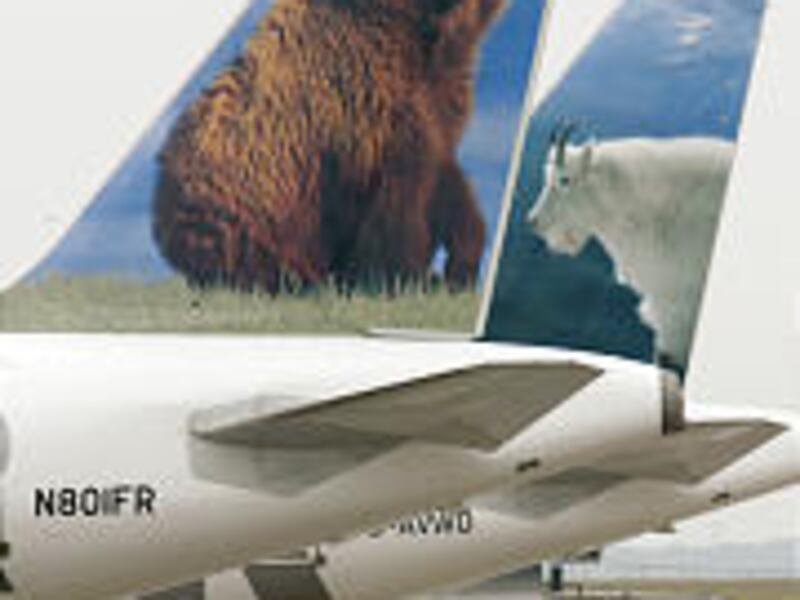
The airline's campaign, dubbed "A whole different animal," is the creation of Boulder-based Sterling-Rice Group, which persuaded Frontier to bring the animals painted on the tails of its planes to life and to overhaul the airline's overall philosophy.
"Everything that is visible is sort of a result of the work we did," says Rick Sterling, who started the brand development and marketing firm 20 years ago with Michael Rice. "This has had the most profound impact on a company of anything we've done — and the fastest."
Frontier passenger loads in October were up for the fifth straight month, and they were up nearly 53 percent from October 2002. The company recently reported a profitable fiscal second quarter 2004, an improvement over the string of quarterly losses dating to March 2002.
Things are looking up since "A whole different animal" began.
"We're really starting to see the fruits of our labor," says Ian Arthur, Frontier's senior director of marketing and branding.
"The organization literally turned itself around 180 degrees," says Buddy Ketchner, a managing director and partner at Sterling-Rice who spearheads the Frontier account.
In just nine years, Frontier has grown into Denver's second largest air carrier, with 3,800 employees and more than 90 nonstop flights around the country.
The company viewed itself as a "spill carrier," meaning it copied United's routes and undercut United's prices to pick up customers.
Frontier's image became so dated that ads and branding continued to push the company's "Spirit of the West" slogan, even though routes now went well beyond the region. Pressures were also mounting in an industry reeling from Sept. 11, looming military action in the Middle East, bankruptcies and the rise of low-cost carriers and Internet deals.
Enter Ian Arthur, who joined Frontier in March 2002 and mapped out a plan. Priority No. 1: find a firm that could conduct research for a company that previously hadn't done much.
In the summer of 2002, a request for proposals led him to Sterling-Rice, a 60-employee firm known for its work with Frito-Lay, Kellogg's, Kraft Foods Inc., Longmont's Horizon Organic Holding Corp. and Louisville's Rock Bottom Restaurants.
Sterling-Rice interviewed 21 Frontier officers and directors, met with more than 200 employees and conducted an in-house survey that 650 employees answered. At the same time, it ran focus groups with Frontier customers, as well as a general survey of 10,000 consumers.
The results: 60 percent of Frontier's fliers actually were business travelers, far from the 20 percent some top-level Frontier execs expected. Fliers also wanted a different experience, one distinguished from the delays, rude customer service and overpriced fares they believe plague the industry.
Consumers said Frontier's strengths included value, friendliness and respect, things the internal survey revealed employees believed they could deliver. Frontier, Sterling-Rice found, had an opportunity to become a "carrier of choice" — the first option in the minds of travelers.
People who were surveyed also said they loved the animals Frontier was painting on new Airbus planes the company was buying to replace its aging Boeing fleet.
Business travelers liked telling their children which animal flew with them. Leisure travelers enjoyed guessing which animal would join them on their trip.
"You found this wellspring of emotion right under the surface that was really, really positive," Ketchner says.
A whole different animal was born. "It gave (the animals) meaning, that's what it really did," Arthur says.
One commercial touts the company's deal with DirecTV, providing 24 channels on flights. Jack, a self-described purist, prefers TVs with rabbit-ear antennas. The ad shows how Frontier uses its personable characters to illustrate its changes.
The ads were part of Arthur's second phase, getting the message out.
Sterling says the concept, presented to Frontier's employees at the Denver Zoo in May, created a sense of unity.
"People didn't feel like they were on the same page," he says. "A whole different animal" brought them to one, he adds.
Arthur calls it the third phase, one changing Frontier's approach from selling seats on planes to delivering fliers an experience. Sterling-Rice is helping Frontier create action plans for every company department, be it a plane cleaner, a ticket agent or a luggage handler, to do just that.
"What we needed was a brand promise and a brand proposition," Arthur says, naming affordability, accommodation, comfort and flexibility as the four keys to Frontier's. "We believe we can deliver that."