

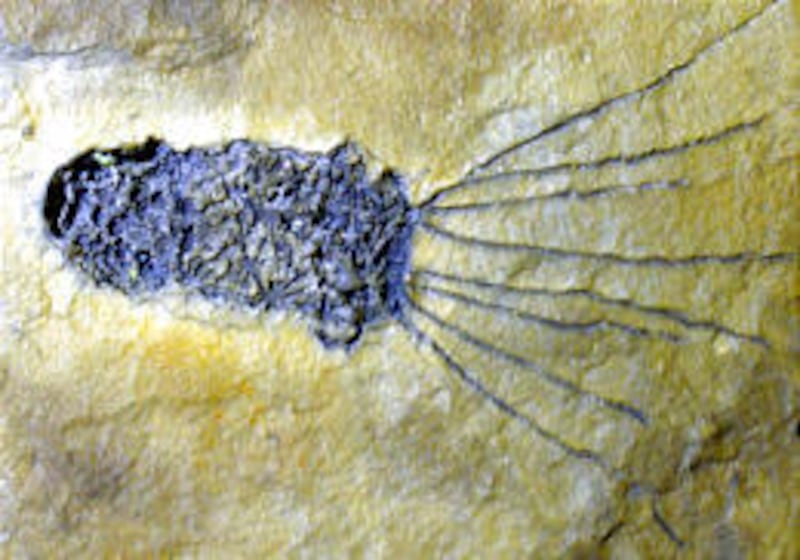

BRIGHAM CITY — The Gunther family has turned a lifetime's passion for fossils — make that three lifetimes' passion — into scientific discoveries, fabulous collections and a tidy Internet business.
They are Lloyd Gunther, 86, the retired former manager of Bird River Bird Refuge; his son Val, 53, retired from Thiokol and now with a start-up company; and his son Glade, 29, who works at Alliant Techsystems.
Their company, Geo-Tools.com, outfits others who are mesmerized with the world of the Middle Cambrian, the era more than half a billion years ago when trilobites and their predators ruled the oceans. The business is at (http://www.geo-tools.com/index.htm.)
The Gunthers carefully follow the law, which allows people to collect invertebrate fossils like trilobites on public land for their own amusement.
Their Web site shows off photos of beautiful fossils and sells specialized equipment for cracking open shale to discover the remains of this ancient life: brick hammers, chisels, backpacks to tote rocks and magnifying glasses to study the small imprints.
"We put our Web site up in January, but it was slow getting started, and we made our first Internet sale on the last day of May," said Val. The three were interviewed in Lloyd's Brigham City home.
Since then, business has picked up and they often ship out six or eight parcels a day. "We send stuff all over the world, so it's really taking off," he said.
Lloyd began collecting fossils 72 or 73 years ago when he was a Boy Scout. His Scoutmaster took him rock-hounding and he was hooked. Val has been climbing mountains and hiking up desert slopes in search of fossils for 47 years, since he was 6.
"And Glade has been out collecting with me since he was about 5 years old," Val said. "And so between the three of us, we have about 145 years of experience."
Glass cases hold beautiful examples of creatures that crawled about the ocean floor 530 million years ago, trilobites with long spines or the clam-like remains of animals that were like shrimp with shells. Below the cases are row after row of wooden drawers, and inside these are hundreds of labeled specimens. But they once had many more.
"Our collection of more than 130,000 specimens, which had really outgrown us, was all being stored here at my Dad's house. And about two years ago we decided that we really ought to get rid of the collection," Val said. They turned it over to the Anasazi Cultural Resource Foundation of Ivans, Washington County, for eventual display.
Meanwhile, many other museums and research institutions around the country hold discoveries by the Gunthers, including Yale University.
"We don't keep anything rare in our possession, because we feel like those are kind of national treasures," he added. "Everyone needs to benefit from it. Things that are common, we'll keep."
The rarities go to researchers, who frequently discover that the Gunthers have found some animal new to science. When that happens, they may describe it in a scientific journal and name the beast after them.
"There are 13 new species described in our family's honor," Lloyd said.
"There are many other that are in the process of being worked on," Val added. When a species or, as in one case, a whole genus of animal is named for them, "that's kind of a nice reward for donating things to science, too."
To some, the rewards may seem a skimpy return for the years of tough labor breaking open rocks in remote localities. People might think it's chain-gang type work, Glade commented.
"Most people look at us like, 'You go out and break rocks, try to get fossils out of it, and that's fun to you?' " he said.
Sometimes the work is dangerous, too.
One winter, Val and Glade were in nearby mountains heading toward a Middle Cambrian locality. "We were trying to climb up a very steep ledge," Val said.
"I'd gone up first, but because I went up before him and there was a light covering of snow, it turned the trail behind me into mud."
When Glade tried to follow, he found the trail too slick. Instead, he decided to climb over a ledge and work his way up over the rock face.
"Right at the top," Val began.
Glade continued the story: "I had a wizard bar," a wrecking bar that is used to pry up shale. He reached the bar up to hook onto a rock at the top of the ledge.
"As I lifted myself up, that rock came loose. And actually the thing that hurt the worst was my pry bar hit me on the head."
When the rock broke away, Glade fell 15 or 20 feet. "And then I hit, and then I kind of fell again, and the last about 20 feet I just kind of slid and got bloodied up. I didn't break anything."
A true explorer of the Middle Cambrian, he dusted himself off and continued collecting that day. It hurt, he said, "but it didn't stop me from collecting."
E-MAIL: bau@desnews.com