

Utah's food supply is safe from mad cow disease, the Utah Department of Agriculture and Food said Tuesday after the federal government announced that a cow in the state of Washington was suspected of having the disease.
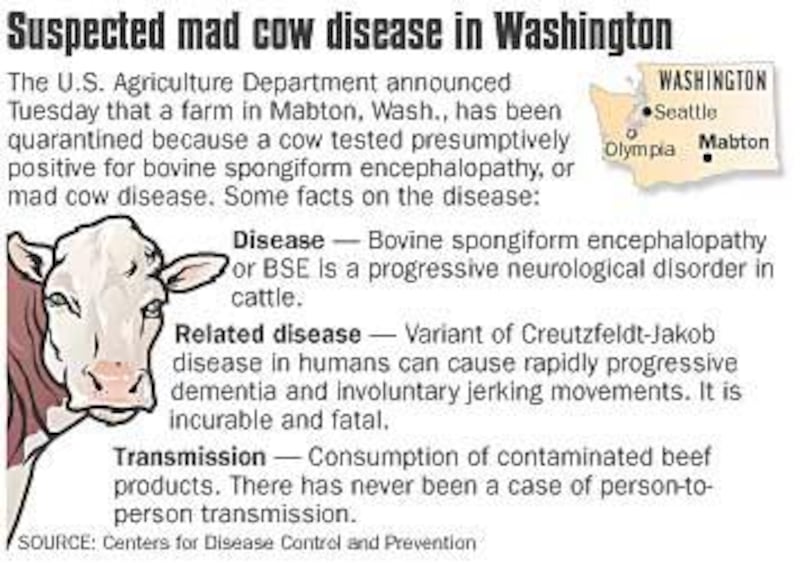
At a news conference Tuesday, U.S. Agriculture Secretary Ann Veneman confirmed that the first-ever U.S. case of mad cow disease was suspected in a cow about 40 miles southeast of Yakima. A tissue sample from the cow, a Holstein, was taken on Dec. 9 to a lab in Iowa, where it returned a "presumptively positive" result for the bovine brain-wasting illness.
The animal was never destined for the U.S. food supply, Veneman said during the news conference, reiterating that the food supply is safe and the incident was "not terrorist-related."
Still, some allies like Japan and South Korea temporarily banned imports of U.S. beef, providing an early indication of the potential economic damage the discovery could cause.
"Even though the risk to human health is minimal, we will take all appropriate actions out of an abundance of caution," Veneman said.
But, she added, it is "too early to at this point to say whether or not this will be an isolated case." Utah Department of Agriculture and Food spokesman Larry Lewis called for patience while the tests are being completed.
Utah Department of Agriculture and Food spokesman Larry Lewis called for patience while the tests are being completed.
"It is not a confirmed case yet," Lewis said. "We need to wait until we know more."
Fear of the disease has brought economic ruin to beef industries in Europe and Canada.
A form of the disease can be contracted by humans if they eat infected beef or nerve tissue, and possibly through blood transfusions. The human form of mad cow disease so far has killed 143 people in Britain and 10 elsewhere, none in the United States. Blood donors possibly at risk for the disease are banned from giving.
But, Lewis said, "our food supply is safe in Utah. We do many things to prevent mad cow disease from entering the state."
Every animal slaughtered for human consumption is inspected by a state veterinarian who looks for physical symptoms of the disease, Lewis said. Animals transported on Utah highways are accompanied by veterinarian certifications of health.
Utah farms and ranches have about 900,000 cows, including dairy and beef cattle, Lewis said. Cattle products constitute three-fourths of Utah's annual livestock revenue, which is estimated at $500 million.
"At this point, it's a presumptive positive," Lewis reiterated. "And at any rate, we don't have it. We've been on guard since the 1986 outbreak in Great Britain."
Veneman said the slaughtered cow was screened earlier this month and any diseased parts were removed before they could enter the food supply and potentially infect humans.
Mad cow disease, known also as bovine spongiform encephalopathy, eats holes in the brains of cattle. It sprang up in Britain and spread through countries in Europe and Asia, prompting massive destruction of herds.
"We remain confident in the safety of our food supply," Veneman told a hastily convened news conference. The farm near Yakima where the cow originated has been quarantined as officials trace how the animal contracted the disease and where its meat went.
Wary of the potential economic impact on their American market, beef producers quickly sought Tuesday to reassure consumers that infected meat wouldn't reach their tables. "There is no risk to consumers based upon the product that came from this animal," said Terry Stokes, chief executive of the National Cattlemen's Beef Association.
President Bush was briefed a few times on the development Tuesday and was confident Veneman's department handling the matter properly, the White House said.
With an election year approaching, the news concerned some in Congress. Rep. Tim Holden, D-Pa., a member of the House Agriculture Committee, said he expected lawmakers to hold hearings when they return to Washington in late January.
"We're going to look into this and see the possibility of how this happened," Holden said. "I'm sure there will be extensive oversight hearings to see what we can do to assure the American people the safety of the food chain."
Lawmakers are keenly aware that a case of mad cow disease in Canada last May — which officials described as a single, isolated incident — still had devastating economic consequences.
"If it's anything like what happened in Canada, it will be bad. The problem won't be that people will stop eating meat in the United States; the problem is the exports will be shut down like we did with Canada," said Rep. Collin Peterson, D-Minn.
Veneman said the Holstein, which could not move on its own, was found at a farm in Mabton, Wash., about 40 miles southeast of Yakima, and tested preliminarily positive for the brain-wasting illness on Dec. 9. Parts of the cow that would be infected — the brain, the spinal cord and the lower part of the small intestine — were removed before the animal went to a meat processing plant.
Samples from the cow have been sent to Britain for confirmation of the preliminary mad cow finding, Veneman said. The results will be known in three to five days. Veneman said consumers can get daily updates by reading the department's Web site or by calling 1-866-4USDACOM.
She said tests are made of all downed cows — old cows that are not mobile — that are sent to slaughterhouses.
But Rep. Gary Ackerman, D-N.Y., said such cows shouldn't be in the food supply in the first place. The Senate passed such a ban earlier this year, but it failed to make it through the House.
"I blame it on greed, greed, greed," Ackerman said. "The greed of the industry, the greed of the lobbyists and the greed of the members of Congress."
Veneman said the Agriculture Department has had safeguards in place since 1990 to check for mad cow disease and 20,526 cows had been tested in 2003 in the United States.
"This is a clear indication that our surveillance and detection program is working," Veneman said.
U.S. beef remains "absolutely safe to eat," she said.
"We see no reason for people to alter their eating habits," she said. "I plan to serve beef for my Christmas dinner."
E-mail: jnii@desnews.com