

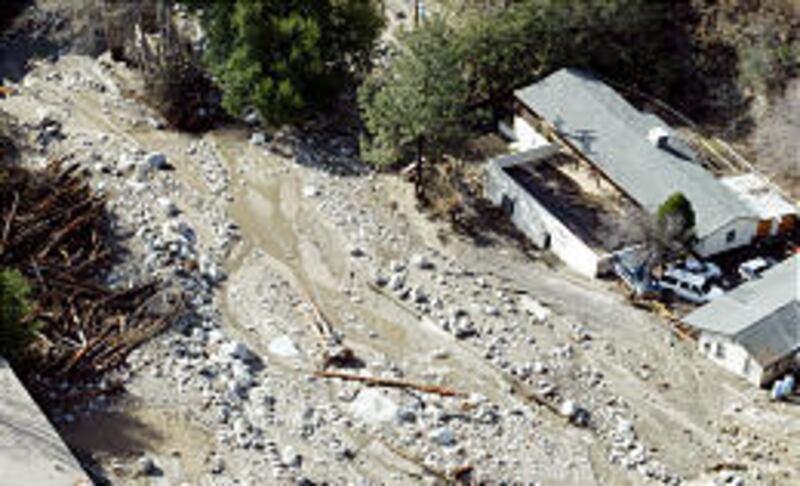
SAN BERNARDINO, Calif. — Slogging through debris fields of mud, rock and tree limbs, searchers on Friday found the bodies of seven people who were carried away by a Christmas Day landslide on the charred slopes of the San Bernardino Mountains. At least nine other people remained missing, most of them children, and hope was beginning to fade.
"There's some reality setting in for us today," San Bernardino County Fire Marshal Peter Brierty said as he helped oversee the search efforts at a church camp and a KOA campground that were inundated by the slide. "We want to be optimistic and save lives, but time is our enemy."
The mudslide was a tragic postscript to the fires that devastated vast swaths of forest and brushland in late October and early November. Beginning early Thursday afternoon, torrential rains unloosed tons of muck on mountainsides left barren by the fires and sent it plunging down creek beds and canyons.
Fire and rescue officials surveying the damage Friday calculated that the slide — which in places had been a 6-to-12-foot wall of mud carrying boulders and entire trees — had been traveling as fast as 45 mph, giving people little opportunity to get out of its way.
"It's unbelievable up there," said Brierty. "There are 75-foot logs stacked like matchsticks. Boulders the size of Volkswagens scattered like pebbles. Old concrete bridges knocked down because they could not take the stress of the debris flow."
"How much energy," he asked, "does it take to wash out a concrete bridge?"
Five of the bodies found Friday were down the slope from the St. Sophia Camp, a rustic retreat in Waterman Canyon that is owned by the Greek Orthodox Church.
Fourteen people were rescued from the camp Thursday, but nine remained missing a day later. At least nine children, who apparently were playing in a playground, were believed to be among the missing or dead. Among those unaccounted for were the camp's popular caretaker, his wife and three children.
The other two bodies were found near a KOA campsite in Devore. Fifty-two people had been rescued there overnight after being stranded by a flooded creek. The dead were identified as Carroll Eugene Nuss, 57, and Janice Bradley, 60. Nuss was believed to have been visiting the area from Kansas; Bradley was the manager of the campground.
Beginning Friday morning, a helicopter and up to 90 people, many accompanied by trained dogs, began searching for the missing in Waterman Canyon.
They strode along the bed of Waterman Creek, staring at the ground and peering into crevices created in debris piles, over and under logs and boulders, even into branches of trees left standing. One rescue worker could be seen yanking soggy clothing out of the muck and piling it on a boulder. In some places, cables were drawn across the stream, reduced to a modest flow by sunrise, to ease crossings on foot.
The camp had been a happy place in the hours before the slide. A group of mostly Guatemalan immigrants had arrived for a Christmas tamale lunch as guests of the camp's caretaker, Jorge Monzon, and his family. After lunch, while adults cleaned up and children cavorted at a small playground near the creek, the sky darkened and rain, which had been falling all day, picked up in intensity.
At about 1 p.m., Clyde Chittenden, a California Department of Forestry battalion chief who lives in the canyon, drove past the camp on his way to a Christmas dinner. After passing the camp, he said, he looked up from his steering wheel and "saw a wall of mud coming down the creek." At that point, he said, the mud was still in the creek channel and the camp was apparently still unharmed.
But sometime before 2 p.m., the mountainside came crashing down.
Among the missing Friday were Monzon, his wife, Clara, and their three children, Wendy, 17, Racquel, 10, and Jeremiah, 6 months.
The Very Rev. John Bakas, dean of St. Sophia Cathedral in Los Angeles, agonized about the fate of the caretaker, who has worked at the camp since 1997.
"We haven't been able to reach them," Bakas said. "We're terribly distressed. On Christmas Day! I still haven't quite come to grips with it. I keep thinking it's something that happened someplace else."
The bodies found in Waterman Canyon were mostly in the lower half of the two-mile slide area, tangled in trees, mud and brush, making it difficult for searchers to remove them. They were not immediately identified.
The search effort was expected to last through the night, and some of those taking part said they were still looking for survivors, not bodies, despite daunting conditions that included overnight temperatures in the 20s.
"Human will, whatever you want to call it — you can survive this," said Jon Usle, a volunteer with San Bernardino County Search and Rescue. "With a little knowledge and some dumb luck, you can make it."
But others sounded notes of futility. "It might be weeks until we find them," said one San Bernardino County firefighter, who declined to give his name.
Dennis Benson, a sheriff's search and rescue volunteer, was among those who went to the slide area Thursday night. He said the flooding ran as high as 20 feet and sounded "like a highway of water."
He returned Friday with a dog and said the search was difficult because of the large area and the debris left by the massive force of the slide. "To see the damage done to the trees and the concrete," he said, "and to imagine what that force could do to a person . . ." He trailed off, not finishing his thought.
Weather officials said 3.5 inches of rain had fallen in the area Thursday. However, Bill Breer, an amateur weather observer whose home just above the camp is one of the few to have survived the fires, said his rain gauge showed that 6 inches had fallen during the day.
"It wasn't the hardest rain I've ever seen," added Breer, who has lived in the area since 1970. "But I've never seen that little creek run like that."
The Saint Sophia Camp and Retreat Center has been operated by the Greek Orthodox Church for about 40 years, Bakas said. It has been used for both youth and adult retreats. When it is not used for church activities, the camp is rented to outside community groups for retreats, conventions, weddings and other functions.
At the time of the mudslide, Bakas said, "The only authorized persons there was the caretaker and his family, who lived on the site."
The camp had been spared by the recent fires and was the lone patch of green in a blackened landscape. Beneath it, the city of San Bernardino splays out across the flats; above it, the walls of the canyon rise 1,000 to 2,000 feet.
Still visible Friday were about eight cabins along the creek, a tennis court, and swimming pool, all relatively unscathed. Other buildings that were more directly in the path of the slide were swept away.
Many of those visiting Monzon were members of his church, Iglesia de Dios de la Prophesia in San Bernardino. Nearly all the missing children were members of the church's Sunday school class.
Perry Skaggs, a committee member of the St. Sophia Cathedral, said the playground where the children were playing sits across an S-shaped creek from Monzon's motel-style home, where the adults were congregated. The location of the playground equipment, close to the creek, could explain why the majority of those declared missing were children, he said.
Skaggs said church officials were aware of the danger posed by mudslides in the aftermath of the fires. "We had done some sandbagging and we were prepared for what we could prepare for," he said. "But when something like this happens, there's nothing you can do. It was an act of God."
Contributing: Clare Luna, Lance Pugmire, Louis Sahagun, Larry Stammer, Julie Tamaki.