



Marc Ballard finally had power restored at his Cottonwood Heights home shortly before noon on Monday — more than 72 hours after it flickered off in Friday's massive snowstorm.
He and his family relied on a wood stove to stay warm and a generator to power its electric blower. "We were able to maintain about 60 degrees," Ballard said. He, his wife and his 18-year-old daughter slept in the family room under "every blanket we own."
Weather-wise, there's good news and bad news for the Ballards and thousands of other Wasatch Front residents. The good news: Snow is expected to taper off today. The bad news: It is expected to hit hard again either late New Year's Day or early Friday. (See story on Page B2.)
Ballard credits the family's camping skills for getting them through their three-day power-outage ordeal, which began about 4 a.m. Friday. But he said Utah Power could have handled the situation better. "We're not getting the type of service we used to," Ballard said, describing the trouble he had getting through to the power company.
"I'm not disgruntled at all with the Utah Power employees. I went to talk to the linemen today, to tell them, 'I appreciate you guys,' " he said, blaming
instead what he called the company's overly profit-conscious leadership.
Complaints from Ballard and thousands of other customers who lost power when the storm slammed into the state early Friday are apparently being heard.
On Monday, the top official of PacifiCorp, which operates as Utah Power in Utah, flew into Salt Lake City from the company's Portland headquarters to address the concern raised by outages that left 70,000 customers in the area without electricity and resulted in 1 million service interruptions.
"This is not an instance of equipment failure," Judi Johansen, president and chief executive of PacifiCorp, said. "This is an instance where Mother Nature has come in and dumped some extremely wet snow on our power grid and has caused these problems."
Compounding the problems was PacifiCorp's new automated outage management system, used to track power failures. Ballard was just one of many customers who had trouble reporting an outage.
By Saturday, the company had abandoned the software after it became apparent it was not working properly.
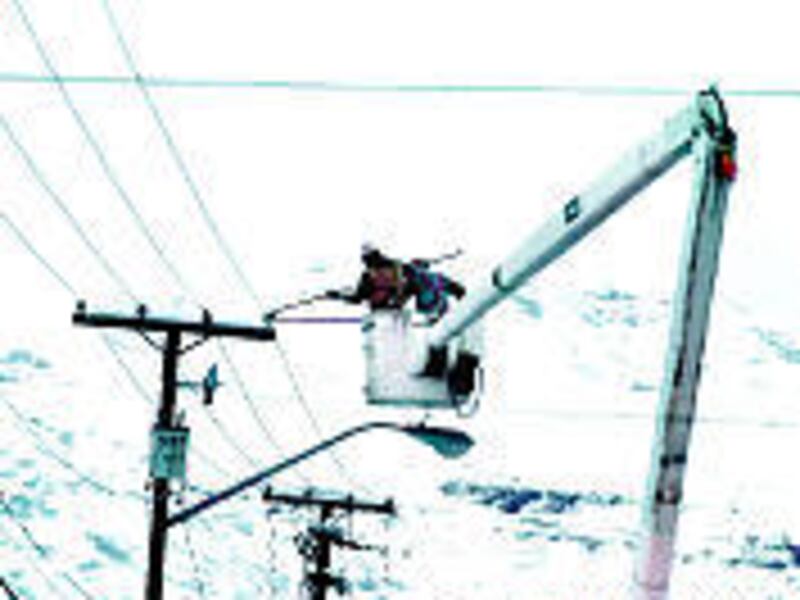
Johansen said that 63 crews, including some from Oregon, Washington and Idaho, were working the lines in Utah, restoring electricity to roughly 200 customers per hour. At that rate, electricity was anticipated to be completely restored by sometime today.
But Johansen cautioned that high winds on Monday preceding another storm could lead to further disruptions. As of Monday evening, about 1,600 customers — metered residences and businesses — were without electricity, most within the Salt Lake Valley.
The Red Cross shelter set up at the Sorenson Multi-Cultural Center in Glendale wasn't very crowded Monday afternoon. But workers were bracing for more people as the latest storm moved into the Wasatch Front.
Gail Milliken, 54, though, was ready to head back to the Terrace Apartments on Main Street, where power had finally been restored. She spent several days in the cold there until finally agreeing to come to the shelter Sunday night.
"I got exhausted. I was suffering from hypothermia," Milliken said. She described her apartment as "colder than the refrigerator." It didn't help that the building's elevator wasn't working, so she couldn't use her wheelchair to get to the building's lobby.
Nearby, Fred and Stephanie Trujillo and their family were preparing to spend yet another night in the shelter. They arrived four days ago, after the power went out at their west-side Salt Lake home.
"I drive by the house every day after work. I left both porch lights on," Fred Trujillo said. So far, the house has remained dark.
Salt Lake City resident Kent Jeppesen returned from a trip to his home on Green Street between 1400 and 1500 South on Sunday to find his power off and his car buried under a deep blanket of snow.
"It was like, 'Whoa, this is a nice gift,' " Jeppesen said sarcastically as he prepared for another bitterly cold night. All he has for heat is a gas fireplace that's "like a campfire. You roast on one side and freeze on the other."
In their Sugar House home, sisters Betty Coleman, 73, and Alice Morehouse, 88, were without power from 2 a.m. Friday to about 4:15 p.m. Monday. Earlier Monday, Coleman had ordered portable oxygen tanks for her sister, who suffers from congestive heart failure and had not used her oxygen machine since about 2 a.m. on Friday, when their power went out.
Despite numerous invitations to stay with family and friends, the two sisters decided to stick it out in their own home. "I like my own bed — even if it's cold," said Coleman, whose home temperature got down into the 50s at night.
During the day, the two wrapped themselves in feather quilts and sat in front of their gas fireplace, reading novels, talking and snoozing. Coleman even cooked meals over the fire. Neighbors checked on the women regularly and kept a path shoveled from their front porch to the sidewalk.
Coleman got a phone call through to Utah Power on Sunday but never mentioned that her sister was not able to use her oxygen machine without their electricity. "I figured we'd just wait our turn," said Coleman. "I used to be a customer service rep for Utah Power, and I know how hard they work to get things fixed for people."
Utah Power's restoration policy focuses first on higher-density areas in order to restore electricity to as many customers as possible. Next, attention turns to more isolated incidents, where pockets of individual customers are affected.
The moisture content of last week's winter storm was around 20 percent, according to Kimball Hansen, a spokesman for the company. A typical snowfall in Utah carries a moisture content of around 2 percent to 3 percent. The result: sagging and broken tree limbs that came into contact with power lines, resulting in the failures.
Johansen said the company in recent years has ramped up its tree trimming efforts. "The issue isn't so much our budget, it's getting access to the trees," she said, "making sure the landowner lets us in there."
Customers of Salt Lake County's only municipal power system fared comparatively well in the storm.
Gary Merrill, general manager of Murray City Power, said 600 to 700 of the city's 16,000 customers were without power for roughly six hours.
"We were very fortunate to have maintained our tree clearances," Merrill said. "We do a lot of preventative maintenance that helps us avoid having a lot of tree damage that otherwise would have been there."
E-MAIL: lisa@desnews.com;
Contributing: Barbara Jean Jones