


FREEPORT, Ill. — The living room of the little house is dark, illuminated only by a television he cannot see.
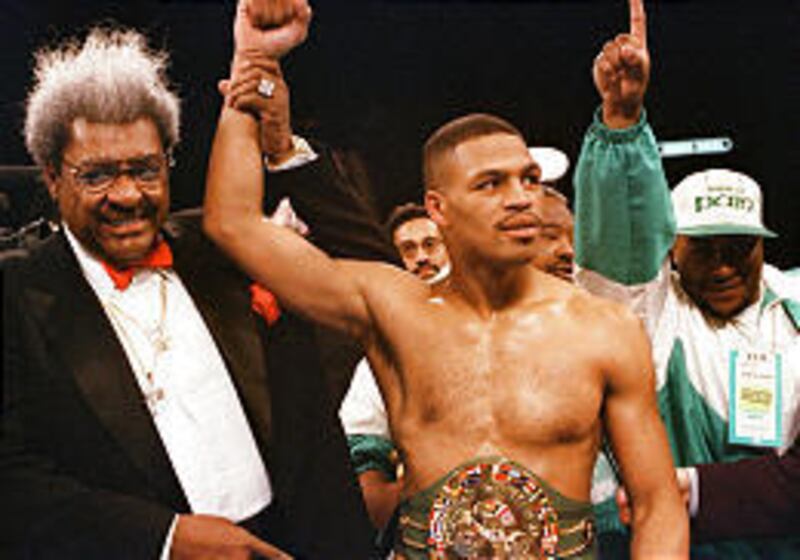
There was a time, not so long ago, when Gerald McClellan was one of the most feared fighters in the world. Now he sits on a couch, holding a visitor's hand as if he's afraid to let go.
"Squeeze me," he pleads. "Squeeze my hands."
I do just that. As McClellan squeezes back, questions tumble out.
"How long have you been here? Are you hungry? What did you eat today?
"You write? You a photographer? Are you Teddy?"
The large hands that knocked 29 middleweights out, many with just one punch, are still strong. McClellan keeps squeezing.
"You drive? What did you drive? What color is it? You got a favorite color?
McClellan pulls the visitor toward him.
"Closer. Come closer. Squeeze me. Squeeze.
"What color is air? Why don't air have a color? Does water have a color?"
The colors are all in McClellan's mind now, swirling amid a jumble of other thoughts he can't keep in order. His brain functions only in spurts, then quickly short-circuits.
He's blind, nearly deaf, and only recently has been able to use a walker to get around.
If McClellan could see, he might be reminded of what happened that night eight years ago when a world that had been so bright suddenly went dark.
In a nearby corner, his prized championship belts are in a display case. On the wall in front of him is a painting of the fight in London with Nigel Benn that ended so tragically.
McClellan is wearing shorts and a tank top. His upper body is still chiseled. Sitting there, at age 35, he almost looks as if he could fight today.
Then he begins to talk.
"Teddy? Is that Teddy?" he asks.
"No," his sister, Lisa, replies, "it's Tim."
"Tim? You write? Where are you from? Are you hungry? What is your favorite meal?
"Tim, come closer.
"Squeeze me. Squeeze me harder."
The G-Man was as ferocious as fighters come, a lanky 160-pounder with devastating power and a menacing aura that frightened people inside the ring and out. He had a stable of fighting pit bulls, a habit of knocking out opponents in the first round and took no guff from anyone.
McClellan was moody, snarled at the press and could be nasty to anyone he came across. On his right shoulder was a tattoo of one of his fighting pit bulls, "Deuce."
"He always had a gangster-type mentality," former trainer Emanuel Steward said. "He always wanted to be tough."
McClellan was also a sharp dresser, always concerned about how he looked. Once, before he fought Julian Jackson in 1994, he stood ironing his pajamas in his hotel room while taking questions from a reporter.
And he could be a soft touch. In Mexico City one day he emptied his pockets to give a beggar all he had.
Such a boxing talent that he beat Roy Jones Jr. in the National Golden Gloves as an amateur, McClellan likely would have gotten rich against Jones in a megafight had tragedy not intervened.
"It would have been one hell of a fight," Steward said. "They both had equal speed and moves, but Gerald was such a heavy handed puncher."
McClellan displayed that early in his career when he knocked out his first four opponents in the first round. By the age of 25, he was the middleweight champion, and three straight first-round knockout defenses merely added to his frightening aura.
On this summer day, he seems to remember that he used to fight. He seems to recall knocking people out.
"You smoked them," Lisa says.
"Like a cigarette?" McClellan asks.
He wants to know why he isn't still fighting.
"You're retired," Lisa says.
"How many years?"
"Eight years."
"The reason?"
"You got hurt. You know."
"Nigel Benn? Las Vegas?"
"No, London."
"Was I bleeding? Did I bleed? Whose fault was it?"
"His."
A rowdy crowd of about 11,000 had gathered for the night in the dank London Arena, hoping against hope that their man could do something against the fearsome American. It was Feb. 25, 1995, and McClellan was a heavy favorite to beat an aging Nigel Benn and take his 168-pound title.
It was the first time McClellan had really topped a card of his own — even though he had to go to Benn's hometown to do it. His purse was $250,000, though there was promise of a lot more against Jones if he won.
Benn knew McClellan's reputation well.
"He's the man who comes out and destroys people with one punch," Benn said.
McClellan was ready to do just that.
"I like to end my fights early," McClellan said before the fight. "That way there's no punishment, no wear and tear on your body."
McClellan, though, was troubled from the moment he arrived in England. He had split with his manager and trainer, and was overwhelmed trying to deal with the fight issues they used to handle. He gorged on cheeseburgers all through camp, but still came into the fight three pounds light.
He talked darkly about going to war, about not being afraid to die in the ring. In his dressing room before the fight, he wrapped his own hands, alone.
It shouldn't have mattered. McClellan was getting used to stopping fights almost before they began, and soon Benn was in trouble. McClellan hit him with a barrage of punches in the first round, including a devastating right that knocked Benn out of the ring.
The referee was an inexperienced Frenchman who gave Benn precious extra seconds to get back into the ring and clear out his head. To McClellan's amazement, he finished the round.
Even more amazing, Benn began holding his own. McClellan was still winning on two scorecards, but he was getting hit with rabbit punches on the back of his head that were hurting. His mouthpiece was dangling dangerously out of his mouth.
Watching on television from home, Steward knew something was wrong with his former fighter.
"It was the same mouthpiece he had his entire career and he couldn't hold it in his mouth," Steward said. "And when he came back to the corner hurt things got crazy. He was out there in the middle of a bad, bad war and he didn't have any team around him to tell him what to do."
Midway through the 10th round, he went down to one knee after an exchange. The referee began counting him out in French and McClellan got up at seven, blinking rapidly. Benn hit him with a series of punches and McClellan slid to the canvas, again on his right knee.
In the arena, 11,000 fans went wild as he was counted out, still on one knee. Benn celebrated, too, not noticing that McClellan had fallen off his ring stool and was now slumped in the corner, with doctors frantically attending to him.
"One of the most compelling fight nights you'll ever see," the Showtime television announcer intoned.
In the ambulance, McClellan was still coherent enough to take off his oxygen mask and ask what happened. But the swelling in his brain worsened, and by the time he got to the hospital doctors had to drill a hole in his head and perform four hours of surgery on a large blood clot before inducing a coma to try and stem the damage.
In the next cubicle over was Benn, who was hospitalized himself after the brutal bout.
Six weeks later, McClellan was airlifted to a hospital in Milwaukee. Six months later, he went home to Freeport, a grimy town two hours outside of Chicago where a rare visitor added some interest to a recent day.
"Who's here?," he asks.
"Tim."
"Teddy?"
"No, Tim."
"He a promoter?"
"No, he's a writer."
"Tim, come here, squeeze my hand. Harder.
"How old are you? What's your birthday?
"What's your favorite color? Are you hungry?
"What's your favorite meal?"
McClellan lives in a world of repeated questions and answers he can't remember. To talk, he likes to tap in rhythm on his knee, and the words come out with a singsong effect.
His life revolves around sisters Lisa and Sandra, who take turns caring for him, though he sees his 9-year-old daughter, who lives just a few blocks away, frequently. McClellan's two sons live in Detroit, where his youngest, 14-year-old Mandel, is following his father as an amateur fighter.
Lisa still loves boxing, and follows it closely. She sees nothing wrong with Mandel fighting, and neither, apparently, does her brother.
"We discussed Mandel's boxing the last time he was here," Lisa said. "I told Gerald he was in training, and he took a lot of interest."
On a typical day, McClellan will get up and have his favorite cereal, Fruity Pebbles, for breakfast. If it's a real good day, Lisa will take him to a nearby park, where he'll eat two quarter pounders with cheese from McDonalds.
Those burgers and grape soda are his biggest treat, though Lisa has cut off his pop supply.
"Is there grape pop?" McClellan asks.
"No pop," Lisa replies.
"Why? We don't have any?"
"G-Man, pop is bad for you."
"What color is grape pop? Does water have color?"
Sometimes at night, McClellan will talk on the phone to Lee Resnick, one of two twin brothers who read about McClellan on the Internet and struck up a friendship.
"He's kind of infectious. The more time I spend with him he just kind of pulls you to him," Resnick said. "I had heard he was a mean bastard before this happened. But he's such a sweet guy now, to me at least."
Lisa, who goes to night school to become a registered nurse, is stubbornly protective of her brother. She decides who gets to see him, and she helped organize a February fund-raiser for McClellan and fellow fighter Greg Page.
Basically, Lisa has given up her other life to take care of the G-Man.
"I think it's gotten easier as time has gone by," Lisa says. "In the beginning it took me a long time to adjust to not having the freedom to have a normal life. Even little things like going to the grocery store you have to do around his schedule."
McClellan's rehabilitation now begins and ends with his sisters. There's a treadmill to help him walk again, and there's conversation to stimulate his brain. No fancy machines or doctors with long credentials to help.
Few in the boxing community seem to care. Jones is traumatized by the thought of his brain-injured friend, but has said he won't go to see McClellan until his own career is safely over.
Joe Frazier once drove to see him and Gerry Cooney and 112-pounder Eric Morel attended the fund-raiser.
Fight photographer Teddy Blackburn has made it his personal crusade to keep McClellan's name alive, and brought him to New York last year to share an award from fight writers.
There, middleweight champion Bernard Hopkins met with him.
"It's like he's a baby," Hopkins said when he saw him. "And it's like he's 100 years old."
Blackburn knows it's painful for other fighters to see.
"When you see Gerald for the first time it will change the way you feel about boxing," he said.
There's no pension for fighters, and no funds for injured boxers, and Lisa worries about the costs of years of care. McClellan was a champion but in a world with fractured titles he never really made big money.
For the Benn fight, his purse was $250,000, but he came away with only $62,920.75.
By mid-afternoon on a recent visit, McClellan was growing weary.
"You're tired," Lisa says.
"Steve? Is that Steve?
"No, it's Tim.
"Tim, where are you staying? Stay here and rest. How long are you here?
"How tall are you? How much do you weigh?"
"What's your favorite meal?"
It was one of McClellan's better days, the kind that give Lisa hope.
"Something I usually tell people and they have a really hard time understanding is that considering everything he's been through, he's happy," she says. "He's content. He doesn't complain about what has happened to him."
Blackburn isn't so sure.
"Let's be honest, he really doesn't know where he is," he
said. "Reality is entirely different."
His sister, though, clings to the notionthat McClellan is making progress. It might be what she needs to deal with him daily.
"It was like this morning he was in a really good mood and I told him that," she said. "And he said 'It's because I love you.' You know, I've heard that a lot more in the last eight years than I ever did before."
On this day, Lisa's 15-year-old daughter Tyesha was in-and-out, before leaving to go to work at a local day care center.
"How old should Tyesha be before I let her go on a date," Lisa asks Gerald.
"She has to be 50," the G-Man replies.
McClellan wants Tyesha to hold his hand and talk to him. She doesn't have time.
"Uncle Gerald, I have to go now," Tyesha says, walking out the door.
"How old is Tyesha?" McClellan asks after she leaves.
"What grade is she in?
"Does she have a favorite meal?"