

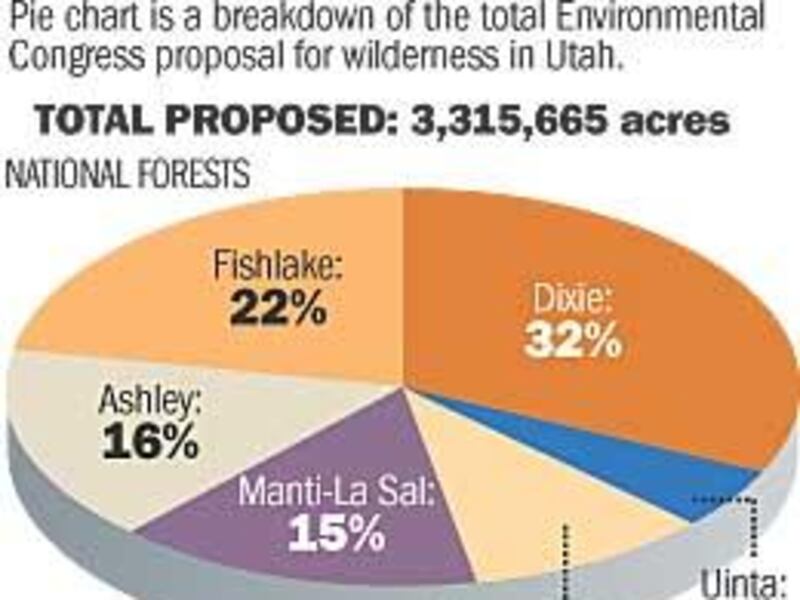
Proponents of wilderness in Utah's redrock desert country have been seeking 9.1 million acres, and now proponents of wilderness in Utah's high country are adding another 3.3 million acres to the total.
Utah Environmental Congress, a grass-roots environmental group, is to unveil today an ambitious and comprehensive initiative to protect 37 percent of "roadless" or undeveloped areas in national forest lands in Utah as wilderness.
The initiative marks one of the most significant land-preservation undertakings in the country, said UEC executive director Denise Boggs.
"This is the most comprehensive survey," Boggs said. "No one has done this level of detail."
She hopes the work pays off with a statewide national forest bill in Congress. She has yet to garner any interest with Utah's congressional delegation to sponsor legislation but is hopeful she can entice a Western lawmaker to carry the bill.
Besides passage of a wilderness bill, she hopes the Forest Service managing the six national forests in Utah will take the plan to heart and close some roads and trails to improve wildlife habitat and water quality.
"Everything has been documented and easy for them to use," Boggs noted.
Forest Service officials have yet to see the proposal, which was mailed to them last week.
"We'll review it, of course," said Daniel Jiron, spokesman for the Ogden-based Intermountain regional forester. "Our process for doing recommendations on wilderness is done through the forest planning process. We wouldn't use just UEC but a combination of many people commenting on a plan. Getting a wilderness recommendation is a complex task."
The Wasatch-Cache National Forest has recommended that Congress add 73,500 acres of new wilderness, including 38,000 acres along Mirror Lake Highway that would be left open to snowmobiling until Congress acts.
By comparison, UEC proposes roughly 352,000 acres of wilderness in the Wasatch-Cache.
Boggs has been working on the inventory since she founded UEC five years ago. In developing the wilderness proposal, UEC followed national Forest Service standards. It involved a survey of 5.2 million acres of roadless lands in Utah — almost two-thirds of the national forest land in the state. UEC then reviewed timber sales and water rights and took extensive photographs to support its proposal to preserve 3.3 million acres of wilderness lands.
The group doesn't suggest that all roadless areas are deserving of wilderness protection. Roadless area designation is off-limits to commercial development, whereas wilderness designation would impose strict restrictions such as bans on motorized traffic like off-road vehicles and even mountain bikes.
For instance, the Clinton administration's so-called roadless rule proposed banning road building in 58.5 million acres of national forests — 4 million acres of national forests in Utah.
UEC, however, recognized that not all Forest Service roadless areas qualify as wilderness-quality lands because of popular use such as snowmobiling and off-road vehicles.
"We considered whether the lands are manageable for wilderness," said Kevin Mueller, UEC's roadless area coordinator.
For instance, UEC's proposal recommends 100,000 acres of wilderness in the Lakes Area, north of Mirror Lake, a popular snowmobile playground. That's less than what has been set aside for roadless areas. The group also recommends 35,000 acres of wilderness in Mount Naomi, a popular recreational area above Logan Canyon on the Utah-Idaho border.
"We are trying to keep in mind there are a lot of uses for the land," Mueller said. "Roadless doesn't always mean that wilderness is the best use of the land."
The group also is not attempting to compete with a similar wilderness survey completed by the Southern Utah Wilderness Alliance, which hopes Congress will set aside as wilderness 9.1 million acres managed by the Bureau of Land Management. That survey is part of a bill pending in Congress, America's Redrock Wilderness Act.
UEC's plan, which will be unveiled to the public at an open house today, covers wilderness areas on Forest Service lands.
Boggs calls the wilderness proposal a reasonable, finely crafted plan. The 3.3 million acres constitutes only 6.1 percent of the state, or 7.5 percent when added to already-designated wilderness.
"Make no mistakes about it, this was a difficult compromise," she writes in her proposal. "We deliberately left almost 2 million acres of qualifying roadless land, one third of the total Forest Service land base in the state, out of our wilderness proposal."
The years-long plan is a labor of love for Boggs, who leaves her post as executive director of UEC at the end of January in order to become the executive director of the Mennen Environmental Foundation in Arcata, Calif.
But she will serve on UEC's board and has hired Stephanie Tidwell to replace her.
"I founded the organization and I really wanted to see this through," she said. "After five years, it's good to bring some new energy to the group."
Open house today on proposal
Where: Utah Environmental Congress, 1817 S. Main, No.10
When: 11 a.m. to 4 p.m. today
Contact: 466-4055 or uec@aros.net
E-MAIL: donna@desnews.com