

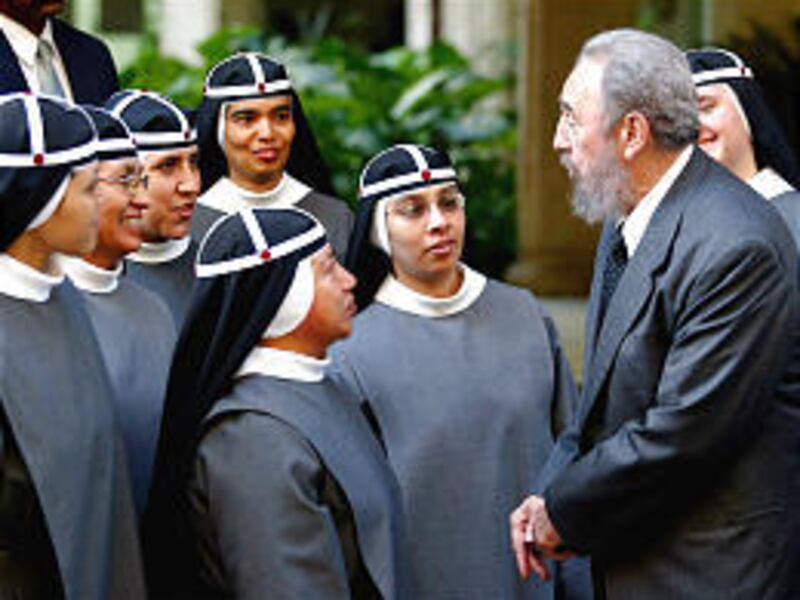
HAVANA (AP) — President Fidel Castro, whose communist Cuba was once officially atheist, on Sunday gave the key for a new Byzantine cathedral to the spiritual leader of the world's 300 million Orthodox Christians.
Consecrating the new St. Nicholas cathedral, Ecumenical Patriarch Bartholomew I in turn honored Castro with his church's Cross of St. Andrew the Apostle, which is given to supporters of the Orthodox faith.
Balancing a heavy golden crown encrusted with jewels on his head, the white-bearded patriarch circled the new cathedral several times during the ceremony conducted in a swirl of Greek chants and pungent incense.
Castro, dressed in a gray suit, looked tired after reportedly staying up all night with a visiting foreign delegation. He left quietly after the exchange of gifts outside the small sanctuary of cream-colored stone with brick trim, about halfway through more than four hours of ancient ritual.
Shortly before the gift exchange, the patriarch spoke out against the U.S. trade embargo of more than four decades against Cuba.
"The blockade of peoples and countries is a historic error," the patriarch said in Greek, which was then translated into Spanish. Problems between people and nations, he said "are resolved through dialogue and communication."
Also at the ceremony were hundreds of Greek-Americans, as well as Orthodox church members from Greece, Turkey and other nations.
It was unclear why Castro agreed to finance the church's construction, but Cuban authorities have been trying to demonstrate that the government respects freedom of worship.
Officials took issue last month with the findings of a U.S. State Department report that said surveillance, infiltration and harassment of religious groups is still common on the Caribbean island.
While Cuba became officially atheist in the years after the 1959 revolution that brought Castro to power, the government removed references to atheism in the constitution more than a decade ago and allowed religious believers to join the Communist Party.
Before that, believers were barred from important jobs and viewed with suspicion by officials who oversaw most aspects of life.
The new cathedral will be used by the island's estimated 2,000 Orthodox Christians. Church members include diplomats and foreign businesspeople from countries such as Greece and Turkey, and people who immigrated here during the Soviet era.
The church was the brainchild of Metropolitan Athenagoras, the Greek Orthodox archbishop for Central America and the Caribbean, and Havana City Historian Eusebio Leal.
Relations between churches and the Cuban state climaxed in January 1998, with the historic visit of Roman Catholic Pope John Paul II.
American officials here were disappointed when the patriarch failed to show at a Saturday night reception at the home of U.S. Interests Section Chief James Cason, whose guests also included a number of vocal Castro opponents.
Archbishop Demetrios, who represents Greek Orthodox Christians in the United States, said the patriarch had other commitments.
Cuba's best-known activist, Oswaldo Paya, spoke with Demetrios at the American reception and gave him a statement to be delivered to the patriarch, asking for his blessing.
"We want peace, we want reconciliation, we want and we can undertake our own Cuban project of justice and democracy — but with the liberty Our Lord God has given us," wrote Paya, a Catholic and top organizer of the Varela Project, a signature gathering drive that seeks deep changes in Cuba's socialist system.