


This weekend marks the end of one of the holiest months for Muslims, who have spent the lunar month of Ramadan fasting during daylight and abstaining from other pleasures.
Ramadan, which began Oct. 14, concludes at the sighting of the new moon this weekend with a great celebration called Eid al-Fitr. While this celebration will be observed by an estimated 1.2 billion Muslims worldwide, for Muslim Americans the occasion is increasingly becoming recognized as a major religious holiday, particularly by the greeting-card and decoration industries.
The trend has started online, with Internet shopping sites offering paper plates, balloons, greeting cards and other items for the celebration of Eid.
Some take it as an indication that Islam as a religion is being embraced by Americans. Last week Secretary of State Colin Powell hosted an iftar (breaking of fast) dinner for Muslim students, professionals, clerics and diplomats at the State Department.
But while local Muslims say it is heartening to know that their religion is being recognized in a positive way, they say they definitely don't want Eid to go the way of the Easter bunny.
"Many Muslim Americans want and enjoy the decorations, wrapping paper and party cups because Eid is truly a celebration that they want their children to experience and understand," said Asha Patel with the Muslim Forum of Utah. "But they do not want it to become religiously insignificant due to commercialization."
Patel said Eid is a day of giving thanks, where Muslims show their appreciation for God's gifts. The day is spent in community prayer, eating with family and helping the poor through charity. "There should be no spending sprees or extravagant gift-giving," Patel said.
While hopeful that Ramadan will be embraced by Americans along with Christmas and Hanukkah, Patel said it will prove difficult because Ramadan follows the lunar calendar, not the Roman calendar. That means Ramadan moves ahead 10 days each year.
In New Jersey, one school district has tried to put Eid on its holiday list but has struggled because the date changes. Patel said this may hinder attempts to make Eid a recognized major holiday, but she thanks some companies for trying.
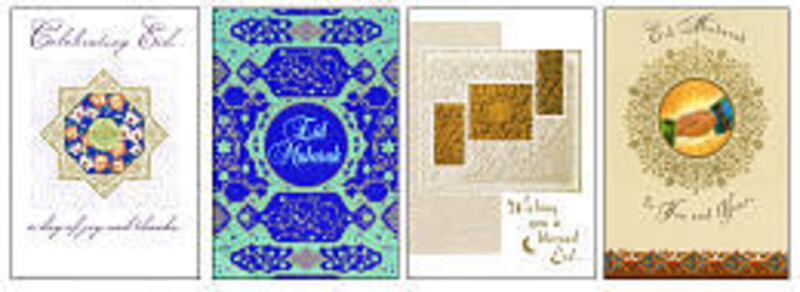
One greeting-card company said when it decided to offer a line of Eid cards for Muslim consumers it wanted to make sure they were appropriate for the holiday.
"We wanted to make sure to have proper images on the cards and proper messages, so we did research," said Deidre Parkes, a spokeswoman for Hallmark.
Parkes said Hallmark released a limited amount of Eid cards in 2003 after Muslim customers asked for them. "We found that this was a card-sending holiday, and year after year we encountered people wanting to send them," Parkes said.
Hallmark sold out of Eid cards last year after offering cards in only 500 stores, Parkes said. This year, Hallmark is expanding the market by offering such cards in about 2,000 stores nationwide. "This is a brand-new market for us, and we're just starting to feel around," she said. "We're educating our distributors and retailers about the importance of this holiday."
But while some companies make the effort to research what Ramadan and Eid al-Fitr are all about, some others do not. One online company was found selling party balloons and banners with "Happy Ramadan" stamped on it. Since Ramadan is a time of fasting and reflection, it's hardly an appropriate thing to say, Parkes said.
"You wouldn't say 'Happy Lent' to someone," she said.
In other parts of the world, the celebration of Eid through greeting cards has hit some bumps. This week police in Pakistan arrested several shopkeepers for selling "obscene" Eid cards bearing the phrase "I love you."
E-mail: gfattah@desnews.com