

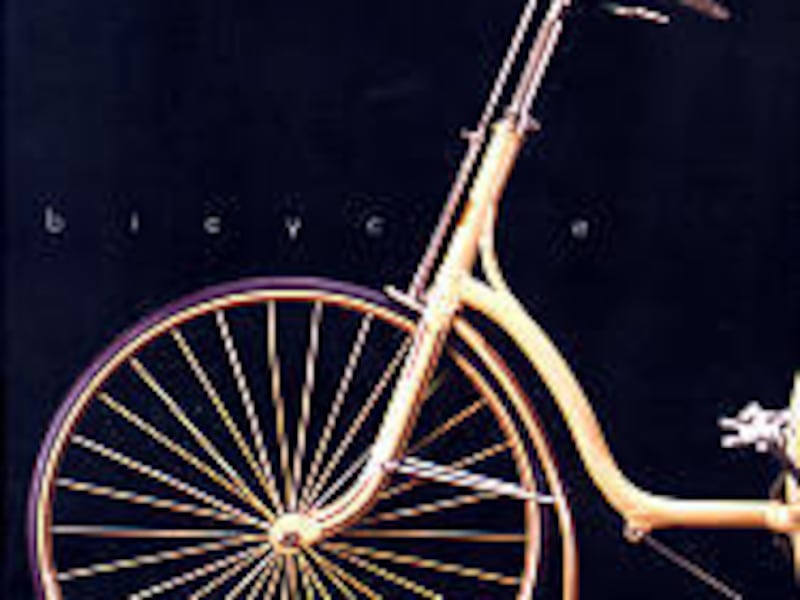
BICYCLE, by David V. Herlihy, Yale University Press, 470 pages, $35.
Of all mechanical developments, we probably take most for granted the bicycle as a solid method of transportation.
It was not always so. Mark Twain told his readers, "get a bicycle. You will not regret it — if you live."
But James Moore, a pioneer racer, predicted that the bicycle would become "as common as umbrellas."
The latter has come true as we have seen myriad different bicycle designs, and children getting bicycles as not only their first memorable gift, but as a gift that grants them mobility.
Over the years we have gone from heavy frames to lightweight, 10-speed models. New popularity has come to the mountain bike for those who enjoy riding rough off-road surfaces. Helmets are now almost automatically considered a must for bicycle use.
According to "Bicycles," by David V. Herlihy, vehicles with two wheels date back to the 1700s, when early experimentation was carried out with limited success. It was the early 1800s before scientific minds tried to figure out a dependable vehicle that would be human-powered. It was not until the 1860s that the basic bicycle mysteriously emerged in Paris. It was discovered that a slender vehicle with just two wheels and pedals on the front hub could be "indefinitely balanced and propelled by means of a mechanical drive." Critics called it a "boneshaker."
By the end of the 1860s, asserts the author, the new vehicle "caught the world's imagination." For the first time, people could imagine a world not dependent on the horse for personal transportation. Still another generation would pass, however, before the two-wheeler became highly enough developed to be universally desirable.
The boom hit in the 1890s, when "the seductive low-mount bicycle encouraged an increasingly sedentary population, including housebound women, to exercise outdoors." Women riding bicycles also forced a radical change in the normally acceptable Victorian dresses women wore to protect modesty.
In 1896, some 300 companies in the United States produced more than a million bicycles, making it a major industry. Cycling launched the "Good Roads Movement," which climaxed with a network of highways that proved useful for the automobile. And many of the techniques used to build a bicycle could be adapted for the construction of an automobile. Soon, bicycle mechanics were experimenting with flying machines that would turn into airplanes.
It wasn't until the early 20th century that the "rich man's toy" became a "poor man's carriage." Bicycles went from selling for $150 to $25, making them more accessible to the masses of society. In the 1920s and 1930s, the lightweight touring bicycle developed in Europe as a popular weekend activity, while in the United States it turned into a child's vehicle.
Today, cycling is enjoying renewed popularity for touring in large or small groups for day trips or extended rides — and it is happening worldwide. The legendary Tour de France seems to get more popular every year as a spectator sport.
This well-written, lavishly illustrated book is written by a writer versed in bicycle technology. The history is complex with respect to disputed patents and missed opportunities — but it is a fact that the bicycle transformed our society and prepared the way for both the automobile and the airplane.
E-mail: dennis@desnews.com