

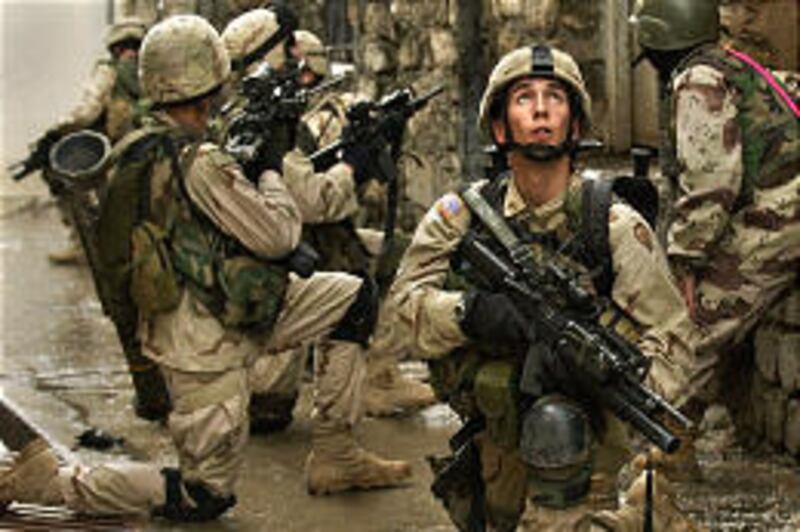
BAGHDAD, Iraq — Thousands of American, British and Iraqi troops began a new offensive sweep on Tuesday across a region south of Baghdad known as the "triangle of death," because of its fearsome reputation as a haven for thieves, killers, crime families and terrorists as well as insurgents who fled Fallujah before the fighting started there.
The operation began on Tuesday with 11 simultaneous early morning raids in the town of Jabella, west of the Euphrates River and about 50 miles south of Baghdad, said Col. Ron Johnson, commander of the 24th Marine Expeditionary Unit, which is leading the effort.
The new push can be seen as the opening of a third front — after the invasion of Fallujah and more limited operations in the northern city of Mosul — by American-led forces against the insurgency. Officials said it would involve 2,000 to 3,000 American Marines, soldiers and sailors, more than 1,000 members of Iraqi security forces, and 850 members of the Black Watch, a British infantry battalion.
The triangle of death, just north of the ancient ruins of Babylon in Babil province, is now best known for gruesome mass killings, insurgent hideouts and ruthless attacks on Iraqi army bases and police stations.
But with the rousting of hundreds or possibly thousands of dedicated insurgents from Fallujah before the American invasion and capture of the city last week, the role played by this area as a transit and resupply district for insurgents has become even more troublesome, Johnson said.
"We know that some of them headed in our direction before the Fallujah battle," he said, citing intelligence reports. "We're going to try to isolate them. Then we're going to bounce all over. We're not going to hit just one area. We're going to hit a multiplicity of targets so that they have no safe haven that they can go to."
Military officials in the province said that nearly 250 insurgents had been captured there in the past three weeks, including 32 in the Jabella raids on Tuesday.
The area is a curious mixture of impoverished villages and opulent residential compounds, many of them along the Euphrates, artifacts of a Sunni-dominated area that was favored under Saddam Hussein.
A recent drive through a central street in Mahmudiya with a police captain revealed a barricaded and largely abandoned police station whose facade was severely damaged from a bomb attack in which several Iraqi police officers died. The drive passed through a close-packed, grimy market of soda stands, groceries, and repair shops where the squad car received only hard stares.
The police captain, who had been in place for several months, said that he had never gotten out of his car or even talked to anyone on the street because it was too dangerous. "We begin with, people see me in the area," said the captain, who estimated that there had been little police presence on the streets for about a year.
Capt. David Nevers, a spokesman for the Marine unit, said that because the area was rural and dotted with villages and towns, operations here would be different from the urban combat of Fallujah and Mosul. The new operation will focus on what Nevers described as "precision raids."
The raids will be carried out with varying combinations of the American, British and Iraqi forces, the officers said. The first operation, in Jabella, was led by an Iraqi commando team that was backed up by Marines, they said.
As recently as mid-October, the unit conducted a major sweep of the same area, but horrific crimes there have continued, as typified by the kidnappings, beheadings, and shootings of local security officers, sometimes as many as 10 at a time.
Asked how the American-led forces would proceed differently this time, Nevers said that with the recent addition of the Black Watch and other Iraqi forces, they would be able to "squeeze the insurgents into a tighter box."
"We're not naive enough to think there are not avenues of escape," Nevers said, "but the cordon is tighter than it's ever been."
Although the new operationis largely military in nature, Johnson recently emphasized the sway of local crime families in the death triangle. He said that both raids and undercover operations would focus on decimating those families.
"There is a lot of crime lords and bosses and mini-bosses and guys who intimidate the neighborhood," Johnson said.
He said that understanding the crime families, whether they sell weaponry or just control some particular piece of local turf, was critical to stopping the insurgency in the area.
As those operations began, fighting continued to fall off in intensity in Fallujah. But new casualty figures released by the Pentagon indicate that 868 American troops had been wounded since the Fallujah offensive began on Nov. 8, and 9,326 since the American-led invasion of Iraq last year. The military said last week that at least 51 troops had been killed and 425 wounded in Fallujah.
In Mosul, Tuesday was a rare day when no bodies of people killed by the insurgents were found, said Lt. Col. Erik Kurilla, commander of the 1st Battalion, 24th Infantry. In the previous five-day period in Mosul, at least 28 bodies had been discovered — some beheaded, some shot execution-style in the head, some burned or otherwise mutilated.
But the American military said that its patrols had discovered a huge hoard of insurgent weapons about 30 miles south of Mosul on Monday, including 15,000 anti-aircraft rounds, 4,600 hand grenades, 144 grenade launchers, and 25 surface-to-air missiles. It ranked as one of the largest weapons caches ever uncovered in northern Iraq.
In Baghdad, the top aide to Muqtada al-Sadr, the Shiite cleric who led an intense anti-American insurgency in the spring, said Tuesday that the interim Iraqi government was violating a peace agreement by continuing to arrest senior officials in the Sadr organization.
The aide, Ali Smesim, said at a news conference that two powerful Shiite political parties, the Dawa Islamic Party and the Supreme Council for the Islamic Revolution in Iraq, were pushing for the arrests. Both parties have prominent positions in the interim government and were favored by the Americans before and after the invasion of March 2003.
Yet, even as Smesim was complaining about the arrests, all the major Shiite parties, including Sadr's group, were busy negotiating to form a powerful coalition to present a unified slate of candidates for the national elections planned for Jan. 30.
Smesim's remarks came after Iraqi police arrested a senior Sadr official, Sheik Hashem Abu Reghif, in the holy city of Najaf last Friday. The government said it acted after several Iraqis filed a court complaint accusing the sheikh of detaining and torturing them.
Smesim said 160 people from the Sadr organization are still in prison, despite a peace agreement reached in October under which they were to be released.
Al-Sadr has been one of the biggest thorns in the side of the Americans, igniting uprisings across the south and in Baghdad in April and August and delivering fiery sermons denouncing the American presence.
The American military routed al-Sadr's militia in Najaf this summer. In October, al-Sadr agreed to try to disarm his thousands-strong militia, the Mahdi Army, after weeks of American airstrikes in Sadr City, a sprawling slum of 2.2 million people in northeastern Baghdad that is al-Sadr's strongest base of support.
Sabah Kadhum, a spokesman for the Interior Ministry, said the government will continue to arrest clerics if they incite violence. The arrests of the Sadr officials have nothing to do with political rivalries, he said.
"The government has no political stand in all of this," he said. "It's not a political matter. It's more about incitement. The government is arresting clerics who incite people."
Also on Tuesday, a spokesman for Sheik Ghazi al-Yawar, the Iraqi president and a Sunni Arab, said that Yawar had formed a political party to run in the elections. The party is called the Iraqis' Party, and it counts among its members the current ministers of defense and industry.