

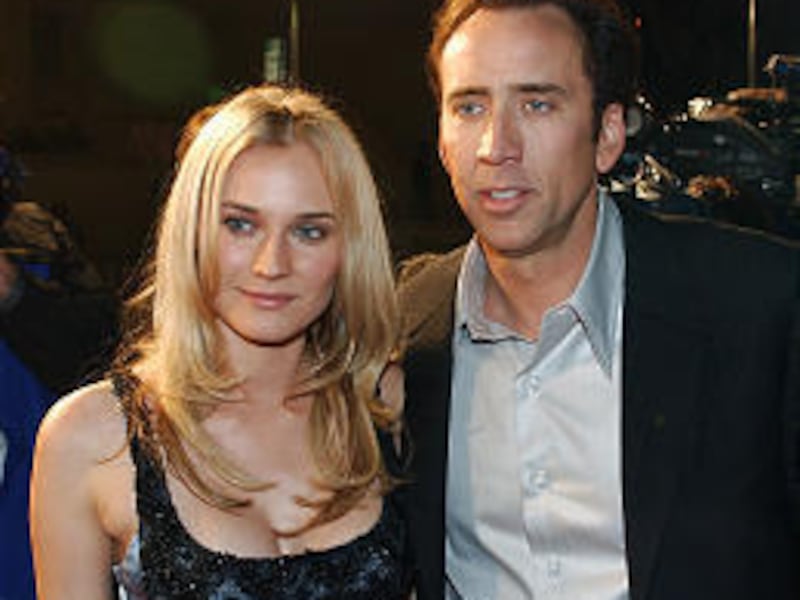
In the movies, Nicolas Cage has stolen babies, money and identities. But he wavered at the concept of stealing the country's most prized document in "National Treasure."
"I think the very thing that made me trepidacious (sic) was the same thing that intrigued me, which is the idea of a man going in and stealing the Declaration of Independence," says Cage. "I thought, 'Well this doesn't seem very plausible. How can this actually be pulled off?'
"I met with (director) Jon Turteltaub, and he said, 'But that's what's interesting. He's audacious. He's bold.' And (producer) Jerry Bruckheimer always brings in a great group of technical advisers to do the research and try to figure out how to make it, within the context of the film, seem as believable as possible.
"And I got to do it in a tuxedo, so that was interesting to me as well."
In "National Treasure," Cage plays Benjamin Franklin Gates, who's not a thief but a man seeking a legendary treasure said to have been brought to America and hidden during the Revolutionary War. Ben has devoted his life to his search, following one clue after another.
When the latest lead suggests that a map to the treasure can be found on the back of the Declaration of Independence, Ben knows he can't just waltz into the National Archives and pull the Declaration out of its case to examine it. But he realizes his former partner, Ian Howe (Sean Bean), has no scruples about stealing it, so Ben ends up pilfering the document — during a black-tie event at the Archives — to protect it.
Cage says people inevitably think of James Bond whenever they see a thief in a tuxedo, and that's not a problem.
"It's interesting because, in the beginning, during the rehearsal process, I wasn't exactly sure what the tone of the movie was going to be," he says. "It was Jon Turteltaub, to his credit, who kept pushing it toward a stylization not unlike what maybe Cary Grant or Jimmy Stewart might have done back in the '30s and '40s."
Cage says he can relate to Ben's single-mindedness.
"He certainly is a character who is obsessed about this treasure, the marvelous Templar treasure, and has devoted his entire life . . . to figure out exactly what he needs to find it, in the face of great ridicule," the actor says in a press conference at the St. Regis Hotel in Los Angeles' Century City area. "I've been obsessed over the years with where I could go with acting or how I could challenge myself with that."
While Cage emphasizes that the movie is fiction, the legend is real.
"Several very highly intelligent people who believe it exists have risked their lives looking for this very treasure," he says.
He believes audiences should just sit back and take the ride.
"I think you have to give yourself over to the context of the movie and go along for the ride, which is what I did," he says. "It has a certain spirit (that) is reminiscent of Indiana Jones, but it parts company with Indiana Jones in that there's nothing supernatural about 'National Treasure.' "
Well, that's something that the box office may dispute. Bruckheimer's films often ring up otherworldly grosses. This is the fourth time Cage has worked with the producer, following "The Rock," "Con Air" and "Gone in 60 Seconds."
"Jerry has a vision; it's an honest one," says Cage. "He's a terrific movie fan. He loves going to the movies, and he likes films that are, I think, very entertaining to himself and to many other people, so it's a vision that a lot of people share.
"What's unique about Jerry is that he really does look in interesting places for his actors and even writers. He's always looking for someone who might come up with an unexpected choice, something a little bit outside the box, which you can see in, like, 'Con Air' — he used a lot of independent-film actors in that; Johnny (Depp) in 'Pirates.' . . . And then he has a sense of nostalgia for veteran actors like (Robert) Duvall or Jon Voight or (Gene) Hackman."
Even though "National Treasure" is make-believe, the star says it touches on some important U.S. history.
"It's nice to remember what the Founding Fathers did," he says. "These were geniuses, and it's amazing they were all alive at the same time and knew one another and debated and shook hands and created philosophies and rules by which we still live today.
"I think that there's something to learn from them still."
Betsy Pickle write for The Knoxville News Sentinel in Tennessee.