
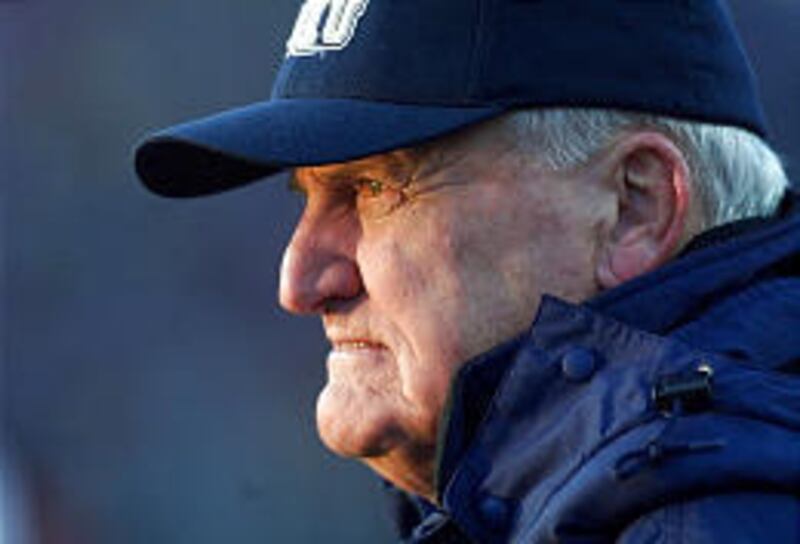

NEW YORK — Coaching and college football have taken LaVell Edwards beyond dare-to-dream-of destinations.
As BYU's head football coach for three decades, Edwards anchored the Cougar sideline for 361 games played from sea to shining sea — and farther, including Hawaii, Japan and Australia. He toured the world — actually, golfed the globe — at the invitation of Nike or as payment for working clinics with legendary peers Duffy Daugherty and Bud Wilkinson. He hoisted a national championship trophy, testified before the Senate Judiciary Committee and swapped stories with the president of the United States in the White House.
Today, coaching and college football return him to New York City, where Edwards and his wife, Patti, spent 18 months for reasons other than football. It's taking him to the Waldorf-Astoria Hotel, home of $800-a-night rooms, $150-a-plate banquets and black-tie-only affairs in multitiered ballrooms, where Edwards first visited as a 40-something coach, never imagining he would be the guest of honor 30 years later.
His profession and his sport are finding him a permanent location — not for him personally, rather for his legacy as one of the game's most respected, successful coaches.
Tonight at the Waldorf-Astoria, Edwards and 13 others will be inducted into the College Football Hall of Fame, followed by an August enshrinement at the hall in South Bend, Ind.
So, after 29 years as head coach, an overall record of 257-101-3, a .716 winning percentage, 21 conference titles, 22 bowl games and the No. 6 spot on all-time victories, how does Edwards respond to becoming Fame-ous?
In trademark LaVell-speak — "Obviously, I'm pleased," the 74-year-old Edwards said recently from his Provo east bench home overlooking BYU and the 65,000-seat football stadium that bears his name. "I still find it hard to believe that so many good things have happened."
Raised in an Orem family of 14 children, attending college was more rarity than rule. But by the ninth grade, Edwards had set his mind to be a coach, solidified by lifelong impressions left by his football and basketball coaches, Sanky Dixon and Val Briggs.
After a Utah State University playing career and a two-year Army stint, Edwards first taught and coached at Davis and Granite high schools, then became a BYU assistant coach — the incoming head coach ran the same single-wing offense Edwards used at Granite.
After Edwards was named head coach in 1972, a mediocre Cougar program took off — winning seasons, conference titles, bowl games, top 10 rankings, bowl victories, undefeated seasons, a national championship and high expectations.
"One of the problems as you got into it — the victories could never quite compensate for the losses," he recalled. "The losses just become more and more difficult. When you start having successes — so much more is expected. I never felt any more pressure, other than internally. That's the worst pressure I ever felt — just the internal pressure you put on yourself."
Competitive by nature, Edwards loved the challenge — and the process. "Thinking back, you never really think of games won or lost, you think more of people and events. And I just loved the process of starting in spring practice, oftentimes from scratch, and trying to get all the elements together," he said. "I'd be out there in the spring, and I'd think, 'I don't know — it's been a good run,' and the next thing you know, everything would fall together."
His 29-year BYU tenure could have been shorter — an early visit to Missouri, a trip to Colorado in the early 1980s, and repeated overtures from other universities. "I made up my mind I'd never go to another college," Edwards said, "but if an NFL job ever came along, then I'd probably do that."
And along came the Detroit Lions, courting the Cougar coach fresh off the 1984 national championship season. With postseason obligations — an all-star game in California, a coaches convention in Tennessee and a White House visit with President Reagan — hindering an Edwards visit to Michigan, Lions officials met him in a D.C. hotel to offer him the head coaching job and ask for a detour visit to Detroit. But with recruits waiting for a weekend visit in Provo, he got home and got busy — eventually telling the Lions' owner thanks, but no thanks.
"It dawned on me, 'If you can't drop everything you're doing and go back there, there's no way this is going to work — it's not fair to them, it's not fair to you,' " he said. "That pretty much did it as far as other offers — I think the word was out by then."
A week later, the Lions hired Edwards' friend Darryl Rogers of Arizona State. "I was thinking at the time, 'Man, I wonder if I did the right thing?' But that didn't last very long, because as it turned out, he was fired in three years, and I would have been the same."
Edwards attended his first Hall of Fame banquet in the mid-1970s, accompanying Cougar offensive lineman Steve Miller, who received one of the several annual scholarship honors.
From his seat on the upper level of the three-floor ballroom, Edwards remembers watching the ceremonies below, "never realizing that I'd ever be going back there for myself."
He returned for the Hall of Fame inductions for four of his BYU quarterbacks — Gifford Nielsen in 1994, Marc Wilson in '96, Jim McMahon in '99 and Steve Young in 2001.
Step outside the Waldorf-Astoria, head northeast on Park Avenue about 20 blocks to 66th Street, then cut through Central Park on Manhattan's Upper West Side. In less than two miles — a five-minute taxi ride on a good day — you'll come to Columbus Avenue, where the Lincoln Center and The Church of Jesus Christ of Latter-day Saints' new Manhattan Temple stand as across-the-street sentinels.
The temple is located in a six-story building also housing a chapel and the offices where Elder and Sister Edwards were based for 18 months as public affairs missionaries for the LDS Church. From mid-2002 to late 2003, they lived on the same block as the building-since-turned-temple, walking the three football-field lengths from their apartment to their office.
Representing the church in efforts and events throughout the Northeast, Edwards didn't completely forsake football. He was invited to testify before the U.S. Senate Judiciary Committee about the ills of the Bowl Championship Series, and he aided the Harlem Hellfighters, the area's first high school football team in more than six decades.
With the team comprised of players from 13 area schools and named after Harlem's World War I regiment, Edwards helped co-coach the gridiron newcomers and assisted in securing $10,000 worth of start-up equipment from the NFL.
Within the past week, BYU obtained the resignation of Gary Crowton — who coached four years after Edwards' retirement — and Utah lost coach Urban Meyer to Florida to the tune of $14 million. Four local programs — BYU, Utah, Utah State and Weber State — now seek new head coaches.
"I'm glad for them, but I'm not totally sure it's in the best interest of college football," he said, admitting multi-decade tenures may be a thing of the past, what with the Internet, sports-talk radio, overambitious boosters and unrealistic expectations. "It's a much tougher job right now . . . it just makes it much more difficult."
Just as difficult is getting Edwards to comment on the current state of BYU football and the Cougars' three straight losing seasons, two more years than his sole sub-.500 season in 1973. He's hesitant, concerned for the program he molded for 29 years but not wanting to be seen as overshadowing or meddlesome. "It was a whole lot easier when they were winning that first year than it has since. Obviously I want to see it keep going — and going well."
Coaching and college football will keep Edwards going — to Hawaii and California as a selection-committee member of the Hula and Holiday bowls. And after sharing Tuesday's induction formalities in Manhattan with their three adult children and their spouses, the Edwardses will be joined by 14 grandchildren for the August enshrinement festivities in Indiana.
He'll keep on the move — spending time in Provo, at his second home in St. George and on the road as a popular speaker.
But he'll be in one place to stay — in the College Football Hall of Fame.
E-mail: taylor@desnews.com