



It's certainly not the average class project.
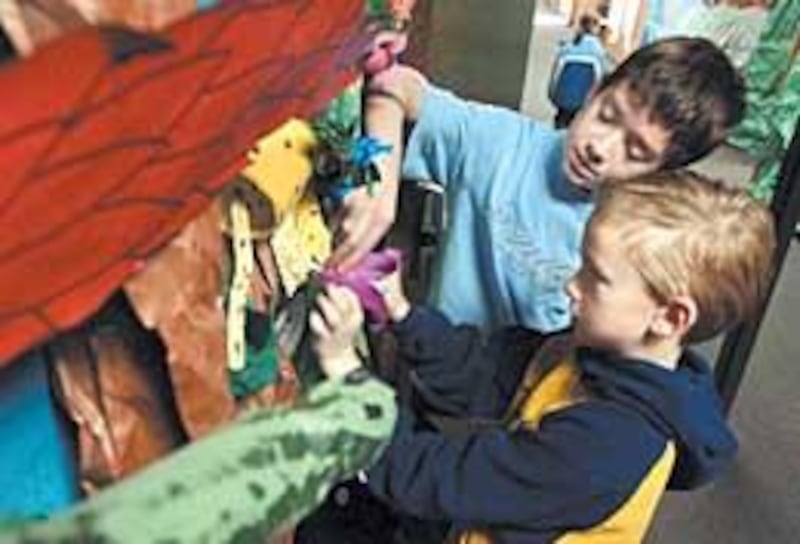
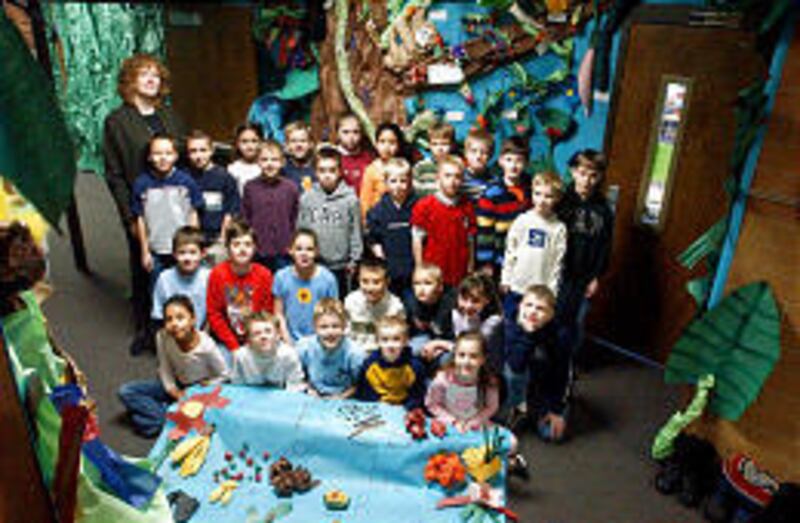
As soon as you enter the hallway near Kari Titemore's third-grade classroom, paper vines hang over your head, an owl made out of plastic bags peeks over your shoulder, and turtles made of egg cartons cover the otherwise plain walls.
It's the Amazon rainforest right in the hallway of Orchard Elementary in Orem, decked out with sloths, gorillas, toucans and even a kapok tree. Even the hallway light is covered up to add to the rainforest atmosphere.
"I have many students say this was their funnest project," Titemore said. "They want to go (to the rainforest) now."
Titemore said she has created the rainforest project almost every year with various grades, but the more she teaches it, it just gets better.
"Being here in Utah, it's really hard to imagine a place that is so green and so wet," Titemore said. "This helps them visualize it more and see what a wonderful place the rainforest is."
Rodney Earle, associate chairman of Brigham Young University's education department, said that Titemore's experience with classroom projects is typical of other teachers who include unconventional teaching techniques in their curriculum.
While elaborate projects demand more of teachers, Earle said that the active involvement required by students is a proven way to reach those children who struggle with traditional learning.
"If all you did were tests, I don't think you would get a full understanding of a child's capabilities," Earle said. "I think that projects are a great way to get children involved in the learning process — to teach social skills and collaborative skills that are so important in the business world."
Beth Shurtleff, 9, who is in Titemore's third-grade class, said she has learned a lot. She said she didn't know so many common foods and medicines come from the rainforest. Even the unique plants found in the rainforest fascinated her.
"My favorite plant is the lily — it's big enough to hold a kid!" Shurtleff said, referring to the Amazon Victoria water lily, which is 6 feet wide and strong enough to hold a child without sinking.
Despite Shurtleff's excitement, Earle said teachers shouldn't put sole emphasis on projects, either.
"We should never just do one thing because children are so different and some will flourish under one particular approach," Earle said. "If you can cater to a variety of things, you are more likely to help every child succeed."
Fourth-grade teacher LaiLoni Elggren agrees with Earle, even though her teaching method is "100 percent hands-on." By integrating structured study and testing into her projects, Elggren said she can help all her students — including those with learning disorders — understand important subjects.
"The more they do and touch and feel, they more they will remember it," said Elggren, who teaches at King Elementary in Layton. "Usually, I can't stop them from learning because they want to do more."
At Majestic Elementary in West Jordan, sixth-grade students have spent the school year in an educational time machine, traveling from ancient Greece to the Middle Ages — all while learning about each society's noted accomplishments.
But students don't even notice that they're absorbing the information, said teacher Heather Rich, because they become so engrossed in the role-playing and creative fun that projects offer.
"Anytime you can relate any subject to real life, they are a lot more interested in it," she said, pointing to a recent stint in old Athens that had her students behaving like real Greeks.
Rather than give her class a lecture on the important influence of ancient Greece on modern society, Rich divided the room into "cities," which were modeled after Greek city-states.
After some explanation and historical background, each city wrote a personal pledge, which Rich casually compared to the U.S. Constitution. A few days later, the cities were busy at work building temples that would rival the Parthenon.
Of course, no trip to Greece could be complete without a visit to the ancient Olympic games, which Rich recreated with relay races and physical competitions.
"Instead of just looking at pictures in a book or reading about what towns were like, they are actually thinking about and creating history . . . and they loved it," Rich said. "Now, they can tell me anything about ancient Greece when I ask them."
Same goes for Titemore's class. Before, many of her students didn't know what a rainforest was. Now, they can name the four different layers of the rainforest (forest floor, understory, canopy, and emergent).
Although the rainforest unit for Titemore's class is about to wrap up, the rainforest will not be cut down anytime soon.
"We'll be studying the Incas, and they live pretty close by," Titemore said.
E-mail: lwarner@desnews.com, jdoria@desnews.com