


When Katie McKenna Peterson was young, she was a tree-climbing tomboy. She says her mother never looked for her on the ground, only up in the branches. Peterson never stopped wanting to look at the world from a high place. Even as an adult she liked to stand at the edge of a cliff or on the top floor of a tall building. She's always preferred a long view.
When she got older, she realized that age offers a certain vista as well. Peterson will turn 100 on Feb. 29. She was a leap-year baby, born in 1904 in the little town of Redmond in Sevier County.
Recently, the Deseret Morning News talked to her — and to two other February-born nonagenarians (people between the ages of 90 and 100). They talked about what was important in their lives. When pressed, they even offered some advice.
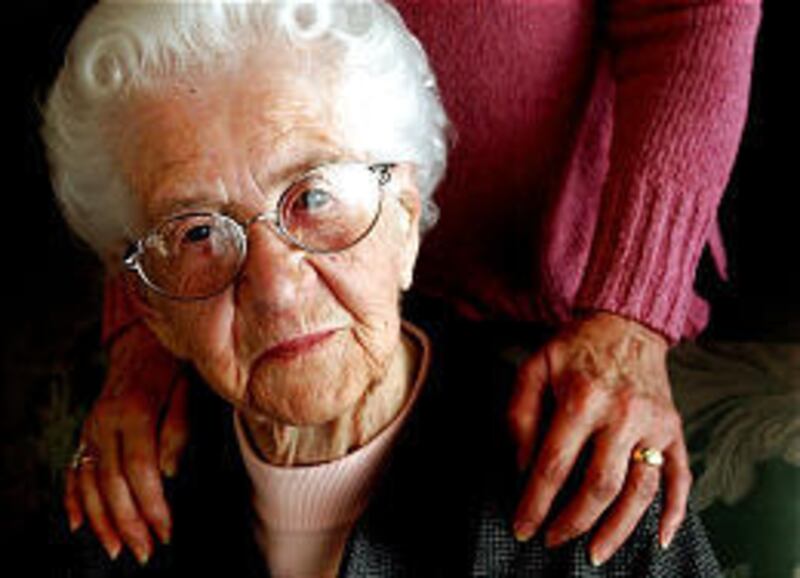
Katie McKenna Peterson, age 99
Friends are important, Peterson says. "People are about my main thing." She has had so many good friends over the years. When she turned 76 and her children threw her a surprise luncheon, more than 100 women came.
She loves her family, too, of course. She and her husband, Peter Peterson, have seven children. Her children and their spouses all get along, which "is really pleasing to a mother," she says.
The hardest times in her life came worrying about the kids. You can still hear the distress in her voice when she talks of her son, Ralph, who, at the age of 8, broke his leg. He spent days in the hospital and had years of complications.
As for Ralph, what he remembers about his childhood was that even the hard times, like the Great Depression, were good times. There was always enough to eat, he recalls, and, yes, their dad was out of work, but eventually he got a job at the mill at Kennecott.
Peterson worked, too, including a stint during the Korean War at the Tooele Army Depot. "I was a mechanic, fixing the big guns," she says, happily. As she talks, it becomes clear that Peterson had another core value in addition to her belief in family and friends. This value is one she doesn't name, but it seems to be defined by the word "openness."
Her house was always open to her children's friends. And open to strangers, too. During the Depression, hungry men knew to knock at her kitchen door.
Peterson was open-minded as well. She could tolerate more than other mothers could in the way of fashion, she says. She let her boys wear their hair in duck tails. She let them glue thick soles on their shoes, back when platforms were popular the first time around.
Her son, Craig, says his parents never tried to pigeonhole him. He grew up knowing he was expected to go to college, but after that he could define his own path, his own idea of success.
Peterson's children say their parents were always the first to buy a new invention: a television, a refrigerator. Never a car, though. Peterson says they never thought they could afford one. But she remembers well the first car she ever saw, coming down the street in Salina, going pretty slow, with a crowd of kids following behind.
The lack of a car didn't stop her from traveling. She was 77 when her husband died, and she didn't stop then, either. She just began taking tours with lady friends.
Her last big trip was six years ago. She went to Thailand to visit a grandson who was living there temporarily.
Her daughter, Glenna Tuttle, took a picture of her on that trip. In the photo, two elephants joined their trunks together, and Peterson is sitting in the crook of their trunks. It's an unusual perch, but she seems to be enjoying the view.
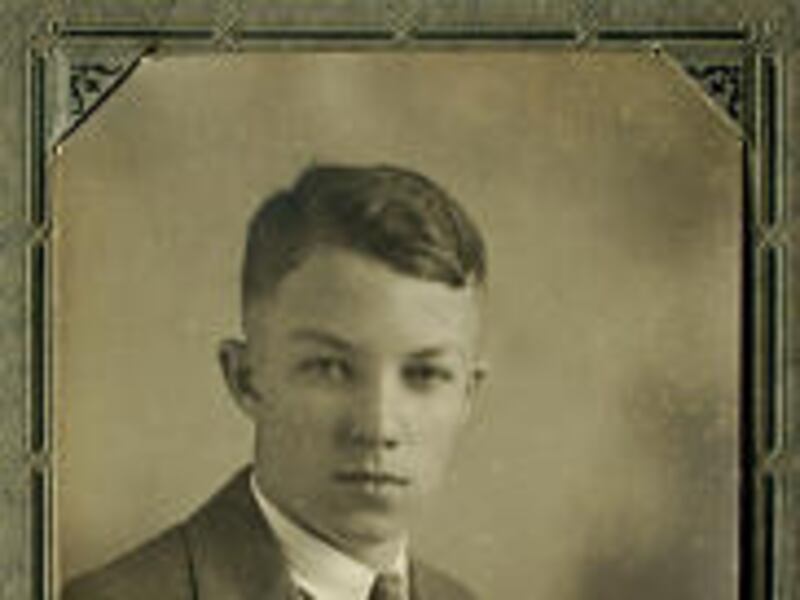
Byron Mock, age 93
Byron Mock has not only lived for 93 years, he has chronicled his life.
In his living room at Brighton Gardens, Mock sits surrounded by bookcases full of ledgers. Each is neatly labeled with the year. He explains how he used a system of columns to track his business dealings, as well as the boards he served on.
The far right column is for "things that should be emphasized," and it is there, sometimes, among the details, both colorful and mundane, that you can discern his philosophy: That we should be historians. That we should take note of the events around us.
Mock was an attorney. For much of his career he headed up the western region of the Bureau of Land Management based in Salt Lake City. Later he was in private practice, representing oil and gas companies.
Mock's father was an attorney himself, in Greenville, Texas. He died young, but first he made his bit of history by running against Sam Rayburn for Congress.
Mock's widowed mother got work as a secretary. "We didn't have any money, but we didn't know it," Mock recalls. When he graduated from college in 1933, he got a job as secretary himself, a secretary to the manager of Fox studios in Hollywood.
He knew when he was hired that he was supposed to know typing. But he didn't. Fortunately, his boss went to Europe for several months just after Mock was hired. Mock was in a frenzy to learn typing and date as many starlets as he could.
Soon, though, Mock's lack of typing was discovered. And when he no longer worked for the studios, the starlets forgot his name, he recalls, shaking his head.
The studio offered him a replacement job, teaching English to an up-and-comer named Charles Boyer. But Mock decided he wanted to go to law school. He took night classes at Georgetown University in Washington, D.C., and worked days.
Mock lived in Utah before and after World War II, and he tried to meet every eligible girl in the state. But somehow he overlooked Mary Morris. They didn't marry until 1949. He regrets that they could never have children. He is thankful, though, for his stepdaughter and the grandchildren she brought him.
In his 1942 notebook, written when he was in the Army in Italy, Mock wrote an essay on "The Lawyer's Place in Society." "The lawyer is a non-producer," he wrote. Therefore it is difficult for a lawyer to maintain his perspective unless he regularly associates with people who live off the land or who produce goods.
In his journals, Mock seems both sensible and idealistic. But in person, he is wry. If you ask him today for his advice to young lawyers, Mock will joke: "Get rich clients."
His stories often have a wry twist as well. Once he rode on Franklin Delano Roosevelt's train, when he worked for the WPA and for presidential assistant Harry Hopkins. The president was coming to Utah for the funeral of George Dern, his secretary of war. Dern had also been Utah's governor. Mock's job on the trip was to turn away the minor officials in every town they passed through.
In another story, Mock recalls arguing with Judge Willis Ritter in Lamb's Cafe. The judge's comments are unprintable. But rest assured, says Mock, they were loud.
These days, when Mock leaves his book-filled study, it is most often to go to the dining room. There Mock is surrounded by friendly faces, many of whom he's known for more than half a century. "We call him Lord Byron," says the lady who sits next to him at meals. It's a tribute to his learning and to his conversation — so rich in detail.
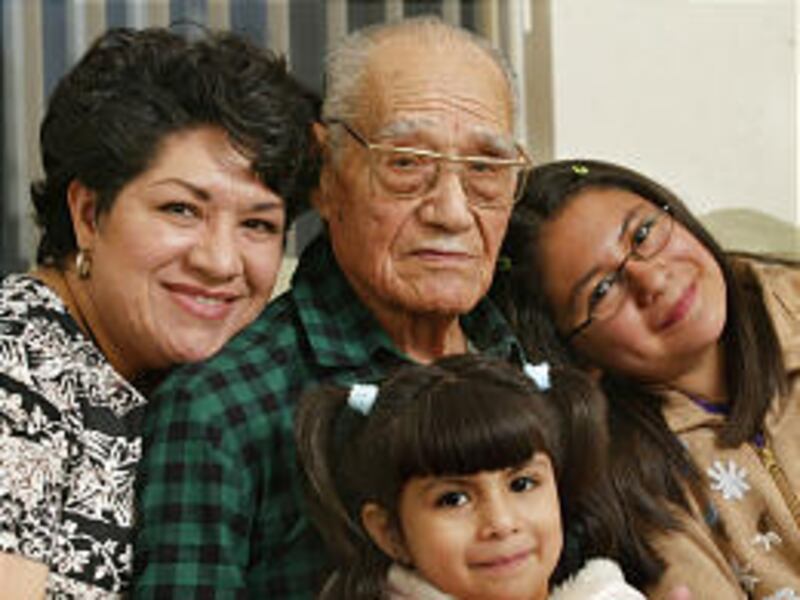
Manuel Fuentes, age 94
When Manuel Fuentes sits down to tell you his life story, he begins with a warning. "There are some sad parts."
He is in the living room of the home of his daughter, Rocio Gonzalez, and she is translating. "I was born on Feb. 2, 1910, in Mexico City, during the revolution," he begins. "Those were very difficult years. We had seven years of war. The home that I knew first was my grandparents' home . . . "
Fuentes carries the dates in his mind. The dates his parents were born, the date they got married, and the year of death for each of his parents and seven older siblings. Death came too early, and sometimes violently, to all but him. He is the only one of his brothers to have had children, to carry on the family's story.
Fuentes' father died when he was 1. His widowed mother took the other children and left him with her parents, who worked as housekeepers in the home of a wealthy French family in Mexico City.
His grandmother died several years later. Soon, his grandfather died, too. So when Fuentes was only 7 years old, he found himself alone with the French family. The oldest son in the family took it upon himself to educate Fuentes and to discipline him. Fuentes recalls being terrified when he was locked in the cellar, in the dark, for 24 hours, as punishment for not doing a homework assignment.
Fortunately his mother came back for him. She taught him the values he holds today: Work hard. Respect your parents. Choose good friends. These are the things he told his own children.
As Fuentes talks, his granddaughters come in to sit at his feet. Jazmeen, 11, and Lizette, 5, have heard his stories before, of course. Their parents raised the girls to be bilingual.
They are glad they are able to talk to their grandfather, because, as Lizette says, "I love him so much." His stories about the Mexican Revolution and about World War II often send Jazmeen to the Internet to learn more about world history.
During the mid-1940s, Fuentes and other Mexican men were hired to come to the United States to work on the railroad. The U.S. Army had taken all its own citizens for the war. Fuentes liked the United States but knew the job was only temporary. He never dreamed he'd return, years later, when one of his children became a U.S. citizen and was living in Manti.
By that time, Fuentes had been married twice. He had several children by his first wife, but they argued a lot, he says. They eventually separated. When he was 41, he met the 16-year-old who would become his second wife and give him nine more children.
Rocio is the youngest of the nine. Her father was an old man when she was growing up. Rarely did they do anything playful, such as go to a park. But she remembers how hard he worked, getting up before dawn to set off for his job as a bus driver. Often he would bring the bus home and wash it, cleaning it carefully inside and out.
When Rocio grew up she got to know her father much better. Her father visits his other children as well, but over the last few years, he has chosen to spend the most time with her and her husband, Ismael.
He likes Rocio's home because it is filled with love, Fuentes says. He uses the Spanish word "harmonia." It seems to imply even more than love. It seems to imply the kind of peace and ease he's been seeking all his life.
E-mail: susan@desnews.com