

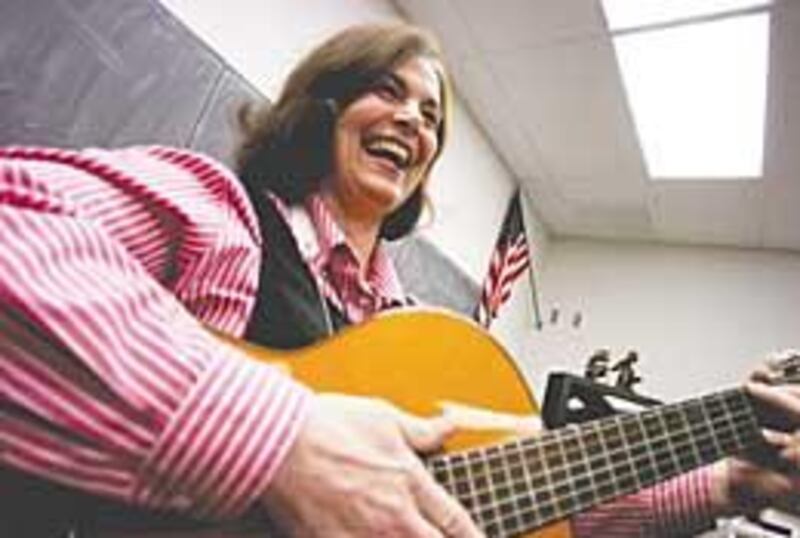


Jana Brinton is a guitar-strumming music-degree holder with a penchant for French lyrics.
And French food, French art and, well, France.
Brinton teaches the language and culture most of the day at Bingham High School. She also teaches Spanish and English. In the summer, she takes students to Europe where, along with her favorite country, they tour nations including Holland, Great Britain and Germany.
"They leave with such a narrow image of the world and come back with a broad, vast understanding of a broader world outside of South Jordan, Utah," Brinton said.
For her dedication, the 20-year teaching veteran has been named the Utah Foreign Language Association's Foreign Language Teacher of the Year. She received a plaque and $200.
"I've seen teachers who spoke absolutely fluently . . . (but) who terrified students," said Joan Patterson, former state foreign language specialist who now coordinates teacher licensing at the State Office of Education. "Brinton is one of those teachers . . . who have set up a learning environment that was so risk-free that students just started speaking the language and weren't afraid to be corrected by the teacher."
Indeed, Brinton is a hit with students, some of whom cite her as the most inspirational teacher on Deseret News/KSL-TV Sterling Scholar applications.
"Foreign language can be a very difficult subject to learn, but as it is, Mrs. Brinton has made the experience not only enjoyable but rewarding also," writes Bingham senior Kiri Redford.
Students write funny stories incorporating new vocabulary words. They learn popular French songs and sing along while Brinton strums guitar.
"She varies her techniques in order to teach every student in the way that they most easily learn," Redford wrote.
Students nationwide apparently seek similar experiences in increasing numbers. In 1982, 46 percent of high school graduates nationwide reported never taking a foreign language class, the National Center for Education statistics reports. By 2000, the number had shrunk to 17 percent.
Utah numbers, however, are different. While Utah has more foreign language speakers than any other state — many are former missionaries for The Church of Jesus Christ of Latter-day Saints — foreign language enrollments have waxed and waned, Patterson said.
In 1980, 16 percent of Utah secondary students took Spanish, French, German or another foreign language, State Office of Education data show.
Enrollments spiked to 35.7 percent in the 1985-86 school year, when the University of Utah first required two years of a foreign language for admission. They hit an all-time high in 1994, with 38 percent of Utah secondary students taking classes, most commonly Spanish.
Still, Utah foreign language students dipped to 35 percent by 2000, the most recent data available. Numbers of French and German students have waned, too: French, from about 16,000 to 14,600 students; German, from 11,350 to 8,500.
Brinton, Bingham's only French language teacher, has 83 students including one AP French class, she says. By comparison, Bingham has about 400 Spanish students — Brinton teaches about 80 of them.
"They have so many requirements for these students to graduate from high school," Brinton said, "that it's very difficult to make room for a language."
Tight budgets also have shifted state priorities. The State Office of Education no longer has a full-time foreign language specialist. And school districts, faced with strict testing standards under No Child Left Behind, are unlikely to make foreign language a top priority, Patterson said.
But six Alpine elementary schools maintain Spanish immersion programs — with no extra dollars, said Barry Graff, administrator of south-area elementary schools.
Those schools choose to have one immersion teacher per grade, beginning with second-graders, he said. Students learn vocabulary and grammar, and by sixth grade, use Spanish in reports, social studies and math.
Cherry Hill Elementary, which started the district's first immersion program some 20 years ago, now does "dual immersion," enrolling native Spanish speakers learning English, and native English speakers learning Spanish, assistant principal Gloria Vorkink said.
"We're excited about the direction it's going," she said.
Parents love it, too, Graff said. And often students, by the time they've completed the ninth grade, are taking — and passing, with college credit — Advanced Placement Spanish tests.
But there's a downside.
Sometimes students drop the program along the way, decreasing class size for the immersion students but increasing it for others.
That's why Meadow Elementary is phasing out the program for its remaining 20 fifth- and sixth-grade immersion students, principal Jeanne Bates said. "We would spend summers trying to drum up enrollment, then we'd have a class of maybe 14 or 15, and another teacher would have around 30. It was just an unfair teacher load."
Bates, however, praised the program as a good one. Research, though limited, indicates such efforts in elementary grades might help on standardized test scores.
If nothing else, educators say, students learn about their own cultures and their own language by learning others.
"When you learn a language, you learn another soul," Brinton said. "You have a different way of looking at life."
E-mail: jtcook@desnews.com