


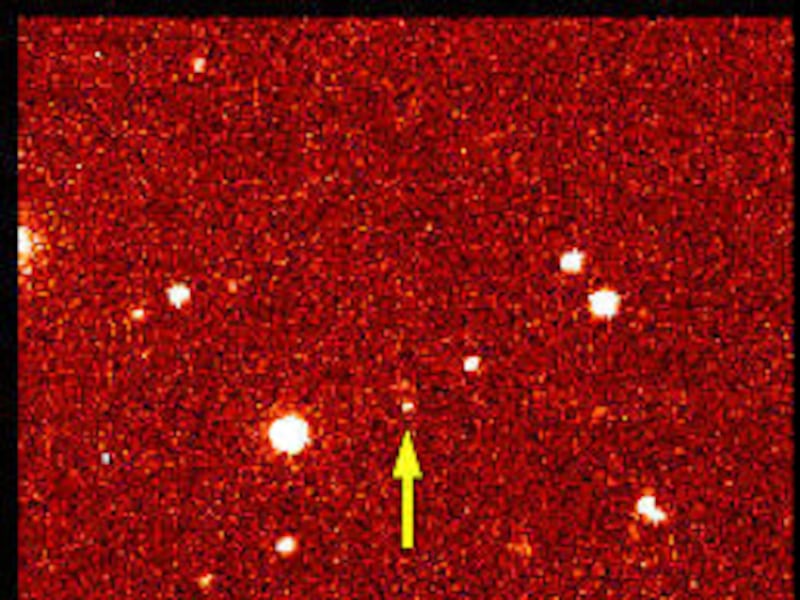

NASA announced discovery of a strange little world Monday, the most distant member of the solar system ever spotted by telescope. It appears too small to be called a planet but larger than anything else known to be circling our sun.
The new object, with a temperature estimated at minus 400 degrees, is named Sedna, after the native Alaskan goddess of the sea.
Because it is so far away — its elliptical orbit takes it from the present 8 billion miles from the sun to an astounding 84 billion miles — it is being hailed as the first object ever found in the Oort Cloud. The swarm of icy bodies called proto-comets hypothesized since 1950, the Oort Cloud is believed to be orbiting the sun in the far depths of space.
That could indicate the sun formed as part of a cluster of stars, now dispersed — possibly the most important aspect of the new discovery.
Other ice and rock bodies left over from the formation of the solar system 4.5 billion years ago are closer in, part of the Kuiper Belt of material. The theory is that the gravity of a big planet like Neptune deflected some of this away, making it fly out toward interstellar space.
Sedna's discovery has reignited an old scientific dispute — whether Pluto should be termed a planet.
"By our definition, Sedna is not a planet," co-discoverer California Institute of Technology Prof. Mike Brown wrote on his Web site. "Nor is Pluto."
Patrick Wiggins, NASA solar system ambassador to Utah, concurred with Brown. "I agree, Pluto's not big enough to be a planet," he said.
Sedna is 8 billion miles away with a diameter estimated at 800 miles to 1,100 miles. By comparison, Pluto, the most distant generally accepted planet, has a diameter of 1,400 miles (half that of Earth's moon) and is about 2.8 billion miles from the sun.
The odd little world is one of the reddest and shiniest body in the solar system, and it may have a moon that is even tinier than it, Brown said.
"There's absolutely nothing else like it known in the solar system," said Brown, leader of three co-discoverers. The others are Chad Trujillo of Gemini Observatory and David Rabinowitz of Yale.
Sedna's formal announcement by NASA was made via telephone press conference.
Brown said the new object seems to be halfway between the size of Pluto and another distant icy body the team discovered, Quaoar (800 miles in diameter).
A 40-day rotation observed on Sedna may point to the presence of a yet-unseen tiny moon. "The Hubble Space Telescope is going to be critical for determining whether or not there's going to be a moon," Brown said.
A 48-inch diameter telescope at Palomar Observatory made the discovery. Finding an object that faint was possible because the telescope is equipped with a huge CCD camera built by Rabinowitz.
When the Deseret Morning News asked for his personal reactions when the team realized it had found something extraordinary, Brown replied, "We didn't believe it. It's actually a very funny story.
"The morning that I first saw this object at our data, I was about to go 10 minutes later to teach my class. That very morning I was telling about the Kuiper Belt and how there's nothing beyond the Kuiper Belt that anyone has ever seen.
"So then I find this object, and I go to my class and I teach my class. And at the end of my class, I say, 'But I'm not sure this is true anymore.' "
Wiggins said he is excited that scientists are searching space "and can find these things.
"If we can find things that's that small and that far away," Wiggins wondered, "how much farther out can our solar system go? It's a wondrous thing."
E-mail: bau@desnews.com