
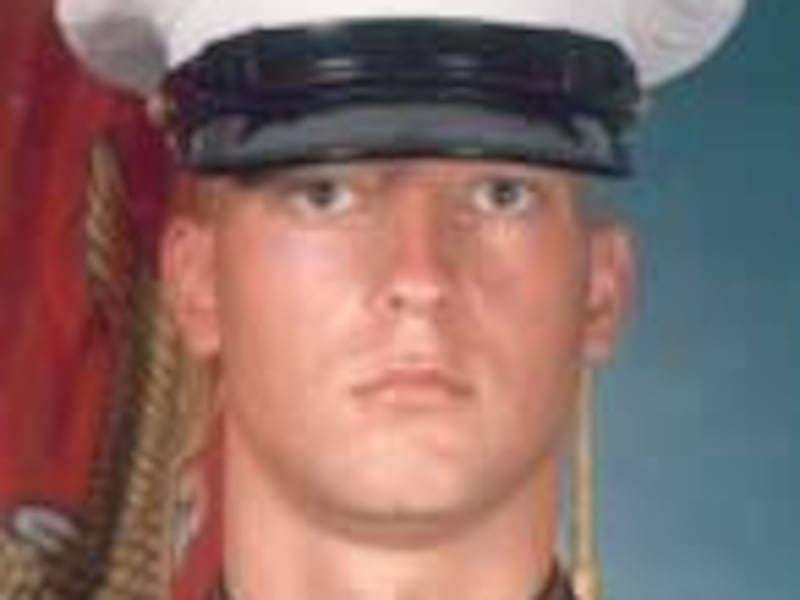
Pfc. Jeremy Ross Purcell never achieved his goal of completing his military service and becoming a law enforcement officer, perhaps joining his brother at the Woods Cross Police Department.
The 19-year-old enlisted Marine was killed during an August 2002 training exercise at Camp Pendleton, Calif. His father has now taken on the U.S. Marine Corps, claiming the government's gross negligence caused his son's death.
Provoan Jon Purcell, himself a 20-year Navy veteran, filed the federal lawsuit Monday afternoon. The suit seeks at least $75,000, and is brought on behalf of Jeremy Purcell's parents and his eight siblings.
Jeremy Purcell died Aug. 28, 2002, after he was shot four times in the chest during a training exercise in which blank ammunition was supposed to be used. Purcell and 10 others from his military police unit were playing the role of the "aggressor" in the force-on-force operation, according to the lawsuit.
The Marine who fired the fatal shot, Sgt. Cody W. Ottley, accepted a plea agreement and pleaded guilty to negligent homicide. He was sentenced in August 2003 to one year in a military jail.
Ottley had participated in a live-fire exercise the night before, and he mistakenly used one magazine loaded with live ammunition from that exercise and a second magazine with blank ammunition, the suit says.
Though Ottley is not named as a defendant, the lawsuit alleges Purcell's death "was the direct result of negligence on the part" of Ottley. However, the suit says, the Marine Corps mistakenly relied on individual Marines to check their own ammunition and failed to put into place policies to prevent such an accident.
"The death of Pfc. Jeremy R. Purcell resulted from a complete and total institutional failure on the part of the Marine Corps at Camp Pendleton to have in place, and enforce, proper policies for use, storage and accountability of ammunition used in training activities," according to the lawsuit.
Second Lt. Robert Shuford, a Camp Pendleton spokesman, said he had not yet seen the lawsuit and declined to comment.
Jon Purcell is representing himself in the action. He said he spoke to several attorneys, all of whom were unwilling to take on the case because of the Feres Doctrine. It is based on the U.S. Supreme Court ruling in 1950 that the government cannot be held liable for injuries suffered by members of the armed forces that result from the negligence of other military personnel.
He admits it may be difficult for him to stand in court and argue his case against government attorneys, but he thinks the case is a good challenge to the Feres Doctrine.
"I think that, first of all, not every incident like this puts the government in a situation where they should have liability for it, but this is just a case that cries out for it," he said. "I think personally the Feres Doctrine has outlived its usefulness and needs to go away."
The case has been assigned to U.S. District Judge David Sam, who served three years as a military attorney at Norton Air Force Base in San Bernardino, Calif. He left the Judge Advocate's Office in 1963 with the rank of captain.
Jon Purcell said he is working closely with the mother of another Marine who died during service. Renee Thurlow has set up a nonprofit organization, the Justin Haase Foundation, dedicated to challenging the Feres Doctrine.
Haase died in December 2001 at boot camp from bacterial meningitis. The foundation's Web site claims he was denied medical attention and could have survived if military officials would have followed standard operating procedure.
Jon Purcell also spoke to the parents of another Marine who was injured during a training exercise at Camp Pendleton. The incident is similar to the one that killed Jeremy Purcell and should have put officials on notice, he said.
Purcell enlisted in the Marine Corps in January 2001. He was a Jordan High School graduate and was engaged at the time of his death.
E-mail: awelling@desnews.com