

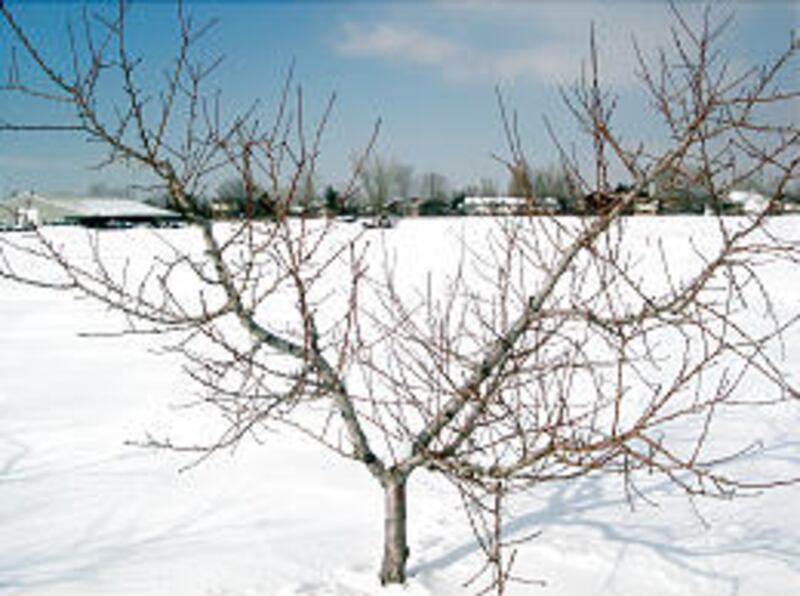


Fruit Growing 101 is our class for the next couple of weeks. Home orchards are coming out of a tough year. Most fruit trees bloomed poorly last spring and set little fruit, and the record heat badly damaged what fruit there was.
This winter's record snowfall has also taken a toll.
A previous article outlined how to clean up the broken branches and repair some of the damage. For today's more in-depth look at putting the home orchard in top shape, I consulted an expert.
Thor Lindstrom is a research associate with the plant, soil and biometeorology department at Utah State University. His primary task is fruit research at the Utah Agricultural Experiment Station Kaysville Farm.
He takes care of about 20 acres of trees as a part of his assignment. As such, he tries many different pruning systems to determine their suitability for fruit production in Utah. He willingly shared his expertise with you, our readers, to help you pass Fruit Growing 101.
Lindstrom grew up on Long Island, N.Y. He enjoyed gardening with his dad, and they grew peaches and other crops. He came to Utah State University in 1974, and after graduation he managed an orchard in Zillah, Wash. Then he returned to USU in his present position.
As the instructor for our fruit-growing course, he starts as follows: "The first thing I would teach is the difference between a heading cut and a thinning cut. Most fruit-tree pruning problems come from people making heading cuts and the trees not responding to those cuts correctly."
Heading cuts are made in the middle of the branch. "Heading cuts are invigorating (they stimulate localized growth of several branches), and the resulting branch angles are narrow and weak," he said. "It is aggressive vegetative growth that does not grow fruit."
Thinning cuts, on the other hand, take the branch out completely by removing it down to a side branch. "These cuts reduce the vigor in the tree, which encourages fruit production. This encourages wide crotch angles, settles the tree down and makes it produce much sooner."
Early production is a key for commercial orchards because it allows the grower to have something to sell. For homeowners, early production is important because many people move frequently. Apple trees that take 10 years or more to start producing are not as much fun for the gardener.
Another important part of tree pruning is the training system. Commercial growers are using many different rootstocks to control the size of the trees and training these trees to many different systems. These trees are often trellised or otherwise supported on wires or stakes. While they are highly productive, this intensive system is beyond the needs of most backyard orchardists.
To help people understand why pruning systems change, Lindstrom offers these observations. "When trees were planted on seedling rootstocks, the typical spacing for the trees was 40 by 40 feet. These trees would overwhelm most back yards. Typically they cut the center out of the tree to let light in and allow the fruit to be picked and sprayed."
With the introduction of size-controlling rootstocks, growers started to develop much smaller trees and train them more intensively. Instead of a few dozen trees per acre, many plant hundreds or even thousands of trees per acre. Although an individual tree produces less fruit, the number of trees per acre more than compensates, producing much more fruit per acre.
Lindstrom encourages homeowners to learn a basic system and stick with it. Once a tree is committed to a basic system, don't try to change it. While certain systems are preferred for certain trees, it is not a matter of right and wrong.
Although commercial growers work with many different systems, homeowners should look at one of two types of pruning systems for their trees.
The central-leader system started a number of decades ago when growers began using the first generation of dwarfing rootstocks. This system is much better for dwarf and semi-dwarf apples and pears. This is a better system because the light penetrates better and you end up with a better quality of fruit.
"The goal of the central-leader system is to produce one-half of the crop where it can be picked from the ground. Most people let their fruit production creep upward over the years, and the trees get too large, and then they are hard to take care of," he said.
Trees that are too high to spray or prune are of little value. Gauge your tree height when you prune. Usually, extremely tall trees are badly neglected, and the quality of the fruit is poor.
The open-center system is easier for peaches, apricots plums and older trees. The basic premise of this system is to open up the trees and let light into the center.
Lindstrom advises you to use thinning cuts when training these trees.
Heading cuts, on the other hand, stimulate excessive waterspout growth high in the top of the tree. This shades the tree's lower branches so they don't produce fruit. Consequently, the trees get higher every year and become less productive.
Lindstrom said that March is the best time for homeowners to prune their trees. "I started pruning my trees way back in December, but that is because I have so many, and I have to prune all of the research trees myself. Home gardeners are not under the same constraints."
Start getting the trees back in shape, and maybe you'll receive a passing grade in fruit-tree growing. The real test is going to be when harvest comes later this year. Hopefully, your pruning will have helped to make this a bountiful fruit-production year.
Larry A. Sagers is the regional horticulturist, Utah State University Extension, at Thanksgiving Point.