

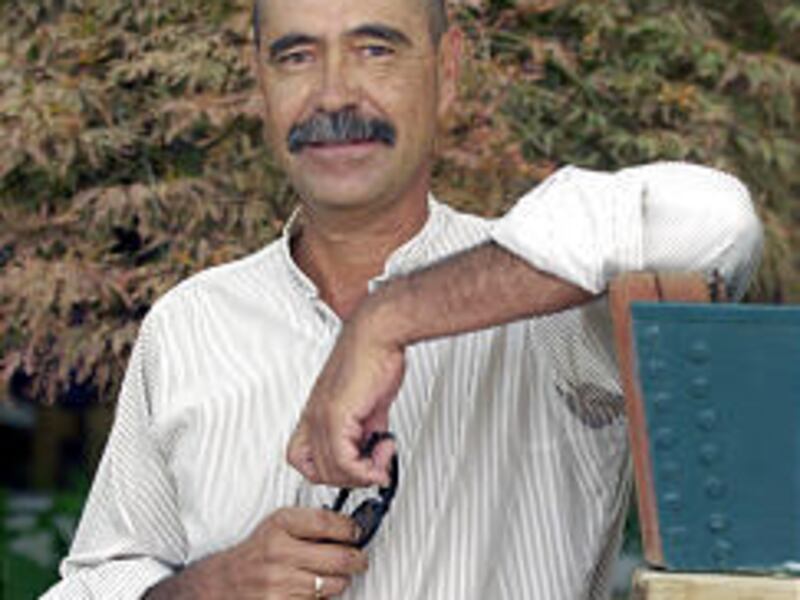
Manny Garcia says he was only 18 when he killed a Vietnamese woman who reminded him of his grandmother. He didn't realize she was a woman when he shot her, he wrote in his memoir.
The Salt Lake City attorney's book, "An Accidental Soldier: Memoirs of a Mestizo in Vietnam," won the Utah Center for the Book's annual nonfiction award Saturday night. The organization is affiliated with the Library of Congress and established the award and others in 1999 to recognize outstanding achievements by Utah writers and publishers.
But Garcia's Army records don't back some of his most significant claims: that he was an Airborne Ranger with the famed 101st Airborne Division's Screamin' Eagles and had received the Silver Star, the military's third-highest combat honor. The records do affirm Garcia was a decorated combat veteran, but not for the year he said he drew on for his book.
In short, much of what Garcia has written appears suspect — some of it untrue by his own admission — putting in question everything else he's claimed in his haunting memoir of his Vietnam combat and what it did to his soul.
Questions about the book underscore what military fraud hunters say is a growing phenomenon of soldiers and others who inflate or fabricate military records.
Garcia was a featured reader at The Great Salt Lake Book Festival in September. He first told his overflow audience that his book was "sometimes humorous." Then he read passages about slitting a man's throat and listening to the spluttering noises, about blowing up an elephant because his unit had to get rid of unneeded ammunition. Some of the audience walked out.
"Believe it or not, I cut some of the worst stuff," Garcia said later.
During the month after the event, Garcia gave several interviews to the Associated Press. When the AP obtained Army records through the Freedom of Information Act that conflicted with his tale, Garcia continued to maintain truth was on his side.
During an Oct. 16 interview, Garcia repeated his book's claim that he threw all his medals, including the Silver Star, over a fence onto the White House lawn after he was discharged in November 1968. He affirmed he had been sent back to the States early in his Vietnam tour because he had tuberculosis.
The Army has no record of Garcia receiving a Silver Star or of the illness that he says briefly sent him home. Garcia wrote that the Army had lost his records, but later said they must have been altered. The Army says he was discharged in November 1969.
He acknowledged he hadn't graduated from Ranger School at Fort Bragg, Ga., as he'd written, because he had been kicked out for using drugs 10 days before he was to finish. But he did finish Ranger schooling in Vietnam, he said. He acknowledged he made up the letters from home he transcribed in his memoir.
In his book and during interviews, Garcia said he'd never received his DD214 summary record of his service — every vet's single most important scrap of paper. Yet the copy he provided the AP, which he said he obtained from the Salt Lake City Veterans Administration offices in October, carries his signature.
Records the Army provided were more complete than those Garcia had provided the AP and did substantiate that he'd received two Bronze Stars, a Purple Heart, a Combat Infantry Badge and other honors.
Garcia insisted he couldn't tell his full story, implying he was still subject to prosecution for some secret activity he'd been involved in. Asked in October if that meant murder, a crime with no statute of limitation, he replied, "You can draw your own conclusions."
"They knew I knew who did it," he continued, speaking about the secret operation. "They knew I wouldn't tell them. They told me I wasn't going to get an honorable discharge. But I didn't do anything."
The next day, when confronted with documents received from the Army, Garcia stopped talking to the AP. In a letter, he wrote, "I was given the Silver Star at Fort Bragg like I said. . . . Now if that was a mistake or accident, well, they got it back. I don't have one. . . . Regarding Ranger training, I do admit that I tweaked the ending there, but the end result was the same. I was certified at Brigade in Phan Rang. . . . I told a lot of truth in this book, but I didn't tell it all, nor am I going to. . . . I'll pit my credibility against the Army any day."
Contacted Friday, Garcia said, "I really don't have anything else to say."
On Nov. 26, the AP received a FOIA response from Thomas M. Jones, FOIA and privacy chief for Army Human Resources Command in Alexandria, Va., saying Ft. Benning officials conducted a records search on Garcia. "No record could be found that confirmed that a Manny Garcia was in or completed Army Ranger training," Jones wrote.
Author and military investigator B.G. "Jug" Burkett says Garcia may be part of a long list of Vietnam "wannabes," which include Adm. Jeremy "Mike" Boorda, the Navy's top uniformed officer in 1996 who killed himself just before he was to be questioned by reporters about two Vietnam combat decorations he wore but may not have earned.
Pulitzer Prize-winning author and history professor Joseph Ellis fabricated a story about Vietnam service. Former Minnesota Gov. Jesse Ventura exaggerated his Navy SEAL record. In late 2002, a Texas former Marine was prosecuted for wearing Navy Cross, Silver Star and Purple Heart medals he hadn't earned.
Co-author with Glenna Whitley of the 1998 expose "Stolen Valor: How the Vietnam Generation Was Robbed of Its Heroes and Its History," Burkett is a Dallas investment adviser and Vietnam veteran who has exposed more than 1,200 people who tried to capitalize on false or inflated Vietnam records. In December, he received the military Distinguished Civilian Service Award from former President George H.W. Bush.
Burkett, who says he has an unremarkable Vietnam record, said the once-reviled and stereotyped Vietnam veteran's image has been rehabilitated to the point that people are seeking its cachet.
Bogus soldiers always have been around, but the number of those claiming untrue Vietnam service has grown since the Persian Gulf war of the early 1990s, Burkett said. Often, the frauds tell extremely gory stories about themselves, but veterans who really have experienced such horrors rarely talk about them, he said.
"There is a phenomenon that people will admit war crimes who never were there," Burkett said. "It's always weird to me that a guy would step up and admit a murder. But it always can excuse or explain all the other failures in their lives."
As for secret operations, "I got a ton of, quote, classified documents," Burkett said. "But they all have been declassified over time. . . . Everything is documented. There are more documents for secret units, because every man's record is on the line."
The University of New Mexico Press, which published Garcia's book last year, didn't vet any of Garcia's claims. Press publicist Lynne Bluestein said the book passed UNM historian David Holtby's "smell test." Holtby defended the lack of substantiation in an October e-mail to the AP, which provided him with copies of Garcia's Army records. The book has since come out in paperback.
Prior to the awards ceremony Saturday night, Dana Tumpowsky, spokeswoman for Utah Center for the Book and the Salt Lake City Library, told the Associated Press she and others were "surprised" to hear about factual problems in Garcia's memoir.
"It's something we're going to have to learn more about," she said. "We will investigate it."
The center decided to recognize Garcia Saturday night after checking with a couple of other writers and talking with Garcia, Tumpowsky told the Deseret Morning News. The center relies on publishers for fact-checking and chose to "accept those nominations as they come to us."