





No matter how widely varied its incarnations, the one thing Sugar House has never been is saccharin.
Over the years, commerce, kitsch, blight, hardened criminals and community spirit have managed to harmonically converge there. And all have left a mark as real and noticeable as the single spire monument at its center dedicated to its namesake — a short-lived sugar factory that only managed to make molasses.
Sugar House, which has been celebrating its 150th birthday over the past two days, is no longer Wild West but still somewhat wild in its way. About 130 years ago, an elementary school teacher was known for keeping a pistol handy for no-goods inside and outside of class. "He had a six-shooter in his desk all the time; (he) didn't tolerate anything that wasn't honest," Albert C. Smoot recalls in an interview on file at Sugar House's Sprague Library. "Some of the things I learned then have stuck with me until now."
The place sticks with a lot of people nowadays, often by being where they got their first tattoo or piercing.
Residents and shop owners — even the ones in the shiny new stores on the east side of 1100 East and 2100 South — say Sugar House is a kind of "Our Town" for both the tragically and affluently hip. It's the sort of place where having tattoos and face piercings can actually help rather than hurt the chance of getting a job, and where exotic dancers come to shop.
"The strippers shop here," says Jesse Dobbs, 22, as he points to a pair of thigh-high, faux snake-skin, high-heel boots for sale at the Blue Boutique. "Who else would want these but a stripper?"
Dobbs, sporting a silver bar through his nose and other larger things in his ears, says he fits right in at Sugar House, where he clerks at the boutique, now considered a fixture in Sugar House after 15 years.
"There's a high flow of traffic here," he said. "And there's a lot of, like, alternative people here. It's not just all regular people."
Indeed there are folks like Dobbs all over Sugar House. The local businesses here have unique lures that aren't found elsewhere in Salt Lake City or Utah.
For instance, at Pib's-X-Change, hipsters can take their old threads and exchange them for old threads that other hipsters used to wear. It's kind of like a Salvation Army for cool people.
The area has a walkable feel, including storefronts that abut sidewalks, and parking lots are stuck underground or behind buildings instead of out front like a lot of Utah suburbs.
Sugar House might be the only place in Utah were you can purchase a Christian Science Monitor newspaper from a sidewalk vending machine, and where charm isn't giving way to economic vitality.
A unique blend
It's almost like Berkeley but not quite, says Kitty Brown who runs the Mystic Dragon, where shoppers can purchase incense, oriental artwork and T-shirts adorned with a Buddha. Next door there's a shop that apparently does all right specializing in polka-dotted high heels.
"It's almost a subculture here in Sugar House," Brown said. "There are people that really prefer Sugar House. People like to come here just to browse and look around."
After all, notes an employee of the Orion's Music CD exchange, where else in Utah can you find a store with a skateboarding half-pipe jump inside?
Of course, Sugar House isn't all subculture.
There are dozens of chain stores — Barnes & Noble, Wild Oats, Bed, Bath & Beyond, Nordstrom Rack, Olive Garden, Red Lobster, Toys-R-Us, even Shopko — stuffed in between the two major parks that buttress Sugar House's boarders — Fairmont to the west and Sugarhouse to the east.
And all that activity is corralled, very normally, by rows and rows of cozy bungalows, ramblers, condos and apartment buildings and tree-lined streets.
Susie Petheram, who founded the Sugar House Historical Society two years ago, says all in all the area is ideal for families.
"It's a nice family atmosphere because there's a lot of different things to do in the area," she said. "You see a lot of people out in the stores frequenting the area."
Blight to bustle
All that bustle is a fairly recent resident in Sugar House. About 25 years ago, the place was known for something else — blight.
It was so distressed that in 1986 the city appropriated Redevelopment Agency funds. The designation came as Sugar House businesses were sucked away by two new downtown malls, Crossroads Plaza and ZCMI Center, which today seem to be fighting downtown blight while Sugar House thrives.
"Sugar House has really come a long ways," RDA executive director Dave Oka said. "It used to be one of those old, tired neighborhoods, but right now it's one of the places of choice to live."
Much of Sugar House's current success can be attributed to RDA help.
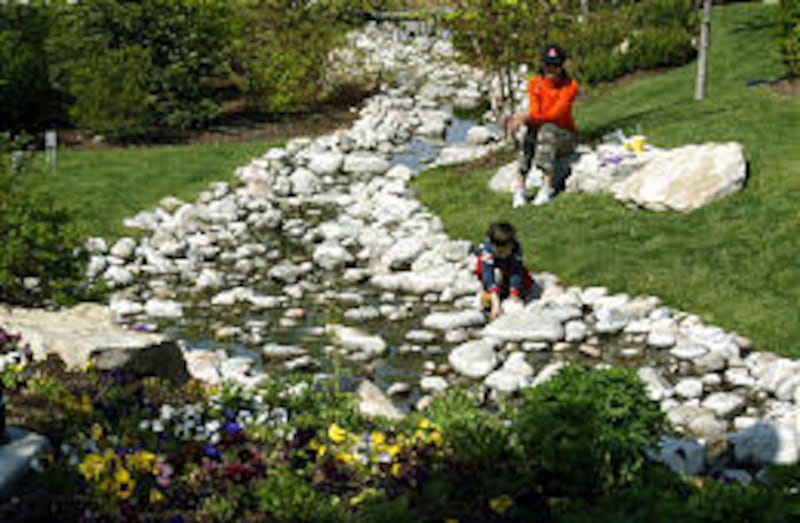
In the early 1990s, the RDA gave The Boyer Co. a tax incentive to build its sprawling Commons at Sugar House development, which now houses dozens of shops and restaurants. The RDA also spent $750,000 to develop a natural park through Hidden Hollow, which connects Boyer's commons to 1300 East.
The RDA facilitated the sale of the Irving Junior High School building for construction of a 232-unit apartment complex and provided infrastructure improvements to the Sugar House Center shopping center. All that, along with many smaller loans and allocations for facade renovations and building improvements for local business.
And there are more projects coming.
The RDA is helping developer Vic Ayers turn the old Redman Moving & Storage building into a mixed-use development with condominiums and retail. Salt Lake City is building a new state of the art skate park at Fairmont Park, and Smith's Food & Drug demolished its store on 900 East to make way for a spiffy, new place to serve the neighborhood.
"People just seem to like Sugar House," said Gloria Chappell, who has run Cobwebs Antiques and Collectibles for 18 years in Sugar House. "I used to have a thrift store in Murray, and I didn't get half the walk-ins I get here."
Diverse history
The area gets its name from an unsuccessful sugar mill that was built about 1854 in the area near 2100 South and 1100 East.
By 1860, the sugar factory was converted into a paper mill and later was used to make buttons, buckets and tubs and finally as a wool and carding mill before being torn down in 1928.
Almost as old as the sugar mill was the state's first penitentiary that sat where Sugarhouse Park is now located. The adobe structure housed criminals from 1855 until 1951, when its inmates were transferred to the Utah State Prison in Draper.
"Behind, the prisoners left a pile of broken glass as they smashed virtually every window in all three cell-blocks," the Deseret News reported about the move. "Kitchen and dining equipment was smashed, but a threat of arson failed to materialize."
By the early 1900s, Sugar House had abandoned its farming roots and became a center of industry and activity. There was a railroad depot that sent trains to Park City. Trolleys, first horse-drawn and later electricity-powered, moved along 1100 East. There was a bank, fire station, library and the Old Princess Theater.
The first barber shop opened in 1900, and three years later the Granite Lumber Co. was established. In 1912, the first men's apparel shop opened, and "Sugar House had the latest in men's fashions," the Deseret News reported.
As the nation dealt with the Great Depression, Sugar House formed its own chamber of commerce and after World War II became a mecca for furniture stores. Today, many furniture outlets remain, the anchor being Granite Furniture just off 1100 East on 2100 South.
The neighborhoods around those stores continue to be some of the best in Utah, according to many who live there.
"I love being able to walk to my store, to my school to my church and be able to reach all the amenities of a big city, and yet I still feel the wonderful warmth and closeness of a small community," said Lynne Olsen, who helped organize various events marking the neighborhood's 150th birthday Friday and Saturday.
To conclude those festivities, today at 3 p.m. at the Sprague Library, 2131 S. 1100 East, Petheram will present a free slide show and photo exhibit titled "Sugar House Through the Years."
E-mail: bsnyder@desnews.com