




For 73 years the Utah State Developmental Center has been caring for the state's most severely retarded and disabled residents. In a two-part series, the Deseret Morning News gives readers a look into the lives of the residents and workers who call "the Hill" home.
AMERICAN FORK — Roger Holden has two birthday cakes in front of him. One is decorated with a plastic circus train, the other with Thomas the Tank Engine. One of the many guests at the party points out the toy trains to Roger, and he unleashes one of his favorite phrases, "Whoo, whoo!"
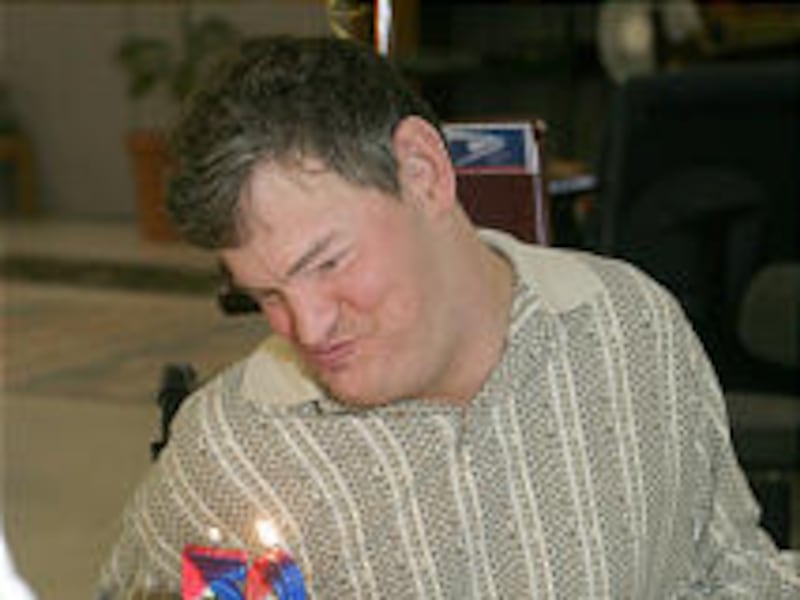
The two candles on the cake are lighted, and everyone sings "Happy Birthday." Without prompting, Roger leans into the table and tilts his head to blow them out. He musters a deep breath and exhales. The flame on the 0 dies. He takes another breath and blows out the 5.
Norman Roger Holden has reached the big 5-0. And it's a big deal.
All his friends at the Utah State Developmental Center are there, and he has dozens. Some surround him in their wheelchairs, a few making involuntary sounds or jerky movements. Staff members mingle and snap Polaroids. The pile of gifts could fill the space under a Christmas tree.
Profoundly mentally retarded and suffering from cerebral palsy, Roger has lived at the center for 24 years. Prior to that, he lived in a state facility in California, in group homes and with his mother and sister until his mother's health started to deteriorate as a result of caring for him.
Roger is among 231 adults at the developmental center, which opened in 1931. The state-run program is part of the Division of Services for People with Disabilities. Residents having various forms of mental retardation and physical disabilities ranging from those who can do nothing for themselves to those who hold off-campus jobs.
When it was known as the American Fork Training School, it had as many as 1,100 residents, many of them children. An effort that began in the 1980s to move mentally challenged people into neighborhood group homes has decreased the center's numbers to the current population.
Over the years, the center's mission has changed, too.
Temporary stay
The center no longer offers general education. It provides a variety of services and treatment to help people reach their greatest potential, always emphasizing personal choice.
Individuals must meet certain criteria to be admitted, including financial need.
"It's not an open-door admission policy there," said George Kelner, director of the Division of Services for People with Disabilities. "It's pretty tight."
Because the state and the courts deem it a restrictive setting, a committee in the division considers other options such as a group home before placing a person in the center. The goal is to find the least restrictive environment possible. It only receives a few applications each year, and many placements now are deemed temporary to stabilize a medical or behavioral problem, Kelner said.
Medicaid and state funds account for the center's $31 million annual budget. It costs about $377 a day to care for an individual.
"Basically, we want them to have the best quality of life they can and be as independent as they can," said Anita Rutledge, a qualified mental retardation professional or QMRP who oversees Roger's care.
Individuals at the center have a full slate of activities and therapies that keep them busy all day long and a dedicated support team to get them through it.
Rise and shine
Getting Roger ready for the day is no small task. It starts about 6 a.m. when he wakes in the room he shares with another man. Roger's side of the room is well-adorned with figurines and pictures of Jesus, train knickknacks of every sort, toy trucks and decorative mailboxes. He is a campus mailman.
Roger has three identical wall clocks. One above his bed, one above his dresser and one over the door. All three picture a locomotive rushing down the tracks toward a railroad crossing sign. The alarms are set to sound on the hour, about 30 seconds apart.
As the big hand ticks to the top of the hour on a recent morning, No. 1 goes off with a chug-chug-chug and a train whistle. Red lights on the sign blink on and off. No. 2 follows, and then No. 3. And then Roger goes off.
"Whoo, whoo!"
Roger can't walk. He has limited use of his arms and hands, which sometimes flail spastically. A worker dresses him in bed, places him in a mechanical sling to transfer his 138-pound body to his wheelchair. He watches TV for a half hour before breakfast.
The meal consists of whatever is on the menu that day, only Roger's food is blended to the consistency of pudding whether it's French toast or scrambled eggs. He is fed one mouthful at a time with a spoon coated in rubber to keep him from chipping his teeth. Sometimes it takes two gulps to swallow one bite. He sucks down milk or juice through a straw.
A worker then combs his salt-and-pepper hair, brushes his teeth and gives him a shave, if necessary. By 8:30 a.m. he's wheeled to his daily activities.
Pooling around
Nine bodies float aimlessly in the 96-degree hydrotherapy pool on a Monday morning. Colorful kites and streamers hang from the ceiling. Rock 'n' roll oldies blare from the radio.
Empty wheelchairs line the deck. A device that looks like a small crane hangs over the pool.
Life vests, sometimes more than one, support the pale, contorted swimmers quietly absorbing the soothing warmth.
Except for Roger.
Roger is the loud one. And the splashy one. He churns up the water with his withered legs, soaking anyone who comes close and then roars with laughter.
His life jacket isn't like the others either. He let it be known that he doesn't like the ones that wrap around his chest. His looks like a big foam bib. The head support rises above his head, giving him a set of Mickey Mouse ears.
Therapist Gary Newman wades around the bobbing bodies to Roger. He works his patient's limbs back and forth, stretching and loosening muscles tightened from nonuse.
"Let's see you kick more, Rog," Newman says. He obliges with a wide grin and more guffaws.
"And he's a little bit ticklish right down here," Newman says, reaching for Roger's ribs.
Roger throws his head back, sticks out his tongue like Michael Jordan and laughs more heartily than before. He is in his element.
Before Roger goes to sleep each night, he gets back in the pool, figuratively speaking. He watches a videotape of himself swimming and receiving a gold medal at the Special Olympics. He seems to relive the moment in his wheelchair, laughing and kicking as if he were in the water.
Making a plan
Every person who lives at the center is assigned a development team, which might include as many as a dozen people.
This week happens to be the week for the annual evaluation of Roger's "person-centered plan," which is similar to a parent-teacher conference.
All those with a hand in his development gather around a long table to discuss his progress for the past year and goals for the next. There's a nurse, social worker, psychologist and several therapists including physical, occupational, recreational and music. Roger also is there along with his sister and legal guardian, Kathy Ackman — "Sissy" to Roger — and her husband, John.
The team goes over every aspect of his life, from his health and happiness to his civil rights. The only health concern during the year is a broken finger, likely suffered while being moved in and out of his wheelchair. They discuss his daily schedule, his needs and wants.
Ackman mentions that when she shops online with him, he picks one thing and sticks with it. He doesn't like to go back and forth.
"That's because he's a man," Rutledge deadpans.
The meeting breaks up after each team member gives a report. Roger and his sister approve of the direction things are going.
"Each time I come, I learn something new," said Ackman, 52, who visits from California three or four times a year. "They have a lot of bases covered that you couldn't cover at home."
Rutledge is in charge of ensuring the plan is carried out.
Progress comes slowly for most individuals at the center, meaning staff members must have an abundance of patience.
"Wherever they happen to be, you try to take them just a little bit farther," Rutledge said. "You're not going to see miracles every day."
Rain nor snow
About half of the center's residents have difficulty expressing themselves.
"Even though these guys cannot communicate, we find a way to recognize their likes and dislikes, what they want and don't want," said Judy Penrod, a lead developmentalist. "You learn to communicate in whatever way works best for them."
For Roger it is with gestures, facial expressions and some words and short phrases. But he seems to understand everything. And he's not shy about expressing himself.
"Mailman" is another of his favorite words. He lets people know he is the mailman. The pronunciation isn't clear but the meaning is.
"I think Roger is probably our social butterfly," said developmentalist Myrna Loveless. "He knows everybody."
That becomes evident when he dons his U.S. Postal Service hat and developmentalist Gary Keller pushes him on his appointed rounds. A maintenance man and a secretary get a Roger greeting as he delivers their mail.
To say it's enthusiastic would be understating it.
A Roger greeting goes something like this: He eyes a friend and lets loose a guttural scream that crescendos in pitch and decibels. It sound like he's on a wild amusement park ride. At the same time, his legs move up and down as if he's going to bounce right out of his wheelchair.
If a Roger greeting were physical, it would be a bear hug.
Purchasing agent Sarah Evans is one of many on the receiving end.
"That means he's happy," she said. "There are several mailmen. He's one of the favorites. He responds to us."
Beautiful noise
Music is another highlight in Roger's week.
"He just puts his whole heart into it," Penrod said.
Roger is in the middle of seven wheelchairs arranged in a semicircle. Music therapists Alison Wendel, Marie Bigelow and Beth Buehne are singing a welcome song to each person. He wriggles in anticipation of their getting to him. He's had a hard time waiting his turn in the past.
Bigelow grasps Roger's hand and helps him strum her guitar as she changes chords. He strains to curl his twisted fingers enough to run them over the strings. The idea is to get him to improve his motor skills.
The three guitarists play song after song. Roger sings — bellows — along with each one. He sounds more like a bull than a bird. But it is beautiful noise.
Roger's rendition of the song usually ends about five seconds after the guitars stop. He used to go on solo for another 20 seconds. Wendel said she doesn't know if he just lags behind or is so caught up in singing that he can't stop.
"He's working hard on that," she said.
Singing does his body good. It forces him sit up straight, inhale and exhale, Wendel said.
Roger really gets going when the guitarists launch into "I've Been Workin' on the Railroad."
"Roger won't you blow, Roger won't you blow, Roger won't you blow your horn," Wendel croons in his ear. Then she pulls a wooden train whistle from his backpack and puts it to his lips. He musters a deep breath and blows, "Whoo, whoo!"
Each participant gets a personalized goodbye song to end the session.
Roger doesn't like to say goodbye. He prefers "Be back," as in, "I will see you again." Ackman had to change the time of her nightly long-distance call because Roger wouldn't hang up. She now phones before dinner.
There was no need for telephone calls on this week. Ackman spent it in person with Roger. "It makes you feel good to be around him," she says.
At Roger's birthday party, Ackman places each present on his lap and gently takes his hand in hers to tear off the wrapping paper. There's a parka, a stamp collection kit, clothes, videos, a toy truck, and, of course, a wooden locomotive.
Roger studies it with his typical glee. "Whoo, whoo!"
Monday: The center's caretakers: a change to give back.
E-mail: romboy@desnews.com