

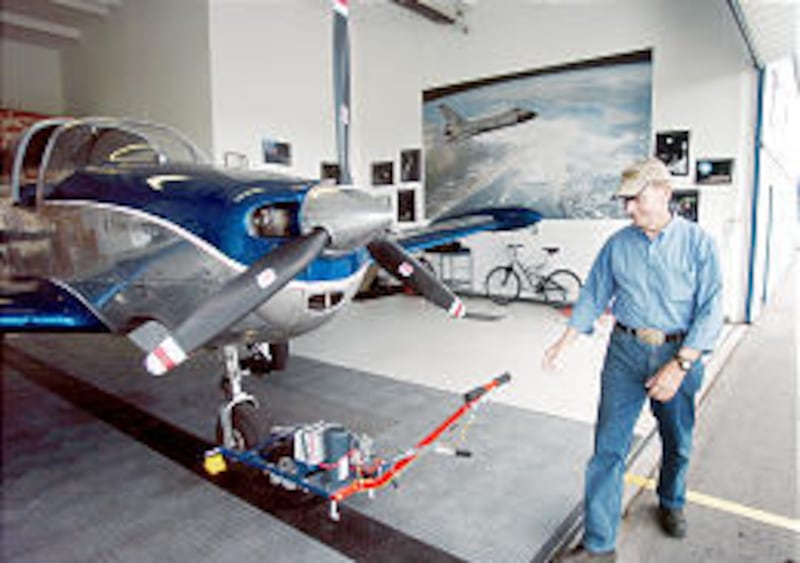

It's the middle of a weekday and Jake Garn is racing down the runway, about to do what he loves most in the world: Fly. He's never happier than when he's sitting in the cockpit of his own silvery 1948 Navion, a plane he has spent entire days polishing and admiring.
"Where do you want to go?" he asks as the plane lifts off the ground. That's the way most of his flights are. He has no clue where he's going. When the urge strikes or he has an open morning, he climbs into his BMW convertible sports car at his home in the foothills above Salt Lake City, and 15 minutes later he's at his hangar. "Where are you going?" friends ask him. "I don't know — I'm not up there yet," he tells them.
His longtime assistant, Alvina Wall, always tries to leave him a morning or two to fly when she makes up his weekly schedule. "As long as I'm in the air I'm happy," he says. "I'm really an irritable person if I haven't been flying. It's expensive, but it's cheaper than a psychiatrist and more effective."
He flies north over Bountiful, banks left and heads for the Great Salt Lake. For the next 90 minutes, he flies wherever the urge takes him, free as the seagulls below him. He explores islands. He playfully banks his wings back and forth over the lake, looking out the side of the plane at the water below.
Some mornings, the old Navy pilot will buzz mountain ridges and pretend he is strafing the enemy. "I'd do that today, but you wouldn't enjoy it," he says to a passenger. "Too bumpy." He likes to fly low over remote areas or fly up Weber Canyon to check his cabin. Sometimes he just explores the clouds, or shoots touch-and-goes, or flies to Richfield for a malt at the Ideal Diary or to Jackson Hole for lunch.
Mostly he just flies and thinks and takes in the scenery of his home state. He has a childlike love of flying and airplanes. There are times when his wife, Kathleen, will say, "OK, let's go down to the hangar; you can fondle your airplane and I'll watch TV." Usually he flies alone — the engine noise puts Kathleen asleep, so what's the point?
"How did little Jake Garn from Richfield, Utah, get to do all these great things?" he says, looking at the landscape below. He says this frequently. Here's the other thing he often says: "I still don't know what I'm going to do when I grow up."
Which begs the question: What's left to do for a 71-year-old former U.S. senator, Salt Lake mayor, Navy pilot, brigadier general, astronaut, water commissioner, businessman?
It has been 12 years since little Jake Garn From Richfield, Utah, gave up his seat in the U.S. Senate after 18 years on the job. He could have won a fourth term, but he gave it up, moved back to Utah, got to know his kids, took a job to earn enough money to support his flying addiction and became one of the state's most requested speakers.
He is a partner in Summit Ventures, a lobbying and consulting firm with offices in Salt Lake City and Washington, D.C. He sits on boards for Morgan Stanley in New York, United Space Alliance in Houston (which maintains and operates the space shuttle), and, locally, Franklin Covey, Nu-Skin, BMW Bank of North America, Intermountain Health Care and Escrow Bank.
But he says he spends most of his time doing volunteer work. He serves on more than a dozen volunteer boards, including Primary Children's Medical Foundation, National Kidney Foundation, Utah Diabetes, Nature Conservancy, Utah Family Council, University of Utah (board of trustees). In the past two weeks, he has been master of ceremonies for four charitable events. He speaks at one or two schools a week, usually about his space adventure, plus church firesides on Sunday, then various public events around the state.
"He is constantly amazed by the number of requests and the variety of requests after all these years," says Wall. "We dream about cutting back, but it doesn't happen. It's hard for him to say no, and he can't sit around."
A few years ago, after giving a speech on Labor Day in Parowan, a woman asked him, "Senator, why would you come here on your Labor Day weekend?"
With tears in his eyes, he told her, "This might sound corny, but I was born not far from here in Richfield. If anybody had told me when I was a little boy the career and opportunities I would have, I never would have believed it. All that was because of the people of Utah. The only way I can say thank you is to do this. And do you know how you can know I am sincere? Because I don't ever need your vote again."
Garn is passionate about Utah. He notes that most senators stay in Washington after they retire. He returned home immediately. During a meeting of retired senators, Garn and another ex-senator, Bill Bradley of New Jersey, realized that 56 out of the 65 senators present had remained in Washington after leaving the Senate.
"They couldn't cut the cord," says Garn. "I could have made a lot of money if I had stayed in Washington. I wanted to come home."
To keep up with the demand for personal appearances, Wall, who has been his assistant for more than two decades, produces yearly, monthly and daily schedules for Garn. Each day she hands him a 5-by-7 card on which she has written the day's events.
"I'm just as busy as ever," Garn says. "I wouldn't want to ruin the marriage by being home too much. Even if I were a billionaire, I wouldn't retire. I have to have something to accomplish each day."
He sounds like a corny politician again, but he says he is motivated by the chance to contribute. Another story he likes to tell: One day a woman stopped him on the street and told him she had a son who had dropped out of school. When the boy heard that the senator-astronaut was going to speak at his school, he got permission to attend. After listening to Garn, he re-enrolled in school. He is now a senior in aeronautical engineering at Purdue.
"I love to talk to the kids about unknown opportunities," says Garn. "If someone had told me I was going to orbit the earth 109 times, I would have said, 'Sure, what have you been smoking?'
"I was 25 when Sputnik flew. Who could have envisioned (the space shuttle)? My message to the kids is, I can't predict what you'll be able to do because I couldn't forecast my own life. But you'll need to be educated so you can stand up and say, 'I can do that.' "
Garn certainly can claim a varied, unforeseen life. Can anyone else claim to have orbited the Earth and stood on both the north and south poles and flown everything from a replica of the Wright Brothers' first plane to the space shuttle and everything in between — while serving as mayor and senator?
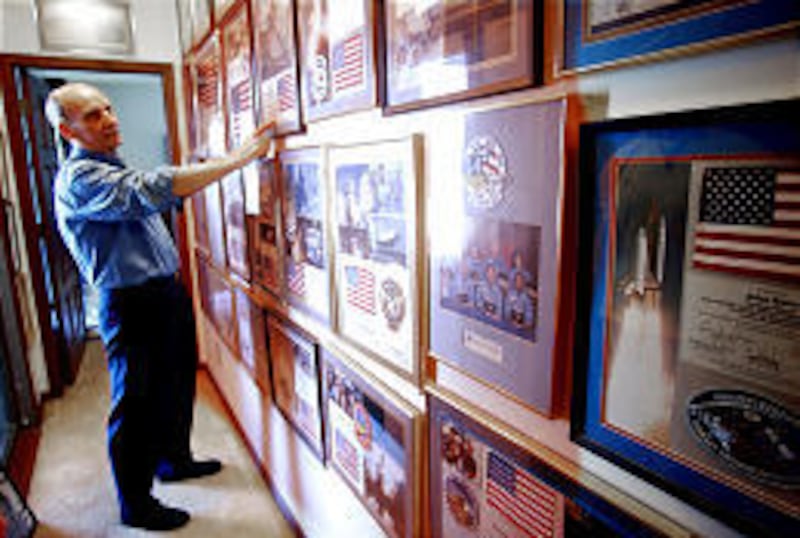
It's all chronicled on a hallway in the basement of the family home. Both sides of the hall are covered with photos — there must be 100 of them. One side is devoted to photos of associates and friends — Howard Baker, Strom Thurmond, Nixon, Carter, Reagan, Ford, Sadat, Bush I, Queen Elizabeth. The other side of the hall is devoted entirely to Garn's obsession with flying. There are pictures of various space shuttle crews with their mission patches, pictures of Garn's space flight, pictures of Garn with various airplanes, pictures of the Jake Garn Mission Simulator and Training Facility in Houston and the Jake Garn Research Building at Utah State.
Did we mention Garn is passionate about airplanes and flight? He carries pictures of his airplane in his wallet. He wears his NASA crew patch lapel pin on every suit. He has slapped the NASA crew patch on his airplane and wears it as a belt buckle. He claims two of the greatest things that ever happened to him were his induction into the Utah Aviation Hall of Fame — his father, Ed, was the first inductee; he was No. 12 — and earning his naval aviator wings. He claims his greatest achievement was not the three Senate terms but the 12,000 hours he flew for his country.
The only thing he planned to be was a pilot. It was in his genes, he'll tell you. His father, Ed, was the first native Utahn to receive a pilot's license. "His father was his hero," says Kathleen. As Garn sat in his living room last week, looking at old pictures and letters from his father, he wept quietly.
"His biggest regret on the space shuttle is that his dad wasn't there to see it," says Kathleen.
Garn supposedly took his first flight before he was even born — his mother was four months pregnant. His father was a World War I pilot, although he never saw overseas action. After working as a civil engineer for the state highway department, he was eventually appointed as Utah's first director of aeronautics, charged with taking Utah into the aviation age. He helped bring airports and airmail and air travel to Utah.
"He was a real pioneer," recalls Garn. "He built a lot of airports, and he'd make the first landing on them. He had an airplane before I was born in 1932. They didn't have a house, but they had an airplane. How many kids then had an airplane? I was pretty popular with the other kids. I was elected vice president of Roosevelt Junior High partly because my dad gave the kids rides."
Father and son shared a passion for flight. Ed cried as he watched the first moon walk with his son. He had been 10 years old, he told Jake, when the Wright brothers flew. Jake began piloting planes when he was 16, and he's been flying ever since.
He was a Navy pilot for four years, flying patrols in the South Pacific. He made 900 water landings. He landed on aircraft carriers. He did ship and submarine recon flights, during which he was harassed by Russian jets — "We had no armament, so we'd go 15 feet off the water, and they'd burn fuel so fast they'd have to go away," says Garn. His most exciting flight: Flying out of Japan to Wake Island, he lost both engines on the left side. "It took two of us to hold the rudder pedal so we could fly with power on one side," he says. "It was one long straight approach."
After finishing four years of active duty, he retired so he could return to Utah and then joined the Utah Air National Guard. He was flying weekend cargo missions in and out of Vietnam while serving as Salt Lake mayor and city commissioner. He continued to fly missions while serving as senator.
His wife claimed he had three loves in life — flying, politics and her. In 1980, she asked him to pick two of them. He retired from the Guard as a brigadier general after two years of service.
He never saw the political career coming. He was working in the insurance business, but his experiences abroad stirred a passion for his country. He became politically involved at the grass-roots level, serving as a delegate. "My intention was to be an involved citizen," he says.
But he became increasingly more involved. He was 34 when he ran for city commission in 1967. At the outset, he had a 3 percent name identification in the polls and a $3,500 budget. He knocked on doors in every neighborhood in the city and won the election. He never did lose an election. He became mayor in 1971 and senator in '74. He claims to have spent only $1.3 million total on the three Senate races. He won the election the old-fashioned way: He knocked on doors. Thousands of them. He flew 50,000 miles in his plane to reach more doors.
He served three terms in Washington and became one of Utah's most popular politicians ever. In Garn's own estimation, he was consumed by the job. To this day, a dozen years later, he is still asked why he retired, although he is still giving the same clear answer now as he did then.
He knew it was time to leave Washington after a brief conversation with his young daughter Jennifer. During a rare quiet moment at home, he was watching the news when a picture of the U.S. Capitol appeared on the screen.
"Daddy, that's where you live," Jennifer said.
"No, that's where I work," he corrected her.
"No, that's where you live," she said.
Looking back, he believes the only real break he took during his Senate years was the time he spent recuperating after donating a kidney to his daughter, Sue.
He missed the birth of his son Matthew while he was out making speeches. He missed Matthew's first eight birthdays while making Lincoln Day speeches. He would leave home for the Capitol at 6 a.m. and return at 9:30 at night. On most weekends and national holidays, he flew to Utah to be with his constituents.
"Before I went to the Senate, I was a Little League coach, and I did all those things that fathers normally do," he says. "In the Senate, I could rarely even get to those things. Kathleen was raising the kids, and I was off playing senator."
Kathleen mowed the lawn, took care of the household and drove the kids to their dance lessons and ball games. This was no small feat.
Not even a family tragedy checked Garn's devotion to his work. In 1976, he was working in his Salt Lake office when he received a phone call from the Highway Patrol in Nebraska. His first wife, Hazel, and three of his four children had been killed in an automobile accident, he was told. They had been returning to Washington after spending the summer in Utah. Garn told his oldest son, Jake Jr., "You and I are all that's left." Two hours later he learned he had been given erroneous information. His children were all alive, but Hazel was gone at the age of 40. Their four children ranged in age from 10 to 17.
In his grief, he turned to his mother, Fern. He told her he planned to resign from the Senate. She told him to wait six months and see how he felt about it then.
"I'll promise you something else," she said. "If you are a good boy, God will bless you."
"What does that mean?" he asked.
"You know what that means. If you live like we've taught you, he'll bless you with another companion."
"Mother, that makes me angry. I don't want to be married again. I am not going to marry again."
"You be a good boy."
Garn wound up staying in Washington, and 10 months after Hazel passed, he married again. Kathleen Bingham, who is 17 years younger than Garn, was divorced and raising a son alone. Her ex-husband, Jeff Bingham, had served as Mayor Garn's assistant years earlier, and Kathleen had tended the Garn children. After Hazel died, Garn sought her advice for raising daughters when he was in Salt Lake City. Their children played together when the Garns were in town. She did his Christmas shopping for him. Eventually, he asked her to go to dinner one night.
"Are you asking me on a date?" she asked.
"I guess I am."
Looking back now, Kathleen says, "We had such a good friendship, I was worried it would be ruined if we dated."
The union has flourished. They have been married 27 years. Garn still acts like a kid with a schoolboy crush on Kathleen, and both encourage and foster a loving memory of Hazel in the family and in their relationship. It is an open subject between them.
"Hazel and Jake had a great marriage," Kathleen says. "Jake still has a hard time at Christmas. I know he loves Hazel, but he'd be lonely without me. I've been blessed to have him come in my life. . . . It's good to be in love after 27 years. We enjoy each other."
They still remember Hazel on her birthday, and Kathleen visits her grave with the grandchildren. "They just have more grandmas than other kids," she says. They still visit Hazel's mother.
"Now I look back I realize how young Hazel was," Garn says. "A lot of men haven't had one good wife, I've had two. They're a lot alike in terms of kindness and calmness."
They brought five kids to their marriage, then had two children of their own. "The way they blended two families and started a new family, it was amazing," says Wall.
In 1986, they decided they wanted their children raised in Utah, so Kathleen and the kids moved to Salt Lake City. Garn actually saw more of his family after that, because he was in Utah two to three weekends a month, plus during congressional recesses.
"I had every Sunday with them," he says.
But by 1992 that wasn't enough. He retired from the Senate. People still ask him if he misses it. "No, in a general sense," he says. "I miss friends, and when certain issues come up, I'll think I wish I was there to debate that one. But, overall, no. The compensation was being home with my family and being home in Utah."
Six of his seven children are married now, and he has 16 grandchildren. Jake Jr. is a CPA in Kaysville; Susan lives in Washington, D.C.; Ellen lives in Park City; Jeff is an airline pilot for SkyWest and lives in Salt Lake City; Brooke manages Staff Care, a medical placement company in Salt Lake City; Matthew is living at home and finishing school; and Jennifer is graduating from nursing school at Westminster. All four sons served missions for The Church of Jesus Christ of Latter-day Saints. They have frequent extended-family vacations and gatherings.
When scheduling his travel, Wall tries to get him home the same day. "He doesn't like to be gone overnight," she says.
Retirement, such as it was, was no easy adjustment at first. He paced the floor in the evening. "What's wrong?" Kathleen asked. "Can't you sit?"
"It's only 7:30 at night," he'd say. "What am I doing home?"
Says Garn now, "It didn't take long. A month later I was thinking, 'Boy, this is great.' "
But he is always restless. His parents frequently counseled him in his youth to relax more, to ease up on the deep streak of perfectionism, but it didn't take. Even when the family goes to their cabin, he has to be doing something — staining the deck or cutting grass or trimming trees.
He still has the energy and drive to do intense aerobic workouts five days a week. He skis in the winter and goes in-line skating in the summer. He still weighs the same as when he was a hurdler for the East High track team (185).
"He hasn't really retired," says Kathleen. "He just switched jobs."
The one time he does relax is when he is flying. He is still the boy from Richfield around airplanes; he is still Ed's kid. "He's always happy when he comes back from flying," says Kathleen.
"Flying solves everything," says Garn. "People say to me, 'What are you so happy about?' Just to be in the air. . . . It's the most fun I have. It's almost a spiritual experience."
He spent 400 hours stripping his plane and refinishing it with a mirror-like finish. It took nine years and $90,000 to complete the job on a plane he originally bought for $10,000. Of the plane, he jokes, "I've been married to my wife for 27 years; I've been with this plane 36 years." He keeps his plane in a hangar that is kept so clean you could perform surgery in it. It includes a small family room with a TV and kitchen. The walls of the hangar are covered with photos of airplanes and spacecraft. When Kathleen threw a surprise 70th birthday party in the hangar, the first thing Garn said was, "Where is my airplane?"
As he turns the plane for home high above the Salt Lake Valley, he looks down at the scenery and says, "No matter how many times I do this, I never get tired of it. How did a little kid from Richfield get to do all these things? I worry that someday I won't pass the physical and I won't be able to do this, but I don't even need glasses yet."
As he approaches the small Skypark Airport in Woods Cross, he puts the plane in a steep banked turn — "I don't do those long Air Force approaches," he says — and drops it on the runway, as soft as a feather dropping from the sky.
He still is every bit his father's son. Earlier in the day, he read a letter aloud that he received from his father on his 12th birthday: "Hitch your wagon to a star. Set your goals high and never give up until you reach them, son. I am expecting big things from you."
But even Ed Garn couldn't know the big things that little Jake Garn from Richfield, Utah, would do.
E-mail: drob@desnews.com