

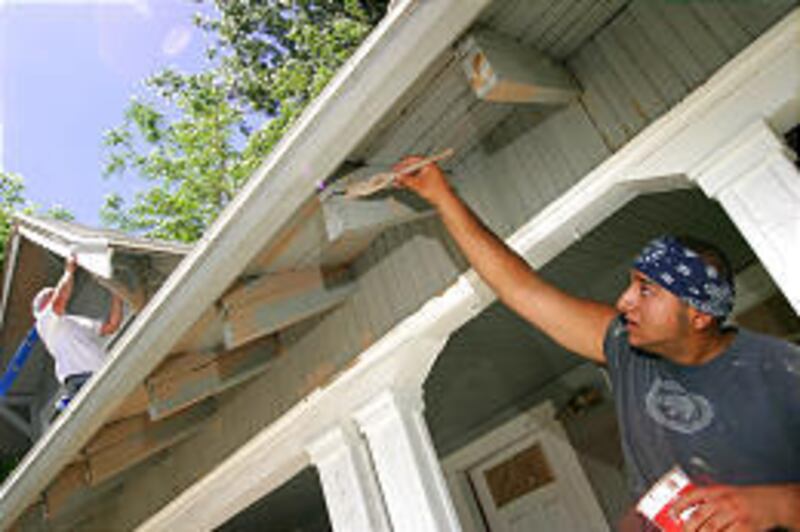

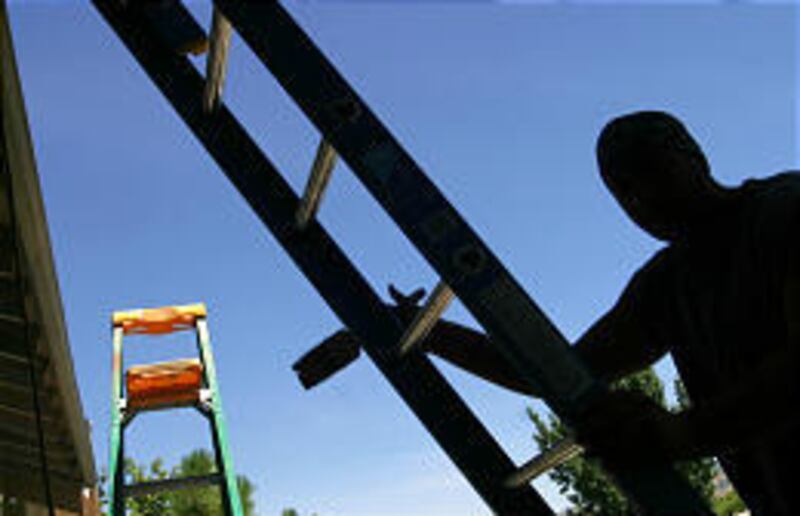

Temperatures in the high 80s. Blazing sun overhead. Some young-man music in the background, sprinkled with the sounds of wood being scraped and ladders being adjusted.
Yes, it's the perfect setting for college students to get an education.
The outside of Anny Lefebvre's home in the Sugar House area of Salt Lake City may not be the traditional site for learning, but it's representative of hundreds of houses across the country each year that get a fresh coat of paint from college students learning the ins and outs of the business world. Several regional painting companies have found collegians a perfect work force, while the collegians — especially the interns overseeing two-person crews — have discovered the work results in a colorful, hefty mix of money and experience.
"I learned more in the internship than I did in four years of school," said Salt Laker Shaun McMurry, vice president over Utah and Nevada for College Works Painting. He started with College Works in 2000 while majoring in business at Brigham Young University. This summer, he's overseeing about 20 students in Utah and about 10 in Nevada.
"You're in charge of the marketing and in charge of all the sales, if you want. You hire and manage a team of marketers. You manage however many crews you have, usually one to three crews. You work with the customers. You're in charge of quality, in charge of customer satisfaction, making sure the job gets done right. You manage all the finances, the profit margin. And you're in control of the amount of money that you make."
College Works Painting is one of several large-scale operations that have college students brushing up on their painting skills in summertime. Several other prominent ones, Tuition Painters and College Pro, are franchise corporations. College Pro is the largest, with more than 300 franchises across the United States and Canada, although none in northern Utah. There are a handful of regional players, such as Tuition Painters on the East Coast, College Craft in the Midwest and Student Painters in the Ohio Valley region.
For vice presidents like McMurry, the process for summertime begins the preceding autumn when they make the rounds to recruit interns, who will learn all about the business before the first brush dips into the paint.
In the case of College Works Painting, interns have a mentor to teach and coach them. The company's corporate office finances the business, acting as customer service reps, receptionists and accountants. A line of credit is established at a local paint store so interns can get the supplies they need for the summer, and they pay off the credit with business revenues.
"When we recruit interns, which is basically from October to March, we tell them this will be the hardest thing they've ever done," McMurry said. "You're really running your own business. It was the hardest thing I've ever done, to this day."
As an intern, Carlos Magdaleno was supervising the two-man crew during the three-day project at Lefebvre's two-story house last week. The University of Utah junior is studying business administration.
"I'm getting experience, definitely. It's one thing to be in the classroom and another to get out there and get some real-world experience," Magdaleno said.
"It's awesome, outstanding. But it's tough work, I'll tell you," he said, noting that 70-hour work weeks for interns are not out of the question.
"I've learned a ton, especially about business. I'm thinking about going out and starting my own business after the internship, and this has given me the experience I need to do that."
Magdaleno and other interns hone their management skills, along with training, marketing, learning to produce a work schedule, handling customer and employee relationships and dealing with money.
For the painters, work life is less complex but "pretty fun," according to Berj Bekearian, a Utah Valley State College student who worked on Lefebvre's house. "You've got to get over your fear of heights, but after that . . . "
Bekearian said he's gaining plenty of experience and a few bucks this summer. "I don't know that I would go into something like this, but it's getting me through for the summer, getting me some spending money," he said of earning roughly $1,200 a month.
McMurry said some students earn about $9,000 during the summer. The top earner in Utah last year pulled down about $27,000.
Brian Honeyman, president of College Pro's U.S. East division, said the average College Pro franchise did $80,000 in sales last summer, with five franchises topping $200,000.
"The learning curve is phenomenal," said Honeyman, who was a College Pro painter and franchisee while studying at the University of Calgary in Alberta during the mid-1980s. "The students who come back and continue, compared with their peer group, they've really developed a tremendous set of skills. They're ready to run a big business."
Paul Flick, a former Student Works Painting franchisee and the founder and chief executive officer of Tuition Painters, said a variety of college students come into the program, but most are business majors or business-minded students.
When not getting references from the www.collegeworks.com Web site or the company's 1-888-450-WORK phone number, people like Magdaleno sometimes hire people to go door to door. That's how Lefebvre got the pitch.
"We needed our house painted. They just came at the right time, I guess," she said. "I think I'd seen their sign before and knew they did that kind of work. I wanted to be sure I got the best for my money, too. I considered doing it myself, but it looks like a lot of work.
"They're doing a good job," she said as much of the prep work continued. "And they're entertaining."
So, what is the magnetism between college students and house painting that is so strong that it has made college painters almost an institution?
"Painting is something there's a good market for. There are people out there looking to have their house painted. It's our job to find out just who they are," McMurry said.
"And painting is something that, yes, takes training and, yes, you need to be taught about how to do it right. But it's not rocket science. It's not real hard to do."
Helping is the fact that crews in Utah only do exteriors and don't get involved with four-story mansions or restorations. "We keep it simple," he said. "There's a good market for it, and it's something you don't need four years of college to learn how to do."
But that's not to say learning doesn't occur. Magdaleno began attending meetings in February, with each focusing on safety. On-site training with painters includes twice-weekly safety meetings, and painters all get a safety manual.
That's part of a professional atmosphere he wants the crews to project on their jobs, which can range from $3,000 to $15,000 — making College Works Painting neither the cheapest nor most-expensive option for customers. The professionalism plays out also in the warranties for the students' work.
"A lot of people think it's just some punk college kid out there trying to start up his own business," Magdaleno said. "But we are backed by a national company, we're really well-trained and we know what we're doing."
Contributing: The Associated Press
E-mail: bwallace@desnews.com