


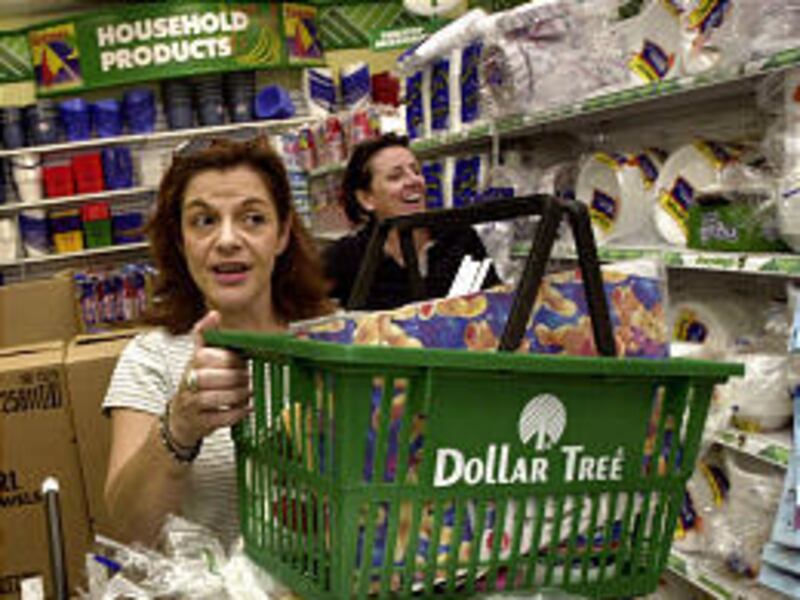
CHESAPEAKE, Va. — With its bright lighting, aisles wide enough to accommodate a shopping cart and relatively uncluttered appearance, the 17,000-square-foot Dollar Tree store in a small shopping center on Military Highway here, in space that once housed a toy retailer, could almost be mistaken for a chain drugstore like CVS.
The resemblance to a well-known mainstream retailer is intentional, even though everything in the Dollar Tree store — the oversized calculator in the back-to-school display, the dishes with a tropical motif, the Barbie-like doll, the Spider-Man puzzle and even the electric toothbrush — is priced at a dollar.
A major player in one of the nation's fastest growing retail sectors, Dollar Tree Stores has become a familiar tenant in suburban strip malls across the country. The company added 3.6 million square feet last year, increasing its selling space by 27.5 percent.
Some of this growth has come from the acquisition of smaller chains, like Greenbacks, a company based in Salt Lake City that was acquired last year. But for the most part, the chain is taking space left vacant by other retailers — drugstores that moved to freestanding stores allowing drive-by windows, say, or supermarkets or toy stores that succumbed to competition from Wal-Mart Stores and Target.
These days, Dollar Tree, whose spartan red-brick headquarters are in an industrial section of this city in southeastern Virginia, is adding a store or expanding an existing store at the rate of one a day, bringing its current total to more than 2,600 outlets in 48 states. The newer stores are larger — 10,000 square feet or more, compared with an older footprint of 3,000 to 4,000 square feet — and are designed to attract people with incomes greater than the company's core customers, who make $30,000 to $50,000, said Adam Bergman, the company's director of investor relations.
Over the past decade, it has become fashionable even for people who do not need to watch their pennies to shop at discount stores like Target and Costco. Today, some of these better-heeled customers are also picking up greeting cards, wrapping paper and children's party favors at dollar stores, the contemporary version of the variety store.
A report issued in June by Retail Forward, a consulting company in Columbus, Ohio, found that one-quarter of Americans with household income exceeding $100,000 had shopped in a dollar store in the previous six months, although only 7 percent were doing so on a monthly basis. The average sale at a Dollar Tree is $7, but customers at the larger stores spend more because more of the merchandise can be displayed at eye level rather than piled up in bins, Bergman said.
As dollar stores have improved their displays and store layouts, strip mall owners who might once have looked down on this type of retailing are now welcoming such stores as tenants. "The good chains put in very nice stores, and we'd be happy to have them in almost any of our centers," said Drew Alexander, the president of Weingarten Realty Investors, a publicly traded company based in Houston that owns 278 shopping centers.
Dollar Tree is the largest national chain to sell merchandise at a single price. Its chief competitors, Dollar General and Family Dollar, are both much larger and are expanding even more rapidly. They offer many items that carry a price of $1 but also sell clothing and other goods at higher but still bargain prices — $10 for pedal pushers at Family Dollar or $15 for a George Foreman grill at Dollar General.
Dollar General has nearly doubled in size since 1999 and now has more than 6,800 stores, two-thirds of them in rural areas. Family Dollar added 2,000 stores in the same period, for a total of more than 5,000. Most of its new stores are in cities.
Despite this growth, retail specialists say that the market is far from saturated. As many as 8,000 new dollar stores are expected to open in the next five years, according to Retail Forward.
One sign of the sector's growing significance is the decision by major manufacturers like Procter & Gamble and Unilever to package products especially for the dollar-store market. And the success of dollar stores has inspired discount retailers like Wal-Mart and Target, as well as the Kroger and Supervalu supermarket chains, to try out dollar sections within their stores.
Bergman said that these new dollar departments do not pose a threat because they are not large enough to carry a wide selection. Reed Anderson, a retail analyst at Friedman Billings Ramsey, said that the giant retailers "don't want to sell a lot of items at a buck."
Dollar Tree, originally known as One Dollar, did not come up with the idea of pricing every item in its stores at a dollar. The concept originated in 1982 with 99 Cents Only, now a chain of 200 stores based in Commerce, Calif. Dollar Tree was founded four years later, but it traces its roots to a Ben Franklin variety store, near the naval station in Norfolk, that belonged to the father of J. Douglas Perry, one of Dollar Tree's founders. The variety store evolved into a chain of toy stores, known as K&K Toys.
Trading on the contacts they developed through their toy-store leases, Perry and his partners — Macon F. Brock Jr., now the company's chairman, and H. Ray Compton — persuaded some landlords to try out their dollar-store concept in enclosed malls. In 1991, however, K&K Toys was sold to the parent company of KayBee Toys, and the founders began focusing on strip malls.
The same year, Dollar Tree began shifting its emphasis from manufacturers' closeout items — which now represent only about 10 percent of the merchandise, according to Bergman — to branded products from domestic manufacturers and items designed by Dollar Tree employees and manufactured abroad, especially in China. Dollar Tree's considerable buying power helps keep prices low, Bergman said.
The company also saves money by employing nonunion labor and paring overhead costs and other expenses. Credit cards, for example, have been introduced only recently — and not at all locations. Another key is not overpaying for real estate, Bergman said, with the rent at a given location equaling no more than 7 percent of sales.
DoronValero, the president of Equity One of North Miami Beach, Fla., which owns 190 strip malls in the South, says Dollar Tree and its competitors drive a hard bargain. "They're very good at what they do, including negotiating leases," he said.
In locating new stores, Dollar Tree tries to find space near a Wal-Mart or Target or a popular supermarket. "Our desire is to be in the cross hairs of the retail trade zone of the community," Bergman said.