


OREM — Most teenage boys probably would have tried to swat the wasp that landed on Jeff Wood's arm.
Another Boy Scout even warned Wood about the "bee" crawling toward his shoulder.
"I didn't know what it was," Wood said. "I was confused for a minute, so I was a little bit scared it might sting me."
But Wood's notoriously laid-back nature made him the perfect 13-year-old to make an unusual find while Scouts from the Provo Sunset LDS Stake dug weeds at Jordanelle State Park's Rock Cliff recreation area during a recent encampment.
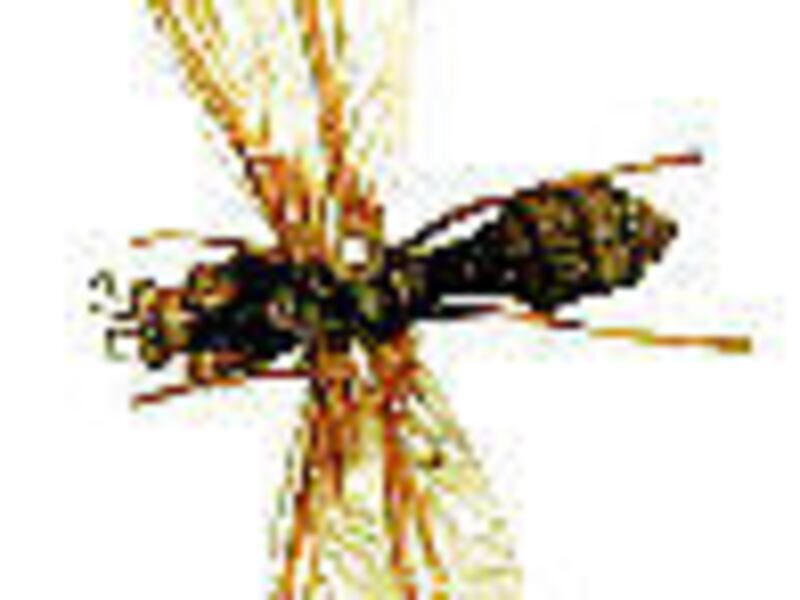
Wood's confusion stemmed from his observation that the bug had the front arms and head of a praying mantis and the body of a wasp.
The boys' LDS bishop, Brigham Young University biologist John Bell, who doesn't specialize in entomology, couldn't identify the half-mantis, half-wasp.
There was more head scratching at the Rock Cliff Nature Center.
The mystery finally was solved at BYU's Monte L. Bean Life Science Museum, where a student entomologist identified it as Climaciella brunnea, a somewhat rare type of mantis-fly that pretends to be a wasp to better catch and eat aphids, stink bugs and lady beetles.
The legend grew quickly.
"They said it's about one in a billion that he would see it and one in a trillion it would land on his arm," said Wood's next-door neighbor, Josh Hasting, a 14-year-old Boy Scout who helped Wood catch the odd insect in a bottle.
The bugs aren't quite that rare, BYU entomology professor Richard Baumann said, but their yellow-and-black stripes — the colors mimic the Polistes wasp drive most people away before they realize they don't sting.
"Unless they land on someone and you're forced to take a good look, you don't recognize them," Baumann said. "If you went to your wife and said, 'How closely did you look at this wasp?' she'd say, 'I stayed as far away from it as I could.' "
Wood didn't flinch.
"It was like a mix between a wasp and a mantis," Hasting said. "It had the body of a bee and the arms of a mantis. It looked kinda cool. Most people would have just killed it. He just said, 'Hey look at this.' He just put his hand over it to keep it from flying away."
Collectors bring between two and six of the strange-looking mantis-flies to the Bean Museum each year, Baumann said, and they often are found by night watchmen at the LDS temple in Provo.
"I had one sitting on my car at the Bean Museum when I left work one night," Baumann said, "but it isn't a common thing, and someone else probably wouldn't have recognized it."
Baumann said C. brunnea is the only mantis-fly whose front legs are raptorial — for grasping prey. Its torso mimics a wasp to fake out other insects.
"It exhibits aggressive mimicry, actually double mimicry," Baumann said. "Predators think it's a wasp and stay away from it, and looking like a wasp helps it sneak up on its prey."
Like the praying mantis, C. brunnea is sometimes cannibalistic.
"It's a carnivore, and in the insect world it's a top carnivore," Baumann said. "Probably only a praying mantis would eat it, so it's high in the food chain."
Wood's specimen didn't live long — one Scout put too many ants in with it and another shook the jar too much on the ride home from camp — and after it died, it fell apart.
The experience inspired Wood. He wants to earn the Insect Study merit badge and maybe even become a 10th-grade biology teacher. If he does, he'll learn enough about mimicry and natural selection to correct one friend's mistaken hypothesis on the origins of C. brunnea.
"He said a praying mantis egg flew into a wasp's nest and got fertilized," Wood said.
But even if he doesn't pursue a creepy career, Wood never will forget his close encounter with a creature that appeared to be suffering from an identity crisis.
"It was pretty cool," he said. "I thought I found a new species or something."
E-mail: twalch@desnews.com