


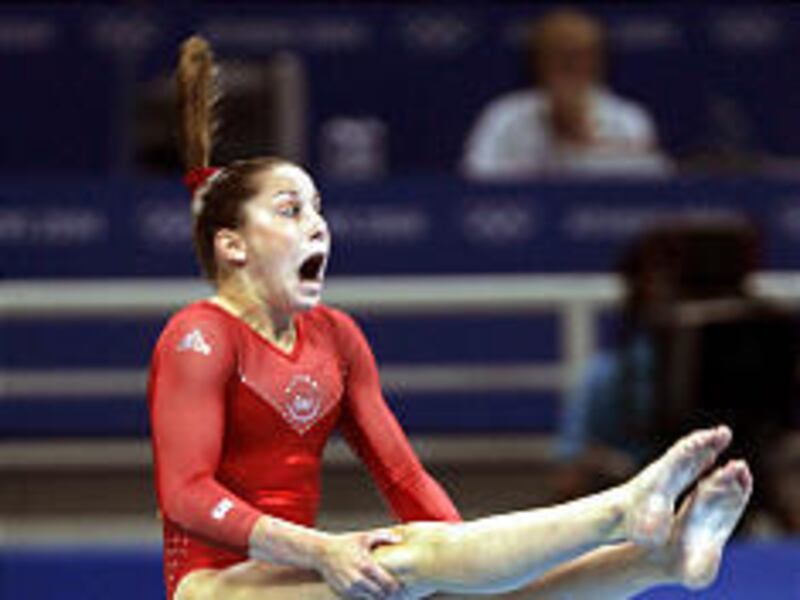

ATHENS, Greece — The 20-year wait is over. America has its new Mary Lou, and her name is Carly Patterson.
The 16-year-old dynamo beat Russian superstar Svetlana Khorkina to give the United States another Olympic all-around champion Thursday night, closing with a dazzling routine on the floor to win gymnastics' premier event.
"It just means a whole lot," Patterson said. "I worked my whole life to be an Olympic champion."
She wasn't the only one who'd been waiting for this night.
Patterson is the first U.S. woman to win the all-around title since Mary Lou Retton did it in 1984, and no one was happier about it than America's first golden girl.
"I have been waiting 20 years. Do you hear me? I have been waiting for 20 years," Retton said in a telephone interview from the States. "The crown has been sitting and waiting for the next all-around champion. Carly Patterson, it's yours."
Patterson's victory came the night after Paul Hamm won gold in the men's all-around on the same floor. The two make the United States only the second country to have both all-around champions in the same Olympics, joining the former Soviet Union and its successor, the Unified Team.
On a riveting evening that came down to the very last tumbling pass, Patterson scored a 9.712 on floor to finish with 38.387 points and defeat Khorkina by .176. Zhang Nan of China won bronze.
When he saw the result, Retton's old coach, Bela Karolyi, jumped for joy and hugged his friends, happy to finally see a champion replace the one he coached at the Los Angeles Games.
"Strong. Sturdy. Just like we expected. It's great. She was beautiful," Karolyi said, before taking the phone to talk to Retton. "It took 20 years. But finally."
Like Khorkina, Patterson closed the night on the floor. On all four tumbling passes, she jumped higher than any of the other 23 women in the meet. Just as importantly, she pulled off perfect landings that almost always make the difference between first and second place.
When Patterson's winning score was posted, coach Evgeny Marchenko lifted her on his left shoulder and paraded her in front of the fans — a champion's chariot for a championship effort.
"I don't even know what to say right now," Patterson said. "You dream about this your whole life. Then you win the gold medal. It's just amazing."
During the medals ceremony, Patterson sang along to "The Star-Spangled Banner," played at the arena for the second straight night, and she looked to be blinking back tears.
Khorkina, meanwhile, stared at the scoreboard and smiled at the fans, most of whom had come to see her.
Khorkina's mistakes left the door open, and Patterson took advantage.
Waiting for the start signal, Marchenko gave her a thumbs-up and she nodded back. The highlights of her routine had little to do with dance, and lots to do with jumping.
On her third tumbling pass, she did two somersaults, and when they were complete, she was still hanging high enough that she could look down and pick the exact spot she wanted to land. She landed perfectly — on all four passes, and that was the difference between first and second.
"I just knew I had to stick a good floor routine," Patterson said. "After my last pass, I knew it."
Khorkina's best event is uneven bars, and two rotations earlier, she scored a 9.725. Patterson answered with a 9.575, a much better effort than in team finals, when she got caught up during one of her spins and lost precious tenths of points that made the difference in America's silver-medal showing against Romania.
Two nights later, though, Patterson got her gold, and Americans found a new gymnastics star.