

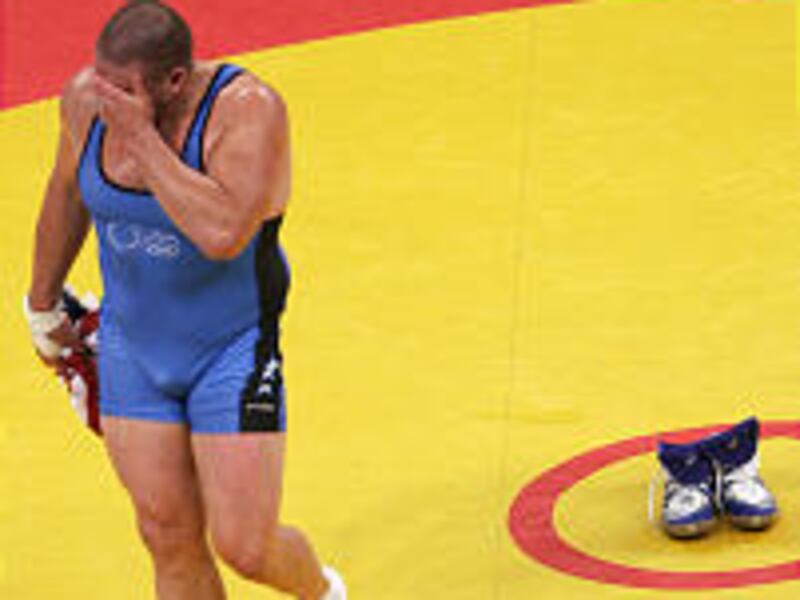

ATHENS, Greece — He cried, he hugged people, he wrapped himself in the flag, he bid an emotional farewell.
It was the finals of the Olympic Greco-Roman wrestling tournament, and Rulon Gardner went ahead as planned with his retirement party, despite the fact the decorations were bronze, not gold.
The man who four years ago beat the unbeatable man got beaten — by a 23-year-old from Tsalenjikha, Kazakhstan, named Georgiy Tsurtsumia, who relegated Gardner to the bronze-medal match with a 4-1 overtime victory in the semifinals.
Then Tsurtsumia was beaten in the gold-medal match by a 21-year-old fellow speaker of the Russian language, Khasan Baroev of Russia.
Seeing all this, the 33-year-old Gardner, from Afton, Wyo., did what the Russian from Siberia, Alexander Karelin, did four years ago in Sydney after Gardner beat him for the gold medal. He retired. Hung 'em up.
Only in this case, laid 'em out.
Leaving absolutely no room for a Michael Jordan-type retirement reversal, he sat in the center of the Olympic mat and in full view of everyone in the arena took off his wrestling shoes.
Just seconds before, he had avenged the morning loss to Tsurtsumia with a 3-0 overtime victory over a 6-foot-7 Iranian from Tehran named Sajad Barzi, who is all of 23.
The shoe retirement was a teary scene for everyone. Barzi was in tears because he lost, while Rulon was in tears because he won and because he doesn't have to make weight and wrestle guys like Baroev, Tsurtsumia and Barzi anymore.
Then Rulon's coach, Steve Fraser, starting crying. And in the stands, where Rulon's friends and family unfurled a bedsheet signed by well-wishers back home in Afton, they were crying too.
Amid all the tears, Rulon Gardner left wrestling with considerably more visibility, not to mention sentiment, than when he entered. He was 4 or 5 years old when he started — with eight older brothers and sisters, it wasn't an option — and it was years before he ever got on top of anyone.
He toiled in typical wrestler's anonymity for decades until he did two things that would dramatically change his profile. One was switching from freestyle wrestling to Greco-Roman, a little-used discipline in the United States that doesn't allow the use of the legs for holds and favors people with brute upper body strength, like Rulon, as well as just about everyone, it seems, from Eastern Europe.
The other was facing Alexander Karelin in the Sydney Olympics, when the Russian was 36 years old, and handing him his first loss in 13 years.
He became America's most famous wrestler since Hulk Hogan.
The shoes in the middle of the ring, Rulon said, "are a way of saying that as a wrestler I left everything on the mat. Even though I'm leaving with a bronze medal, I have no regrets. I gave it 100 percent. I made a commitment to do this for eight years, and that's what I did. I don't look it as tarnishing the victory (of four years ago), I look at it as completing a goal and leaving with no regrets.
"I put the shoes on as a 4- or 5-year-old kid, and I took them off as a 33-year-old kid."
Rulon did allow that the frostbite he suffered on his feet — causing him to lose one toe and creating a numbness in all his toes — during an infamous snowmobile trip in the Wyoming mountains 2 1/2 years ago has made a difference in his wrestling. He didn't use it as an alibi for allowing the slippery overtime move by Tsurtsumia — a wrestler he had beaten in their two previous meetings in 2003 — that cost him the semifinal match, but he did say, "I really don't sense all the tiny details my toes are telling me. When he got me, I thought he was going to throw me, but he suckered me into a kind of inside step and pop."
Gardner said "the young guys" use technique and style whereas old-school Greco-Roman practitioners such as Karelin used mountainous strength. "When you grabbed Karelin," he said, "you really felt insignificant. Grabbing these (new) guys, you feel like they're going to do something you don't know about."
Gardner paid tribute to "the character, the discipline and the dignity" anyone can learn from wrestling, especially by pursuing it to its highest summit, the Olympic Games.
"Anyone who truly understands the Olympic story understands that my story, or any athlete's story, is what it is all about," he said. "You train your whole life to get here."
And when you leave, you shed a lot of tears.
Lee Benson is in Athens to report on the 2004 Summer Games for Deseret Morning News readers. This is his ninth assignment to cover the Olympics. Please send e-mail to benson@desnews.com.