

PARIS — With French and American flags, vintage military vehicles and heartfelt memories, Paris on Wednesday marked the 60th anniversary of its liberation from the occupying Nazis — the day the French capital recovered its honor after four years of hardship and shame.
President Jacques Chirac, in an address at Paris City Hall, urged "vigilance" by younger generations in dealing with present-day manifestations of "this hate of the other, still at work, the most somber face of the human soul."
The president was referring to racist-inspired acts plaguing today's France, including anti-Semitic attacks.
Parisians braved intermittent rain during daylong celebrations meant to capture the drama and euphoria of Aug. 25, 1944, when the Allies marched on a capital already in revolt and the World War II occupiers surrendered — ignoring Hitler's order to demolish Paris.
Even writer Ernest Hemingway joined in, famously "liberating" the bar at the Ritz Hotel.
The day was charged with symbolism as France remembered its liberators, from American soldiers who backed a French division, clinching victory, to communist Resistance members in the vanguard of the underground fight.
The liberation of Paris was "an essential step in the capitulation of the Nazi regime," Chirac said, speaking before thousands on the esplanade of the ornate City Hall.
It was there that Gen. Charles de Gaulle, head of a government-in-exile, declared Paris liberated.
The liberation was "also France standing, France restored in its honor, in its values and in its rights," Chirac said.
De Gaulle's victory march the following day down the Champs-Elysees has come to symbolize the rebirth of France, shamed for its World War II collaboration.
"It was a day of glory," said Claude Correia, a former Resistance member. "We knew that if Paris were liberated, it would be the start of the deliverance" for all of France.
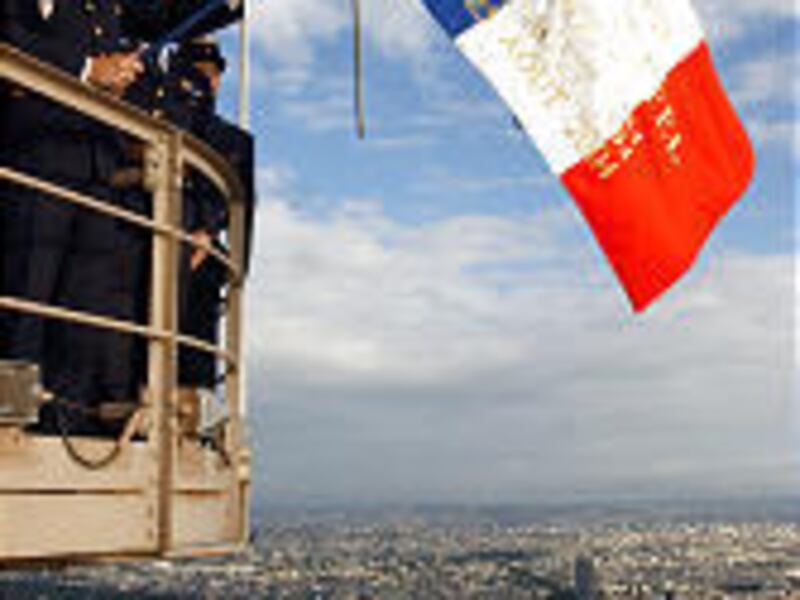
At the Eiffel Tower, six firefighters hoisted the French tricolor in a re-enactment of the secret scramble up the Tower's 1,710 steps 60 years ago to raise a homemade flag.
Capt. Lucien Sarniguet was ordered to remove the flag when the Nazis marched into Paris on June 14, 1940.
He "swore that he'd be the one to put it back up. He kept his word," with a flag fashioned from sheets and hidden until the liberation, said his daughter, Jeanne-Marie Badoche, 77. "For Papa, it was the most emotional act of his life."
Vintage vehicles carried actors portraying GIs and French soldiers through Paris streets.
Contributing: Jocelyn Gecker.